Artwork
St. James
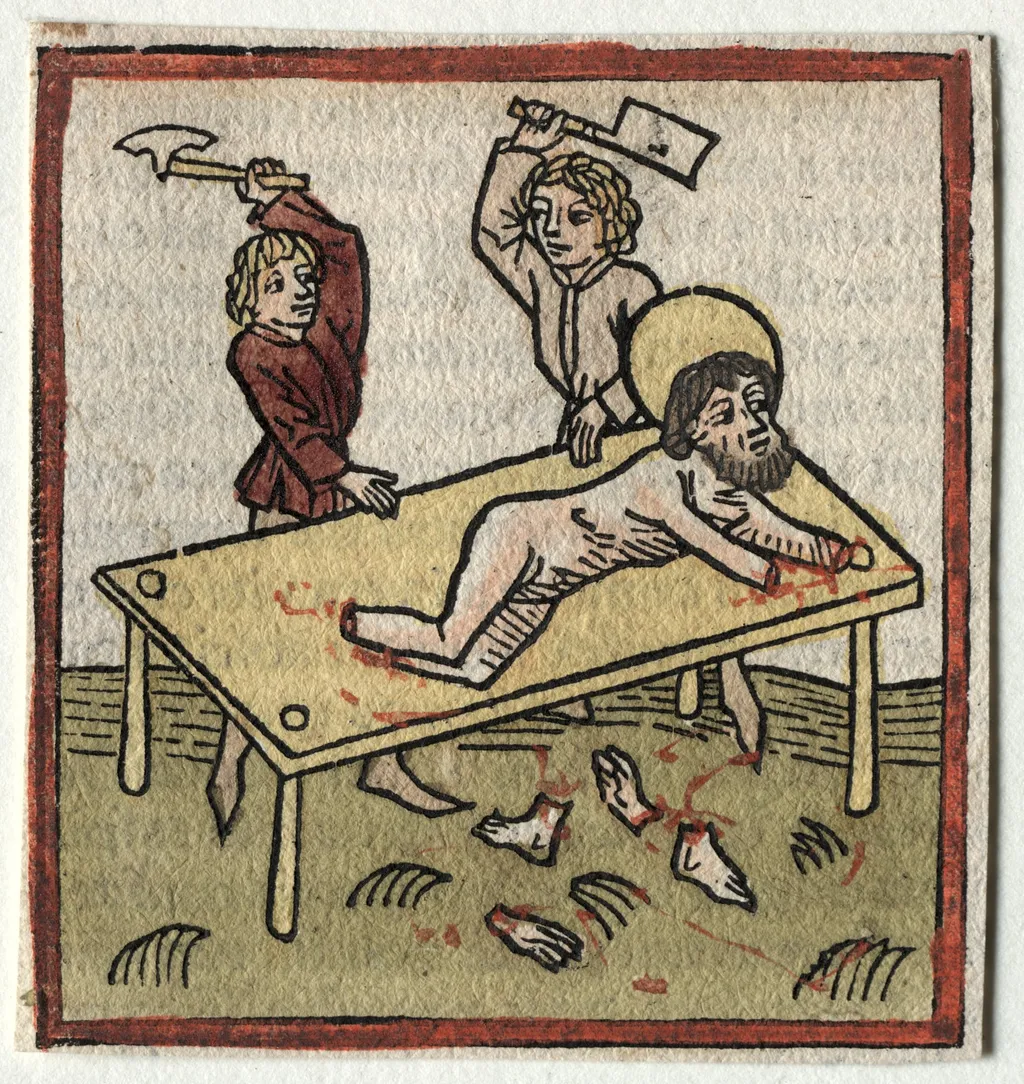
St. James is a print by Günther Zainer. It dates from 1528 and is held in the collection of the Cleveland Museum of Art.
About this work
Overview
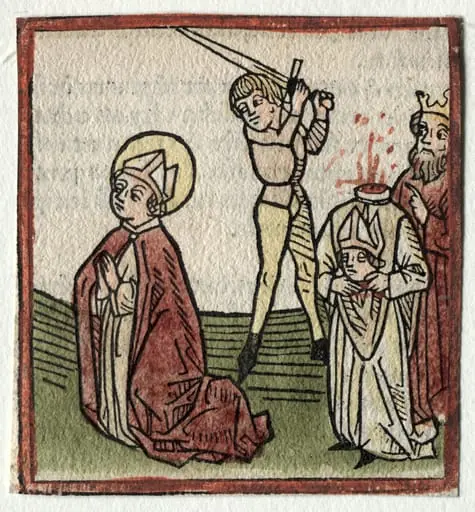
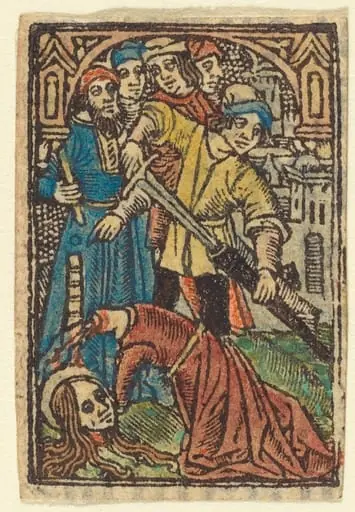
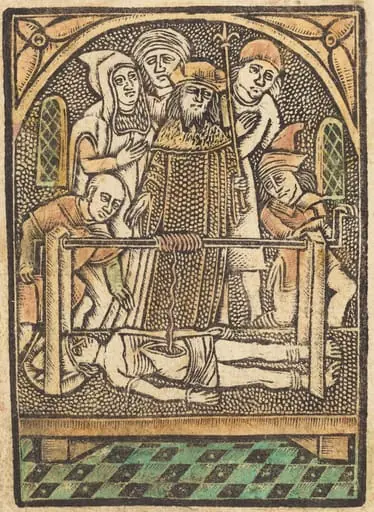
Created around 1528 by Günther Zainer, this small printed image depicts the martyrdom of St. James the Greater. Executed in a rudimentary woodcut style, it uses bold lines and minimal shading to convey a stark, symbolic narrative. The work is part of the collection at The Cleveland Museum of Art, where it is preserved as an example of early 16th-century German devotional printing.
Subject & Meaning
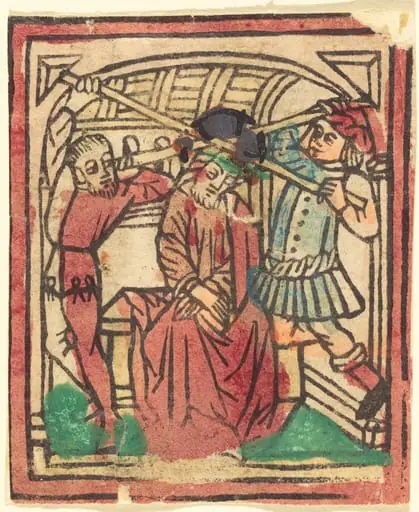
Blood drips from the surface, and scattered hands suggest the violence of the act, reinforcing the theme of sacrifice and martyrdom.
The scene illustrates the execution of St. James, one of Christ’s apostles, traditionally said to have been beheaded. The central figure, identified by his halo, lies on a table with arms outstretched, while two attendants prepare the fatal blow—one holds a hammer, the other reaches toward his head. Blood drips from the surface, and scattered hands suggest the violence of the act, reinforcing the theme of sacrifice and martyrdom.
Technique & Style
The image is rendered in a crude, linear woodcut technique typical of early German printing. Flat areas of ink, strong outlines, and absence of perspective or modeling create a graphic, almost hieratic quality. The lack of detail and emphasis on symbolic gestures reflect a functional, devotional purpose rather than aesthetic refinement, aligning with mass-produced religious imagery of the period.
History & Provenance
Günther Zainer, a printer active in Augsburg, produced this print during a time of religious upheaval in the Holy Roman Empire. Though few of his works survive, this piece is documented in the collection of The Cleveland Museum of Art, acquired as part of a broader effort to preserve early printed religious materials from the Reformation era.
Context
In the decades before the Protestant Reformation, devotional prints like this served as accessible tools for piety among the laity. Zainer’s work reflects the persistence of Catholic iconography even as reformist ideas spread. Its simplicity made it suitable for wide distribution, functioning as both instruction and meditation for viewers unfamiliar with complex theological narratives.
Legacy
Though not widely known today, Zainer’s print exemplifies the role of printmaking in shaping religious experience before the rise of mass literacy. Its raw aesthetic anticipates later expressions of spiritual intensity in folk and expressionist art. As a surviving artifact of early print culture, it offers insight into how ordinary believers engaged with sacred stories through visual means.
Artist & collection

Artist
Günther Zainer was the first printer in Augsburg, where he worked from 1468 until his death; he produced about 80 books including two German editions of the Bible and the first printed calendar.