Artwork
Pietà with Saint John
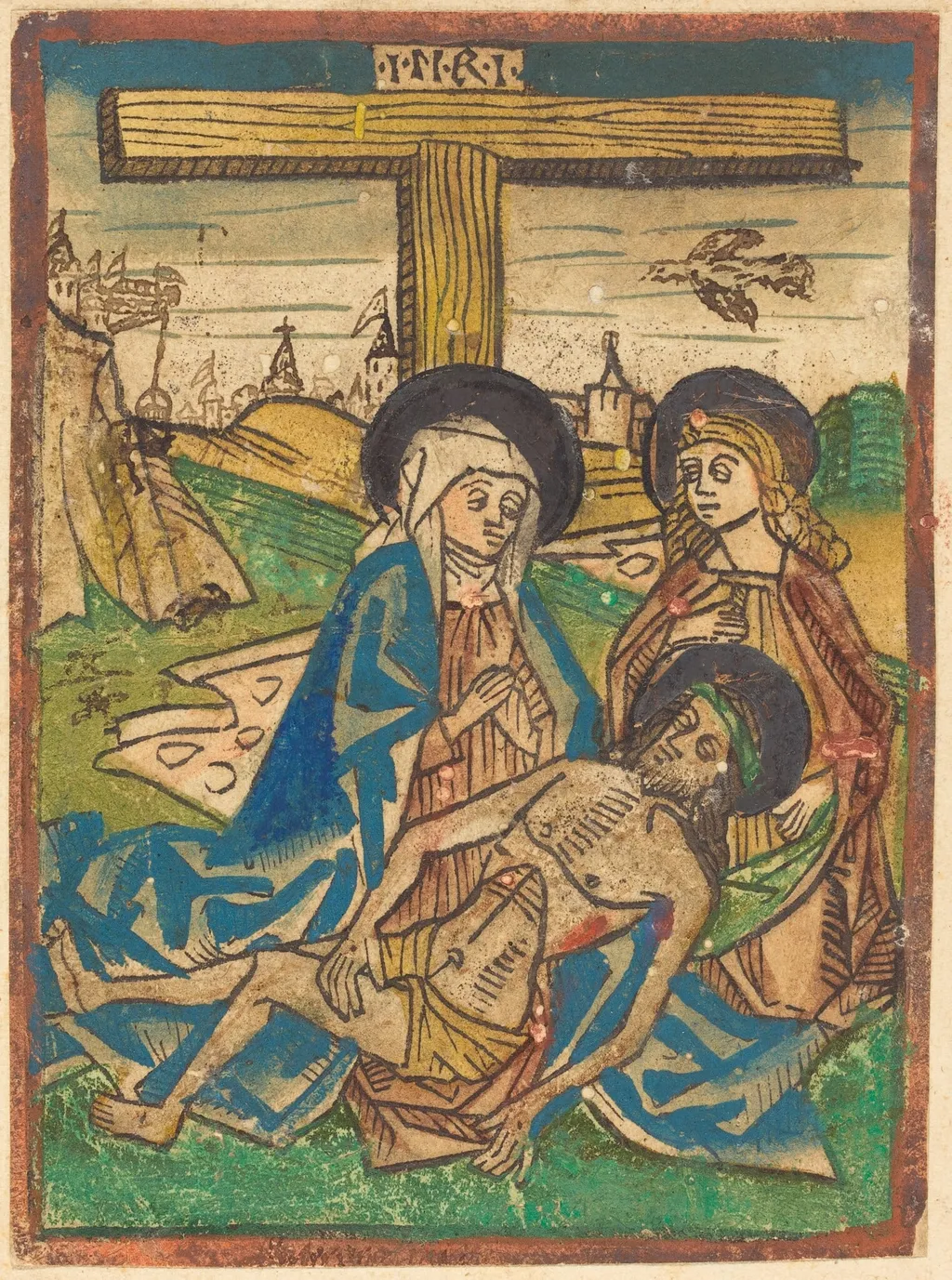
Pietà with Saint John is an ink print by the Renaissance artist German 15th Century. It dates from 1480 and is held in the collection of the National Gallery of Art.
About this work
Overview
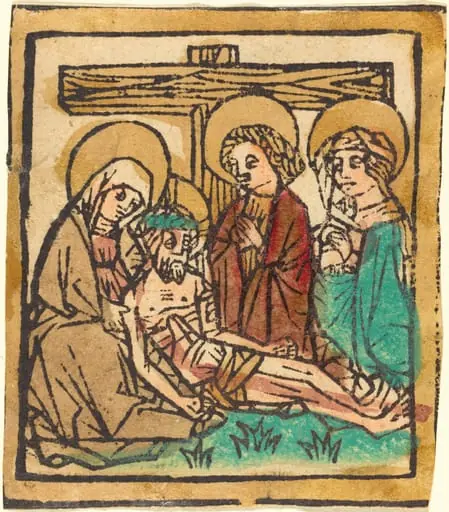
The composition centers on the Virgin Mary cradling the dead Christ, flanked by Saint John, against a distant landscape with a cross on a hill.
This woodcut, hand-colored with pigments including blue, red, green, ochre, orange, and gold, depicts the Pietà with Saint John. The image is printed from a carved wooden block, with additional details added in pen and ink. The composition centers on the Virgin Mary cradling the dead Christ, flanked by Saint John, against a distant landscape with a cross on a hill. The colors are applied deliberately, enhancing emotional focus while retaining the textured, linear quality of the woodcut medium.
Subject & Meaning
The scene illustrates the Virgin Mary mourning the body of Christ after the Crucifixion, with Saint John standing beside her in silent grief. The inclusion of the distant cross and landscape situates the moment within the broader narrative of Christ’s death and resurrection. The figures’ stillness and close grouping emphasize sorrow and intimacy, reflecting devotional themes common in late medieval and early Renaissance religious imagery.
Technique & Style
The image was produced using a woodcut technique, where lines were carved into a wooden block and inked to transfer the design onto paper. Hand-coloring with mineral-based pigments adds vibrancy, while pen-and-ink additions refine contours and details. The figures appear stylized and rigid, characteristic of early printmaking, where form is defined by bold outlines rather than naturalistic modeling.
History & Provenance
This print likely originated in southern Germany or the Rhineland during the late 15th or early 16th century, a period when devotional woodcuts were widely produced for private worship. Its hand-coloring suggests it was made for a private patron rather than mass distribution. Surviving examples of such colored prints are rare, as pigments often faded or were removed over time.
Context
During the late Middle Ages, woodcuts served as accessible religious images for laypeople, especially as literacy grew and personal devotion became more common. The Pietà theme, though more common in sculpture, was adapted into prints to aid meditation on Christ’s suffering. This work reflects the intersection of craft, faith, and emerging print culture in pre-Reformation Europe.
Legacy
Though not by a named artist, this print exemplifies the technical and devotional potential of early printed images. Its survival with original coloring offers insight into how such works were experienced in domestic settings. It contributes to understanding the transition from manuscript illumination to printed imagery in Northern European religious art.
Artist & collection

Artist
This 15th-century German artist carved vivid religious scenes into metal and wood, then hand-painted them in bright, symbolic colors.

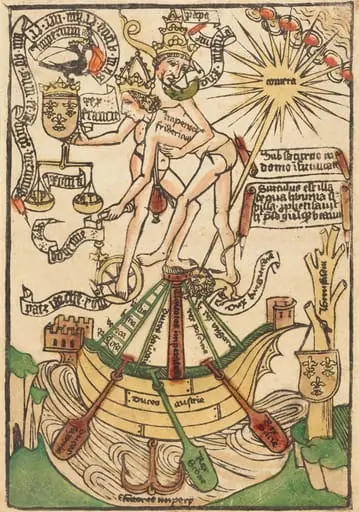 Allegory of the Meeting of Pope Paul II and Emperor Frederick III
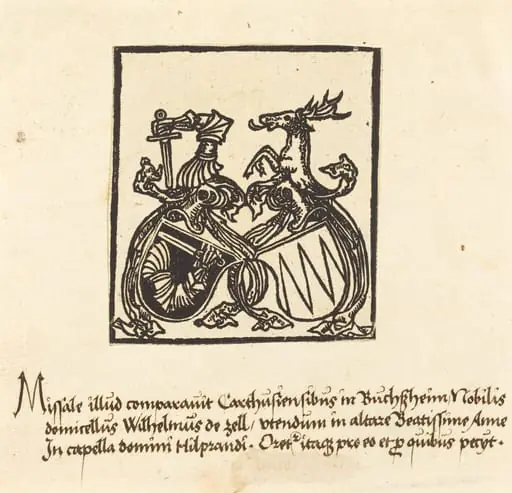 Bookplate of Wilhelm von Zell
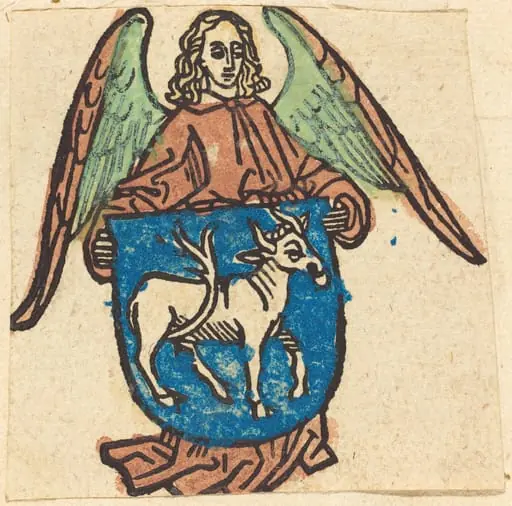 Bookplate of Hilprand Brandenburg of Bibrach
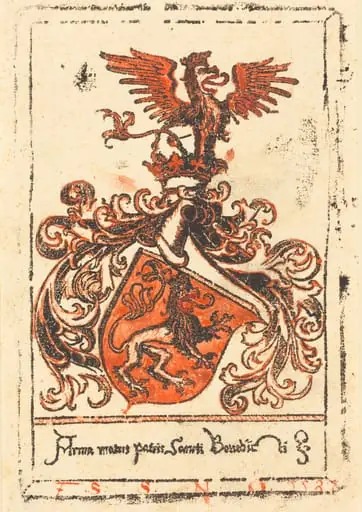 Bookplate of the Abbey of Ottobeuren
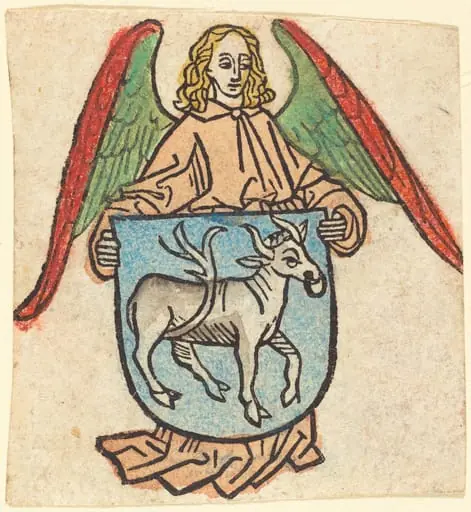 Bookplate of Hilprand Brandenburg of Bibrach
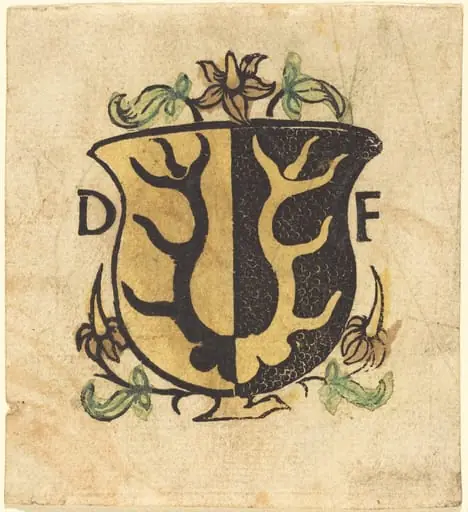 Bookplate of Dominicus Frauenfelder
![Studies for Six Figures (sheet from a model book) [recto], by German 15th Century](https://artifactworldgallery.com/img/german-15th-century--studies-for-six-figures-sheet-from-a-model-book-recto--4837429e0755bc3f-w320.webp) Studies for Six Figures (sheet from a model book) [recto]
Studies for Six Figures (sheet from a model book) [recto] Christ and Mary Interceding with God the Father