Artwork
Saint Agnes
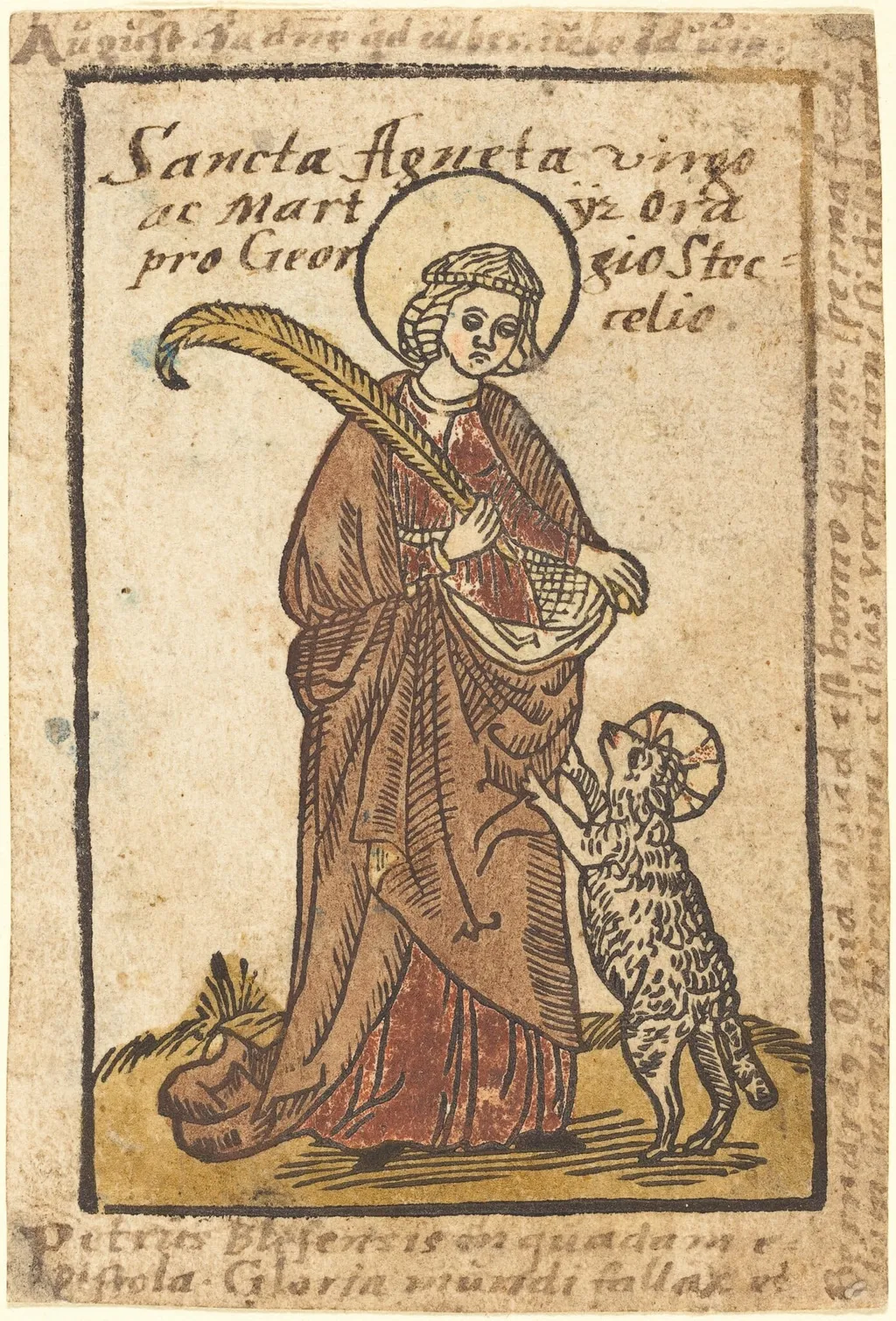
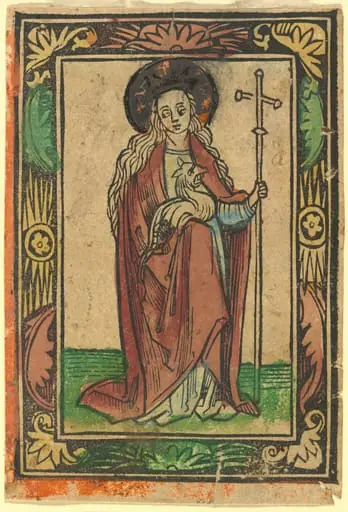
Saint Agnes is an ink print by the Renaissance artist German 15th Century. It dates from 1490 and is held in the collection of the National Gallery of Art.
About this work
Overview
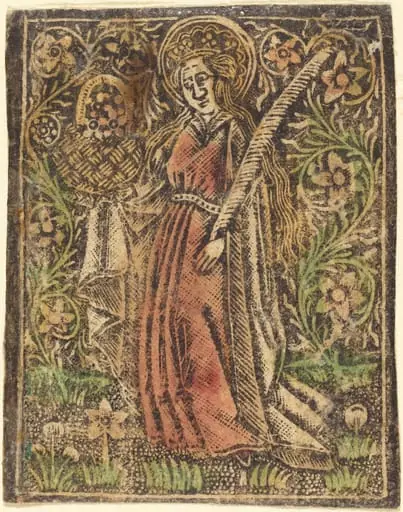
This hand-colored woodcut on laid paper depicts Saint Agnes, a Christian martyr, rendered in a simplified, devotional style.
This hand-colored woodcut on laid paper depicts Saint Agnes, a Christian martyr, rendered in a simplified, devotional style. The image combines printmaking with manual painting, resulting in a unique hybrid object. A border of manuscript text encircles the figure, identifying her and likely serving a liturgical or instructional purpose. The faded pigments suggest age and repeated handling, typical of devotional prints used in private or communal worship.
Subject & Meaning
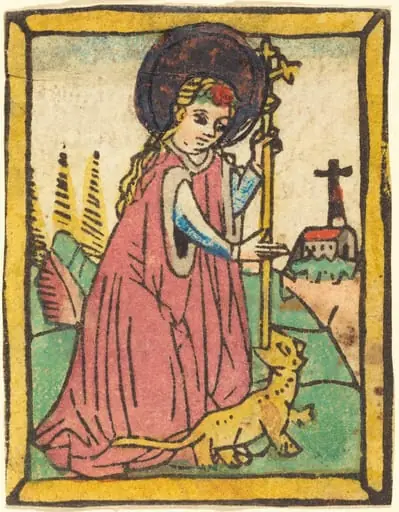
Saint Agnes is shown kneeling before a lamb, a symbol of her purity and martyrdom. The bundle of sticks on her shoulder may reference the firewood used in her execution, a detail from hagiographic tradition. Her halo confirms her sanctity, while the lamb, often associated with Christ, reinforces her spiritual innocence. The composition avoids narrative detail, focusing instead on emblematic attributes to convey her identity and virtue to viewers.
Technique & Style
The image was produced using a woodcut block, with lines carved to form the figure and border text. After printing, pigments were applied by hand, allowing for individual variation in color. The style is deliberately flat and linear, prioritizing clarity over naturalism. The minimal background and lack of perspective reflect a medieval aesthetic suited to devotional use, where symbolic recognition outweighed illusionistic depth.
History & Provenance
The work likely dates to the late medieval or early Renaissance period, when devotional prints with handwritten annotations were common in northern Europe. Its survival suggests it was preserved in a religious context, perhaps in a monastery or private chapel. The presence of manuscript inscriptions indicates it was used as a teaching or prayer aid, possibly copied from a model sheet or produced in a small workshop.
Context
In the late Middle Ages, images of saints like Agnes circulated widely as aids to personal piety. Woodcuts offered an affordable alternative to painted icons, especially for non-elite communities. Agnes, as a young female martyr, was a popular subject for women’s devotion. This print’s combination of print and hand-coloring reflects a transitional phase in religious imagery, bridging manuscript culture and the coming age of mass printing.
Legacy
This print exemplifies the role of affordable religious imagery in shaping popular devotion before the Reformation. Its survival offers insight into how saints were visually codified for lay audiences. Though not the work of a known artist, its craftsmanship and use of traditional iconography reveal the enduring influence of medieval hagiography in everyday religious practice.
Artist & collection

Artist
This 15th-century German artist carved vivid religious scenes into metal and wood, then hand-painted them in bright, symbolic colors.

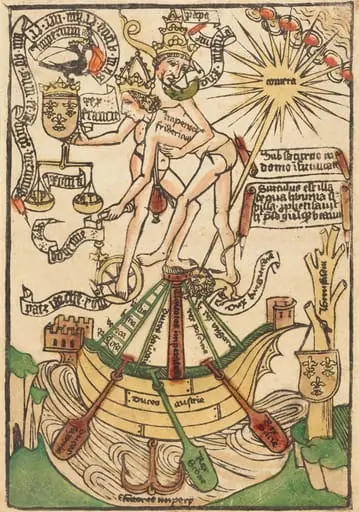 Allegory of the Meeting of Pope Paul II and Emperor Frederick III
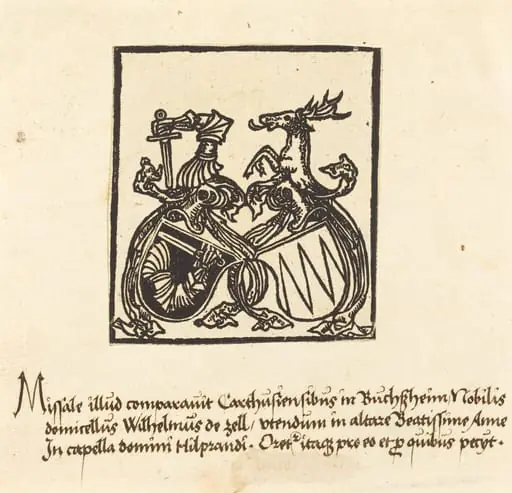 Bookplate of Wilhelm von Zell
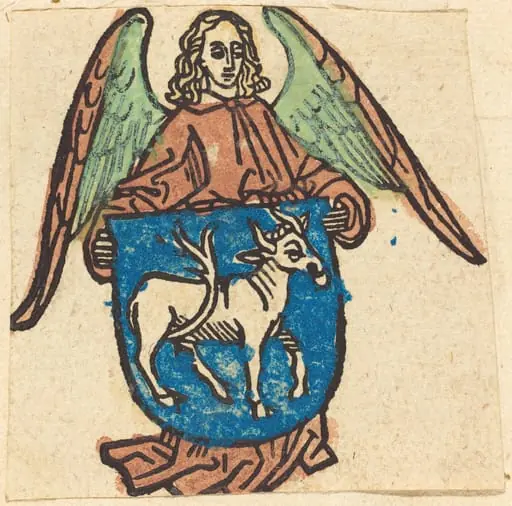 Bookplate of Hilprand Brandenburg of Bibrach
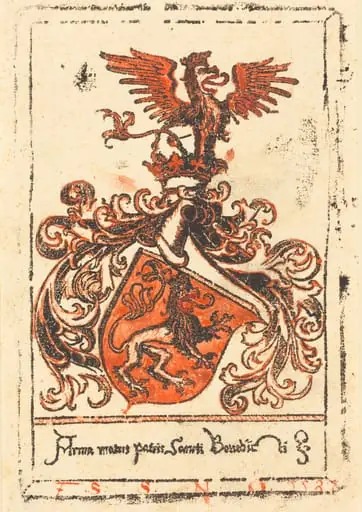 Bookplate of the Abbey of Ottobeuren
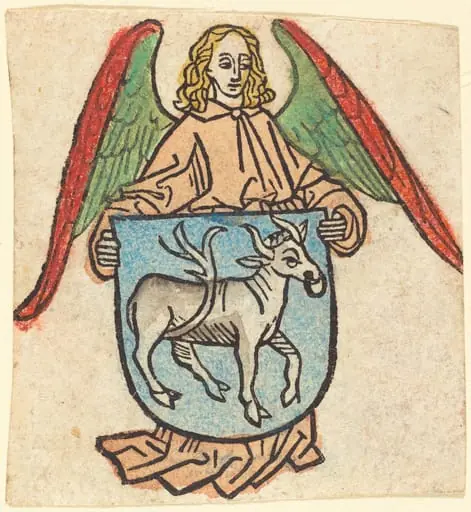 Bookplate of Hilprand Brandenburg of Bibrach
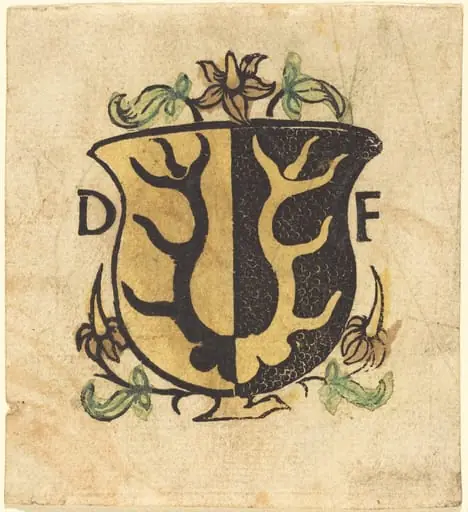 Bookplate of Dominicus Frauenfelder
![Studies for Six Figures (sheet from a model book) [recto], by German 15th Century](https://artifactworldgallery.com/img/german-15th-century--studies-for-six-figures-sheet-from-a-model-book-recto--4837429e0755bc3f-w320.webp) Studies for Six Figures (sheet from a model book) [recto]
Studies for Six Figures (sheet from a model book) [recto]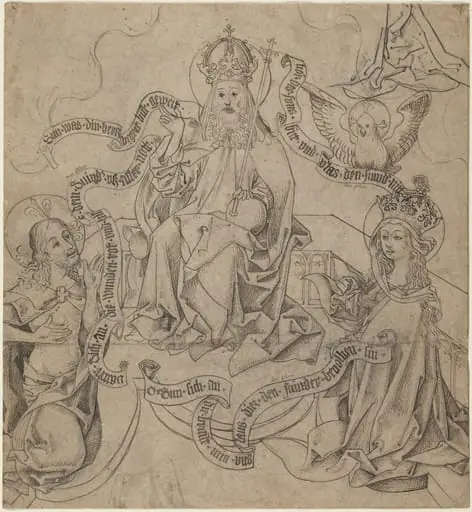 Christ and Mary Interceding with God the Father