Artwork
Arkansaw Flycatcher, Swallow-tailed Flycatcher and Says Flycatcher
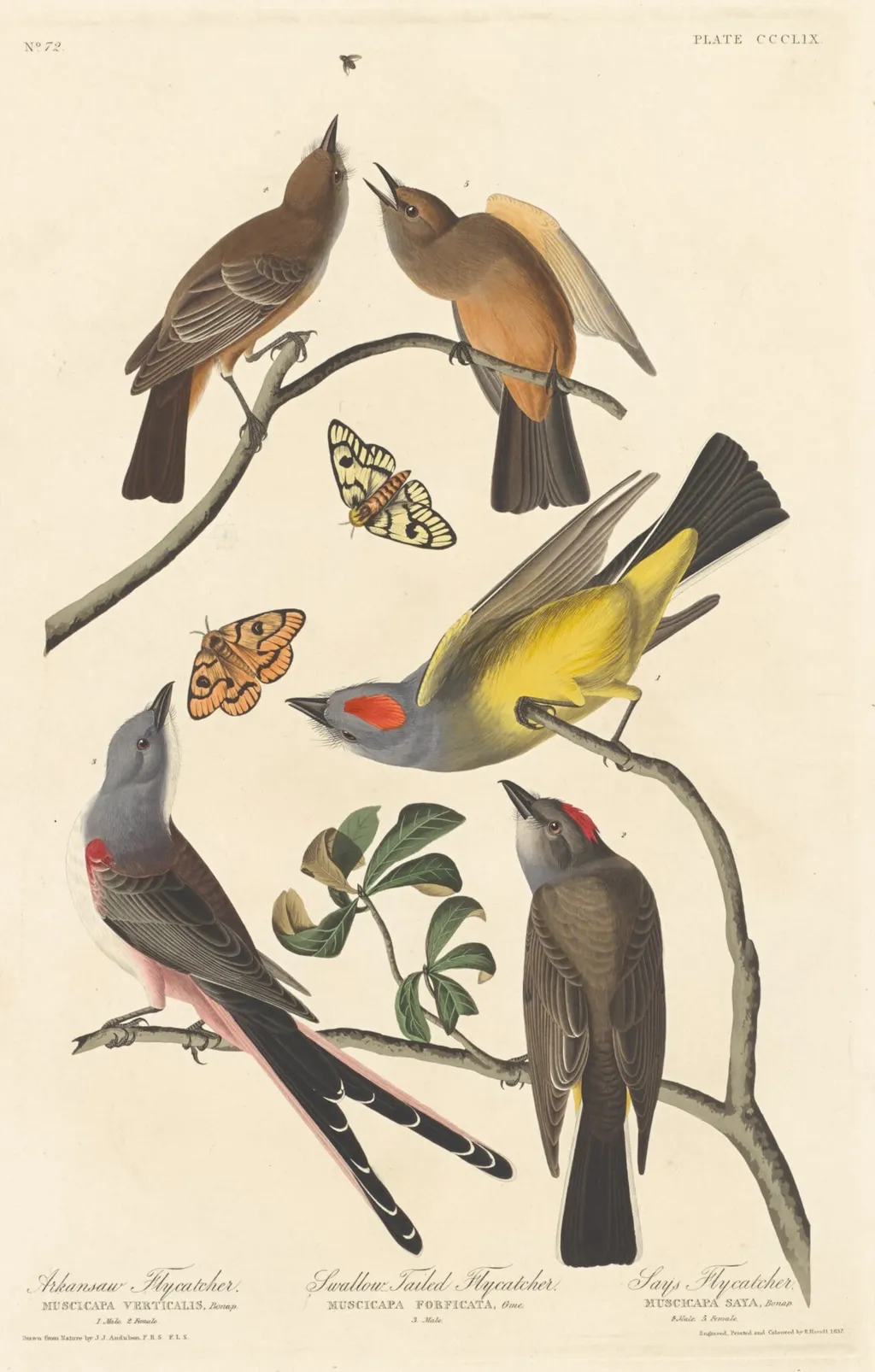
Arkansaw Flycatcher, Swallow-tailed Flycatcher and Says Flycatcher is an ink print by the Romanticist artist Robert Havell Jr.. It dates from 1837 and is held in the collection of the National Gallery of Art.
About this work
Overview
The image captures the birds in naturalistic poses, surrounded by foliage and two fluttering butterflies, emphasizing observational accuracy over stylization.
This 1837 print by Robert Havell Jr. presents three North American flycatcher species—Arkansaw, Swallow-tailed, and Says—rendered in hand-colored engraving and aquatint on Whatman wove paper. Part of a broader tradition of natural history illustration, the work reflects the precision and technical care characteristic of early 19th-century ornithological publishing. The image captures the birds in naturalistic poses, surrounded by foliage and two fluttering butterflies, emphasizing observational accuracy over stylization.
Subject & Meaning
The three flycatchers depicted are native to eastern and central North America, each distinguished by subtle plumage variations. Their placement among twigs and leaves suggests a quiet, undisturbed habitat, reinforcing the scientific intent to document species in their natural context. The inclusion of butterflies adds a sense of movement and ecological interdependence, subtly extending the narrative beyond taxonomy toward a more holistic view of the avian environment.
Technique & Style
Havell employed fine-line engraving and aquatint to achieve nuanced tonal gradations, allowing for lifelike feather textures and depth. Hand-coloring, applied with care, enhanced the birds’ warm hues—yellows, grays, browns, and russets—without obscuring the underlying line work. The use of Whatman paper, prized for its smooth, even surface, supported the delicate rendering of fine details, a hallmark of high-quality natural history prints of the era.
History & Provenance
Robert Havell Jr. was part of a family of English engravers known for their work on major natural history publications, including John James Audubon’s Birds of America. This print likely originated from a similar commission, produced during a period when illustrated ornithology was gaining traction among scientific and amateur audiences. Its survival on original Whatman paper indicates careful preservation, consistent with its status as a scholarly artifact rather than a decorative piece.
Context
In the 1830s, detailed natural history illustrations were central to scientific documentation, especially in regions like North America where species were still being cataloged. Havell’s work aligned with transatlantic efforts to visually record biodiversity, often commissioned by institutions or private collectors. The emphasis on realism, botanical accuracy, and ecological setting reflected broader Enlightenment ideals of observation and classification.
Legacy
Havell’s prints contributed to the standardization of ornithological imagery, influencing later field guides and scientific publications. While modern taxonomy has refined species classifications, his technical approach—combining engraving, aquatint, and hand-coloring—remains a benchmark for pre-photographic natural history illustration. The work endures as a record of both avian diversity and the craftsmanship of 19th-century printmaking.
Artist & collection

Artist
The Havell family of Reading, Berkshire, England, included a number of notable engravers, etchers and painters, as well as writers, publishers, educators, and musicians.

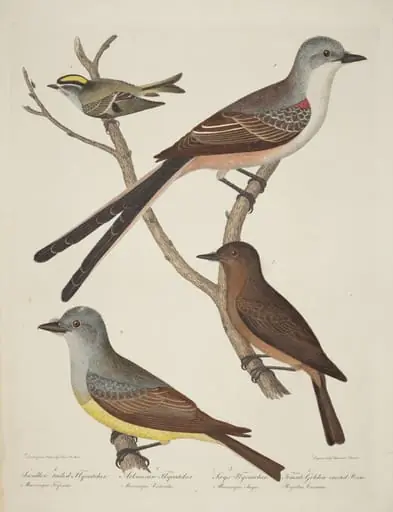 Swallow-tailed Flycatcher, Arkansas Flycatcher, Say's Flycatcher, and Female Golden-crested Wren
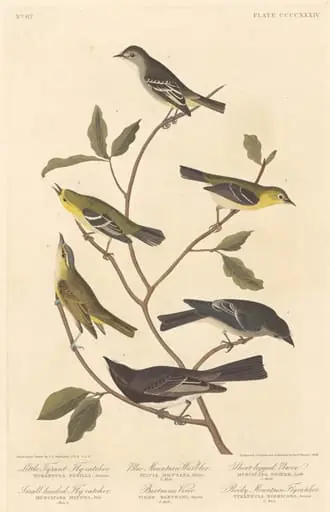 Little Tyrant Flycatcher, Small-Headed Flycatcher, Blue Mountain Warbler, Bartram's Vireo, Short-Legged Pewee, and Rocky Mountain Flycatcher
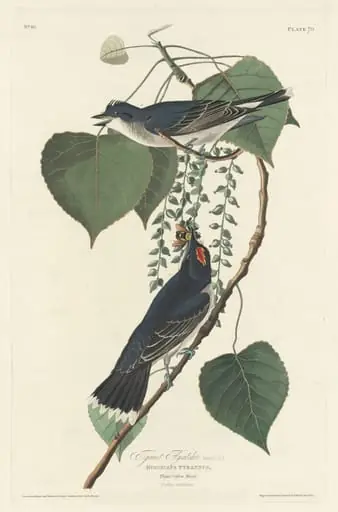 Tyrant Flycatcher
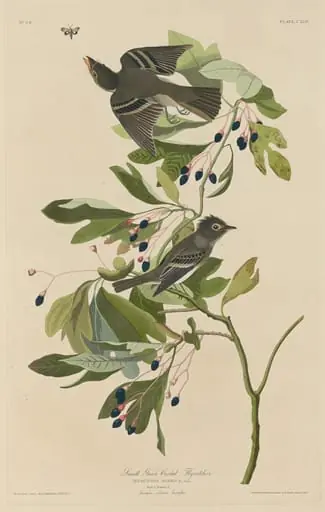 Small Green-Crested Flycatcher
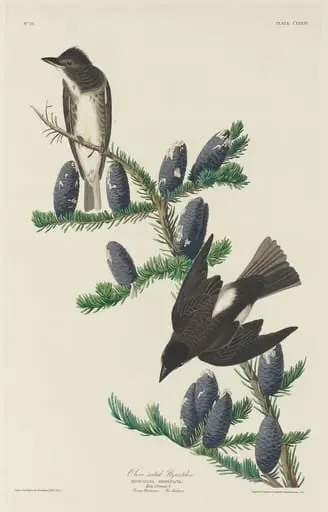 Olive-sided Flycatcher
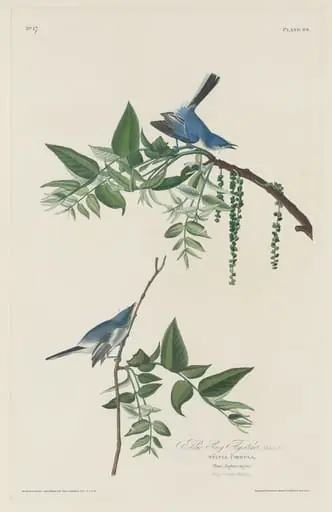 Blue-grey Flycatcher