Artwork
Slender-billed Guillemot
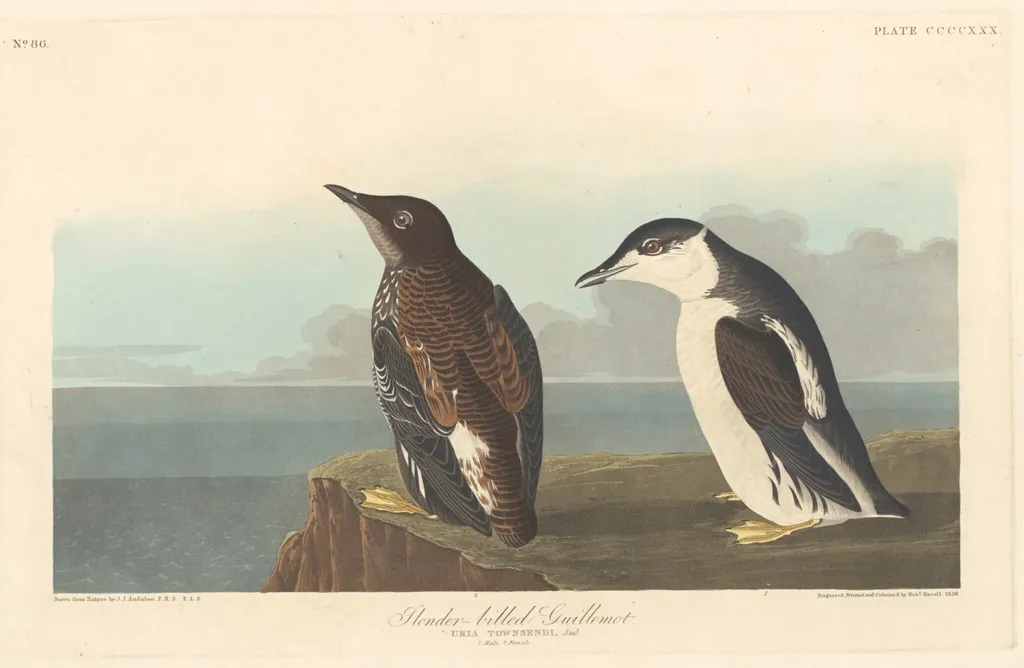
Slender-billed Guillemot is an ink print by the Romanticist artist Robert Havell Jr.. It dates from 1838 and is held in the collection of the National Gallery of Art.
About this work
It was made for John James Audubon’s *Birds of America* to teach people about real birds.
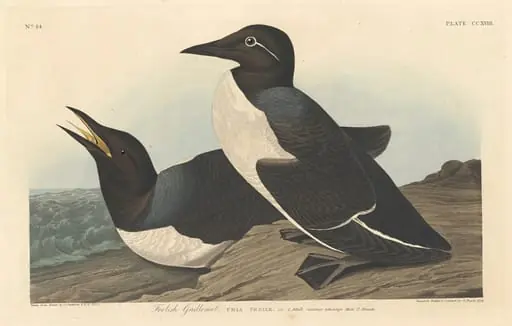
Robert Havell Jr.’s 1838 hand-colored engraving shows a Common Murre perched on a dark rock. The bird’s sharp beak and glossy black back stand out against its soft white belly. Its dark eye seems to watch you.
This wasn’t just a pretty picture. It was made for John James Audubon’s *Birds of America* to teach people about real birds. The details helped scientists too.
You can see this print at the National Gallery of Art, Washington.
Overview
Created in 1838 by Robert Havell Jr., this hand-colored engraving and aquatint was produced on Whatman wove paper as part of John James Audubon’s *Birds of America*. Though titled as a Slender-billed Guillemot, the depicted bird is scientifically identified as a Common Murre. The print exemplifies the Havell family’s technical precision in reproductive printmaking, blending detailed line work with delicate hand-applied color to achieve lifelike natural history imagery.
Subject & Meaning
The image captures a Common Murre perched on a dark, rugged rock, its glossy black back and pale underparts rendered with careful contrast. The bird’s narrow beak and alert, dark eye convey a sense of quiet vigilance. Though intended for scientific documentation, the composition invites contemplation of the bird’s presence in its natural habitat. The work served both educational and aesthetic purposes, bridging ornithological study with visual representation for a broader audience.
Technique & Style
Havell employed engraving and aquatint techniques to achieve fine detail and tonal gradation, then applied color by hand to enhance realism. The use of Whatman wove paper provided a smooth, durable surface ideal for intricate ink lines and subtle washes. The rendering emphasizes texture—the bird’s feathers, the rock’s roughness—while maintaining a restrained palette that reflects the bird’s natural appearance. This method was standard in 19th-century natural history illustration for its fidelity and reproducibility.
History & Provenance
Robert Havell Jr. belonged to a family of English printmakers renowned for their work on Audubon’s publications. His contribution to *Birds of America* followed his father’s legacy in reproductive engraving. The print was produced in London between 1827 and 1838 as part of a serial publication. It is now held in the collection of the National Gallery of Art in Washington, D.C., where it remains a key example of early American natural history printing executed in Britain.
Context
During the 1830s, illustrated natural history books were vital tools for science and public education, as photography did not yet exist. Audubon’s project sought to document North American birds with unprecedented accuracy, relying on skilled European printmakers like Havell to translate his watercolors into prints. The collaboration between American naturalist and British engraver reflects transatlantic scientific networks and the high value placed on visual precision in biological study.
Legacy
Havell’s prints from *Birds of America* remain among the most technically accomplished natural history illustrations of the 19th century. While modern ornithology has superseded some of its classifications, the prints retain value as historical documents of both avian biology and printmaking craft. Their continued presence in major collections underscores their role in shaping public and scientific engagement with wildlife during a formative period in ecological observation.
Artist & collection

Artist
The Havell family of Reading, Berkshire, England, included a number of notable engravers, etchers and painters, as well as writers, publishers, educators, and musicians.