Artwork
Brown-Headed Nuthatch
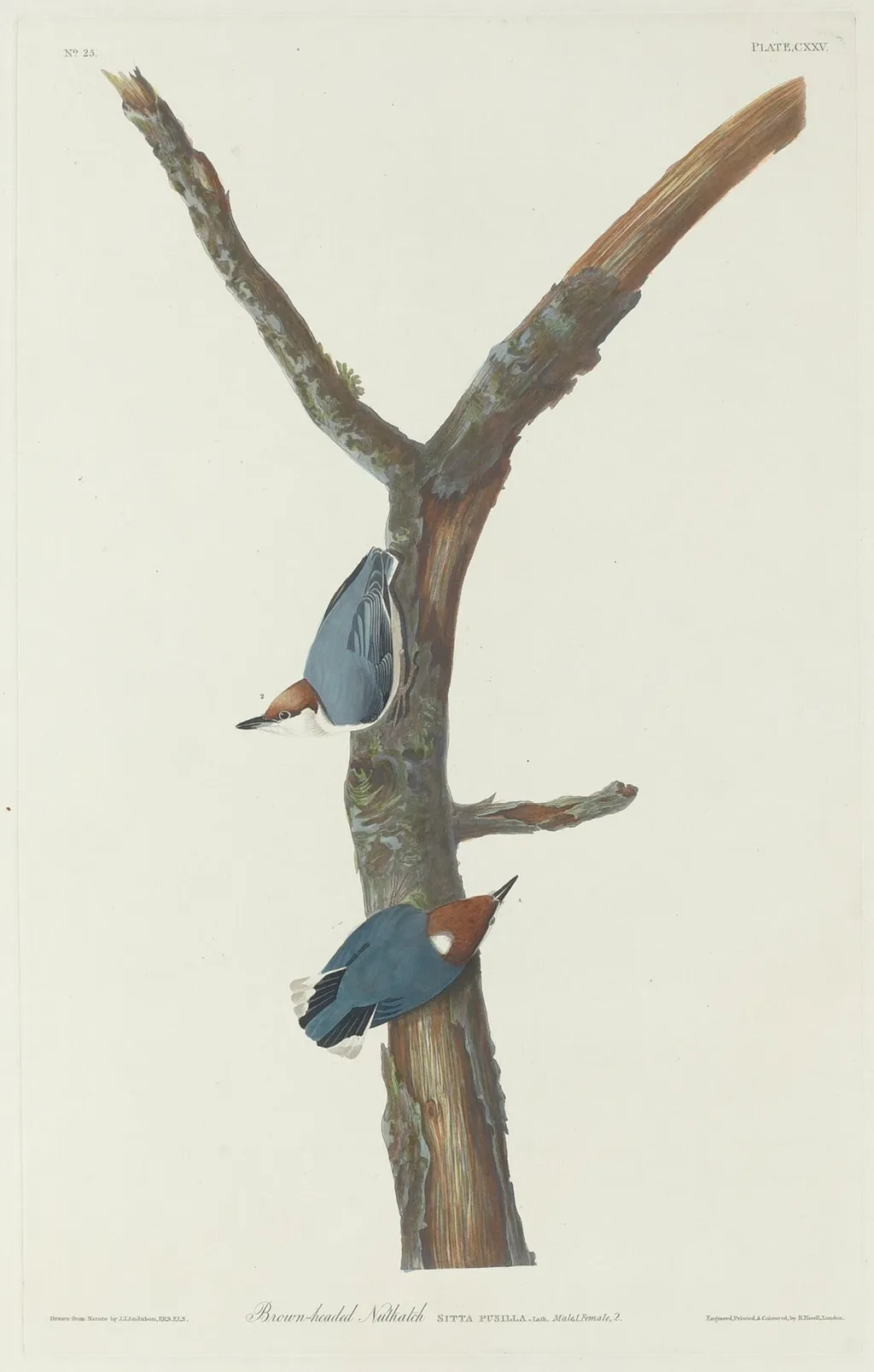
Brown-Headed Nuthatch is an ink print by the Romanticist artist Robert Havell Jr.. It dates from 1831 and is held in the collection of the National Gallery of Art.
About this work
Overview
, this hand-colored engraving and aquatint depicts a brown-headed nuthatch on Whatman wove paper, a preferred support for high-quality prints of the era.
Created in 1831 by Robert Havell Jr., this hand-colored engraving and aquatint depicts a brown-headed nuthatch on Whatman wove paper, a preferred support for high-quality prints of the era. Part of a larger ornithological publication, the work reflects the Havell family’s reputation for precise naturalistic illustration. The technique combines engraved lines with aquatint tonal areas, enhanced by delicate hand coloring to capture the bird’s plumage and habitat with scientific accuracy.
Subject & Meaning
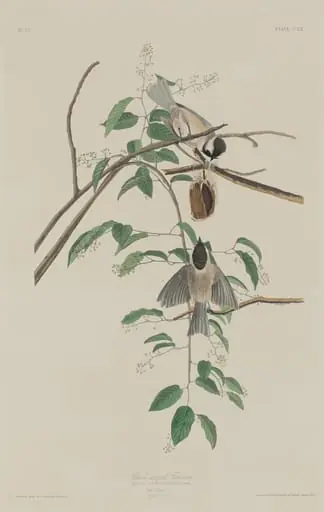
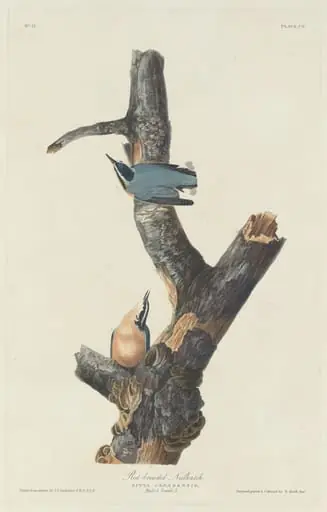
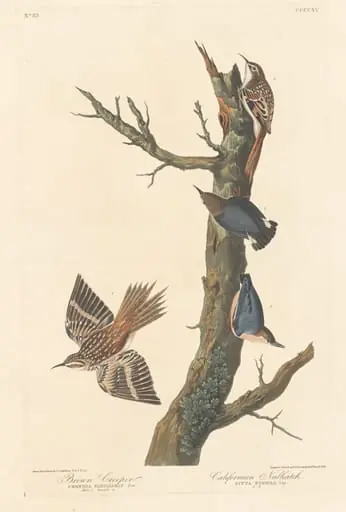
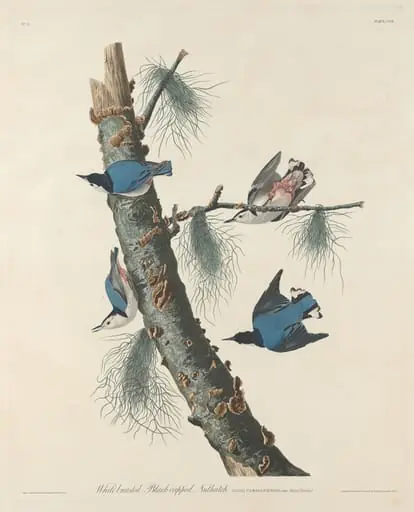
The print portrays two nuthatches perched on a bare branch, one with a gray body and white face, the other displaying blue-gray feathers and a rust-colored head and tail. These birds, native to eastern North American woodlands, are rendered not as symbols but as observed specimens. The composition emphasizes their natural posture and interaction, aligning with the scientific intent of 19th-century natural history illustration to document species accurately for study and record.
Technique & Style
Robert Havell Jr. employed engraving for fine linear detail and aquatint to achieve subtle gradations of tone, particularly in the feathers and bark. Cross-hatching defines texture in the wings and the rough, moss-dappled trunk. Hand coloring was applied with precision to match the birds’ natural hues, avoiding exaggeration. The use of Whatman paper, known for its smooth, even surface, allowed for crisp ink hold and delicate washes, supporting the work’s lifelike realism.
History & Provenance
The print originated as part of a multi-volume ornithological series published in the early 1830s, likely linked to John James Audubon’s projects, though not directly by him. Robert Havell Jr., based in England, was the principal engraver for such works, continuing a family tradition of printmaking with ties to Indian artistic traditions. The print’s survival in institutional collections reflects its role in the dissemination of American wildlife imagery to European audiences during the period.
Context
In the 1830s, illustrated natural history books were vital tools for scientists and collectors, bridging art and biology. European publishers relied on skilled engravers like Havell to translate American specimens into print, often based on field sketches sent across the Atlantic. This work emerged amid growing public interest in natural science, where visual accuracy was prized over artistic flourish, and print technology enabled wider access to biological knowledge.
Legacy
Havell’s prints, including this one, helped standardize the visual representation of North American birds in scientific literature. Though later superseded by photography, his technique set a benchmark for detail and fidelity in ornithological illustration. The work remains a reference in museum and academic collections, valued for its technical discipline and contribution to the historical record of avian biodiversity.
Artist & collection

Artist
The Havell family of Reading, Berkshire, England, included a number of notable engravers, etchers and painters, as well as writers, publishers, educators, and musicians.