Artwork
Carolina Pigeon or Turtle Dove
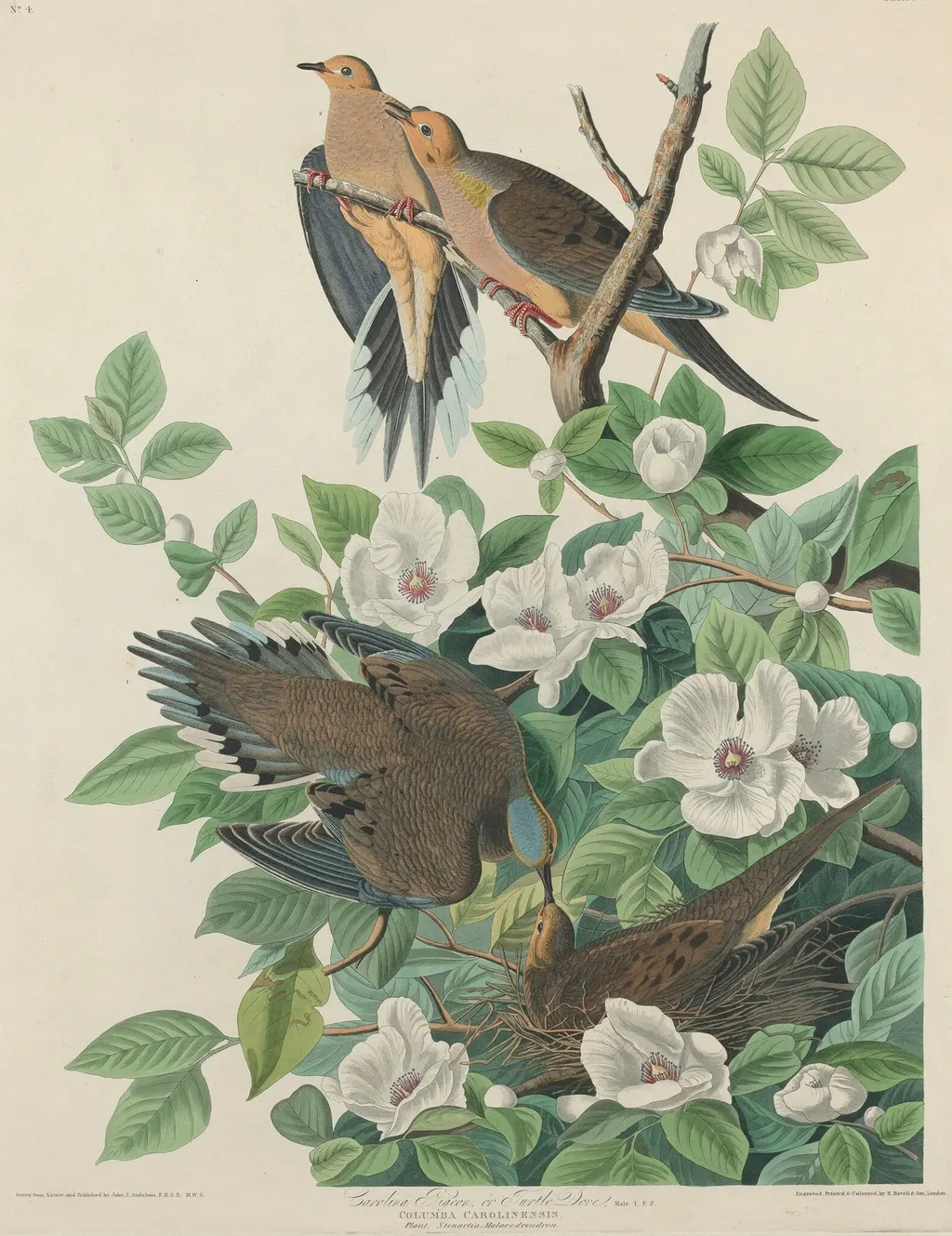
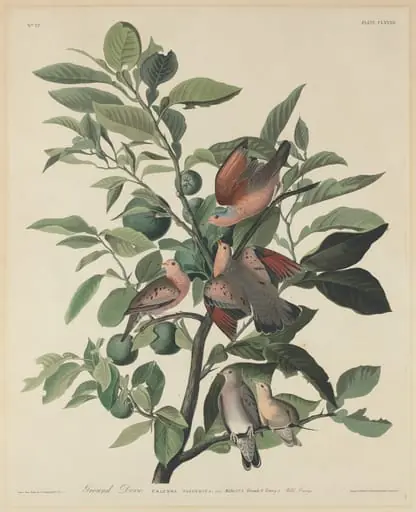
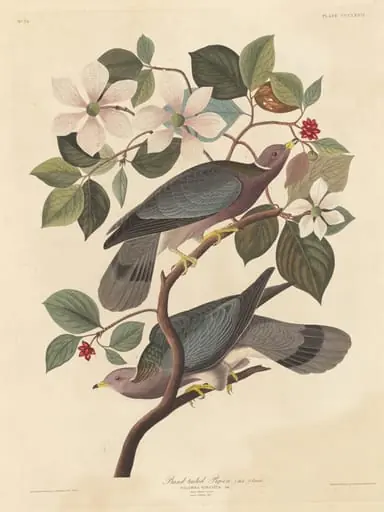
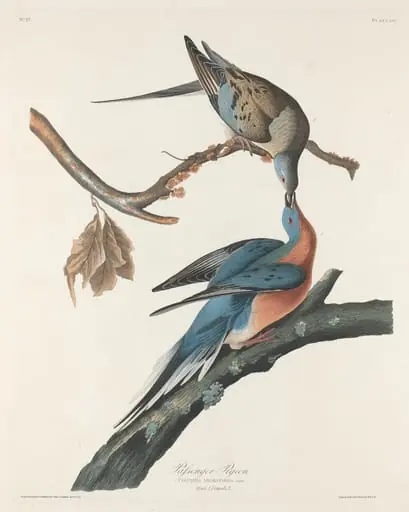
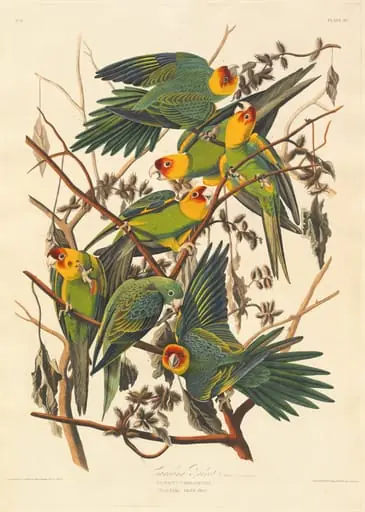
Carolina Pigeon or Turtle Dove is an ink print by the Romanticist artist Robert Havell Jr.. It dates from 1827 and is held in the collection of the National Gallery of Art.
About this work
Overview
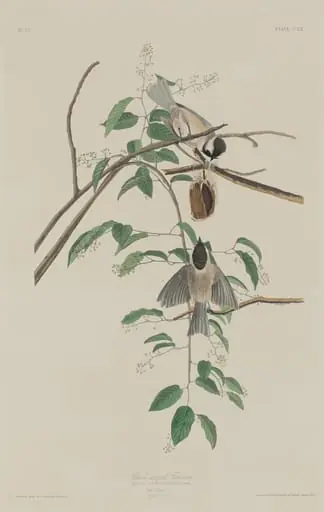
Robert Havell Jr.’s 1827 hand‑colored engraving and aquatint, titled *Carolina Pigeon or Turtle Dove*, presents a naturalistic study of a small bird set against foliage and blossoms. Executed on Whatman wove paper, the print combines delicate line work with the tonal softness of aquatint, resulting in a muted palette of browns, blues and creams that emphasizes the bird’s form and surrounding vegetation.
Subject & Meaning
The image captures two individuals of the same species: one perched calmly on a branch, the other captured in mid‑flight beneath it, wings fully extended.
The image captures two individuals of the same species: one perched calmly on a branch, the other captured in mid‑flight beneath it, wings fully extended. The juxtaposition of stillness and motion offers a visual exploration of avian behavior, while the inclusion of green leaves and white flowers situates the bird within its natural habitat, reflecting an interest in accurate, observational representation.
Technique & Style
Havell employed fine linear drawing to render feather texture and leaf venation, then applied aquatint to achieve subtle gradations of tone across the birds and background. The hand‑coloring, applied after printing, adds soft earth tones that enhance the three‑dimensional illusion. This combination of line engraving and tonal aquatint was a common method for scientific illustration in the early nineteenth century.
History & Provenance
Born into the renowned Havell family of English engravers, Robert Havell Jr. continued the workshop’s tradition of producing natural history prints. His father, Robert Havell the Elder, had established a prolific publishing house that supplied images for scientific works, particularly those concerning Indian flora and fauna. The 1827 print reflects this familial expertise in both technical execution and subject matter.
Context
During the early 1800s, European interest in cataloguing the natural world spurred a demand for detailed, accurate illustrations. Engravings such as Havell’s were often used in ornithological texts and collections, serving both educational and aesthetic purposes. The use of aquatint allowed artists to mimic the tonal qualities of watercolor, aligning the medium with contemporary scientific standards.
Legacy
Havell’s work exemplifies the intersection of art and science that characterized nineteenth‑century natural history publishing. The print’s meticulous detail and tonal richness contributed to the visual vocabulary of ornithological illustration, influencing subsequent generations of artists who sought to balance scientific precision with artistic expression.
Artist & collection

Artist
The Havell family of Reading, Berkshire, England, included a number of notable engravers, etchers and painters, as well as writers, publishers, educators, and musicians.