Artwork
Maryland Yellow Throat
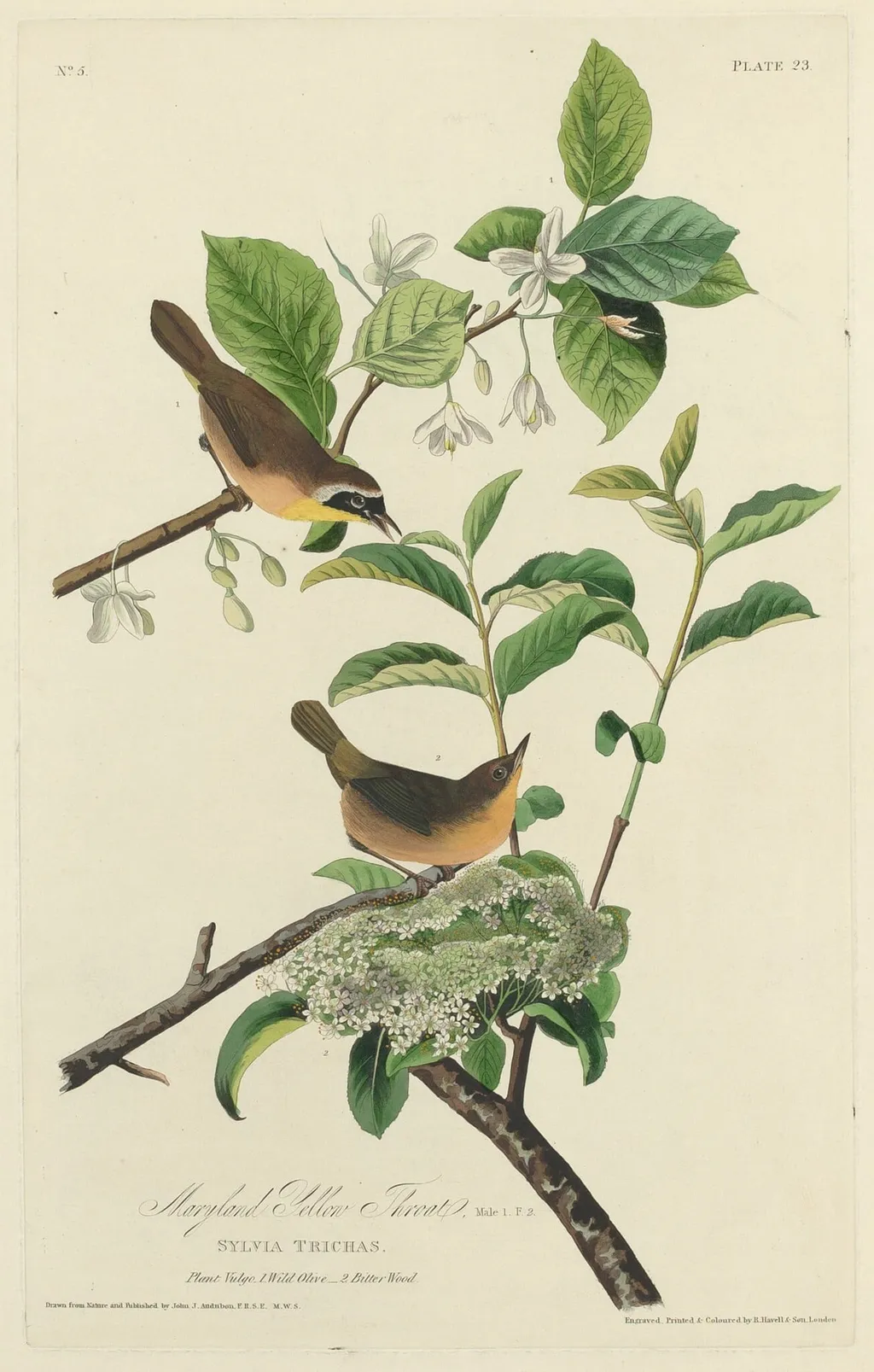
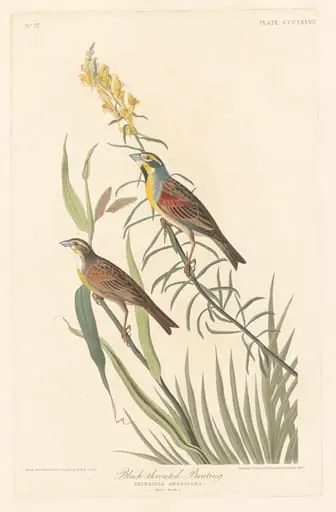
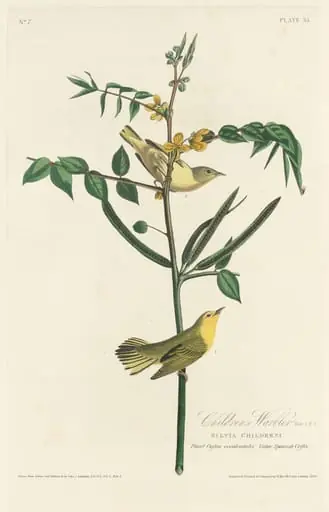
Maryland Yellow Throat is an ink print by the Romanticist artist Robert Havell Jr.. It dates from 1827 and is held in the collection of the National Gallery of Art. Created in 1827, this hand-colored engraving and aquatint on Whatman wove paper depicts a Maryland yellow-throat warbler.
About this work
Overview
Created in 1827, this hand-colored engraving and aquatint on Whatman wove paper depicts a Maryland yellow-throat warbler.
Created in 1827, this hand-colored engraving and aquatint on Whatman wove paper depicts a Maryland yellow-throat warbler. The work was produced by Robert Havell Jr., a member of a prominent English family of printmakers known for their technical precision in aquatint. It belongs to a series of ornithological illustrations that combined scientific observation with artistic craftsmanship, reflecting the 19th-century interest in natural history documentation.
Subject & Meaning
The print portrays a male Maryland yellow-throat warbler perched on a branch among flowering vegetation. Its bright yellow throat and breast contrast with its olive-brown back, while the surrounding flora includes delicate white blossoms and finely rendered leaves. The composition emphasizes the bird’s natural habitat, not as a specimen but as a living creature within its environment, aligning with the era’s growing appreciation for ecological context in natural history art.
Technique & Style
Havell employed engraving to define the bird’s form and the branching structure, then used aquatint to achieve subtle tonal gradations in the feathers and foliage. Hand-coloring added lifelike hues to the plumage and petals, enhancing realism without obscuring the underlying line work. The meticulous rendering of feather textures and leaf veins demonstrates the Havell family’s mastery of combining printmaking techniques to capture fine natural detail.
History & Provenance
Robert Havell Jr. worked within a family tradition of printmaking centered in Reading, Berkshire, where his father and uncle were established engravers and publishers. This piece likely originated as part of a larger ornithological project, possibly linked to American naturalist publications of the period. Its production reflects transatlantic artistic collaboration, as Havell often reproduced American bird studies for European audiences.
Context
In the 1820s, detailed natural history illustrations were in demand among scientific and amateur naturalist circles. The Havell family’s work contributed to a broader movement that sought to document North American wildlife through art, often based on field sketches sent from the United States. This print exemplifies how European printmakers interpreted and refined American specimens for an international audience.
Legacy
Havell’s prints, including this one, remain valued for their technical fidelity and historical significance in ornithological illustration. While later photographic methods replaced hand-colored prints, his work preserved a moment when art and science converged to document biodiversity. His contributions helped shape public understanding of North American birds during a formative period in natural history study.
Artist & collection

Artist
The Havell family of Reading, Berkshire, England, included a number of notable engravers, etchers and painters, as well as writers, publishers, educators, and musicians.