Artwork
Nuttall's Lesser Marsh Wren
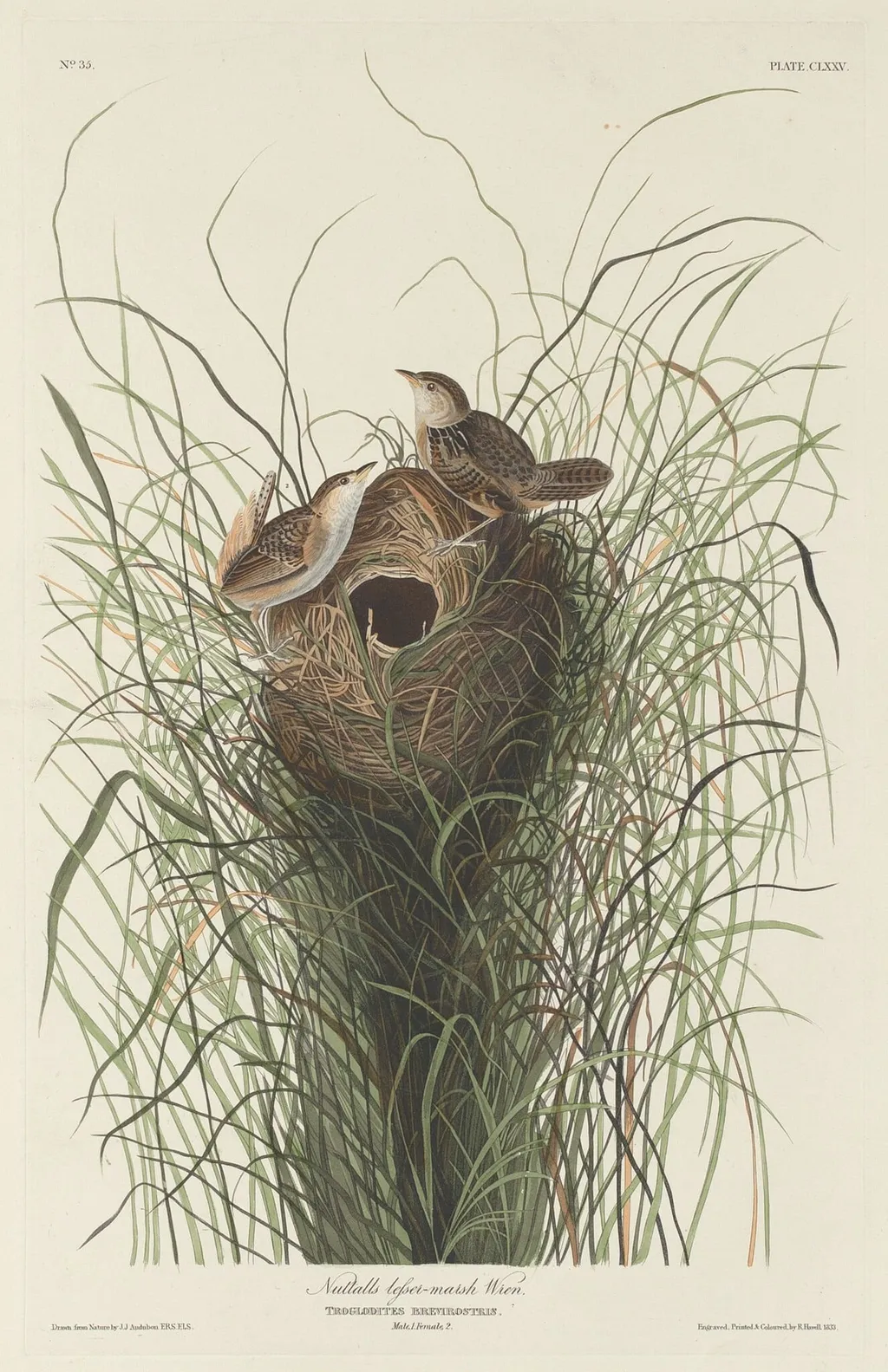
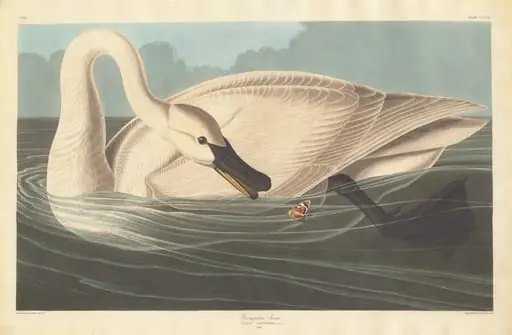
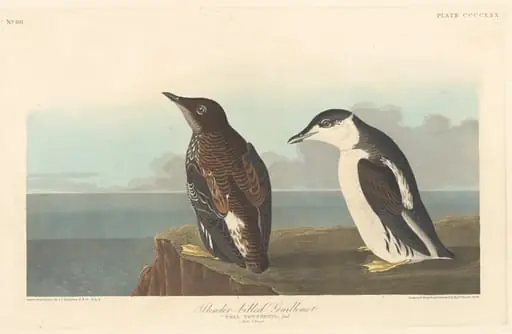
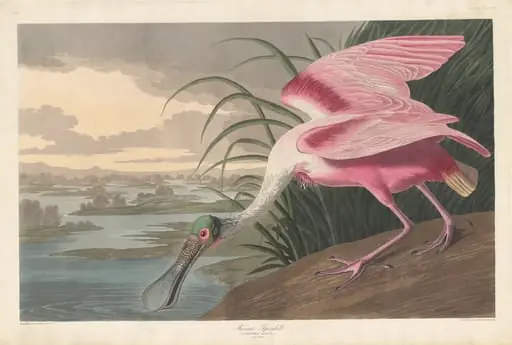
Nuttall's Lesser Marsh Wren is an ink print by the Romanticist artist Robert Havell Jr.. It dates from 1833 and is held in the collection of the National Gallery of Art.
About this work
Overview
It forms part of a broader project documenting North American birds, executed with precision typical of early 19th-century naturalist publishing.
Created in 1833 by Robert Havell Jr., this print is a hand-colored engraving and aquatint on Whatman wove paper. It forms part of a broader project documenting North American birds, executed with precision typical of early 19th-century naturalist publishing. Havell Jr. belonged to a multi-generational family of English printmakers known for their technical skill in reproductive illustration, particularly in the fields of natural history and topography.
Subject & Meaning
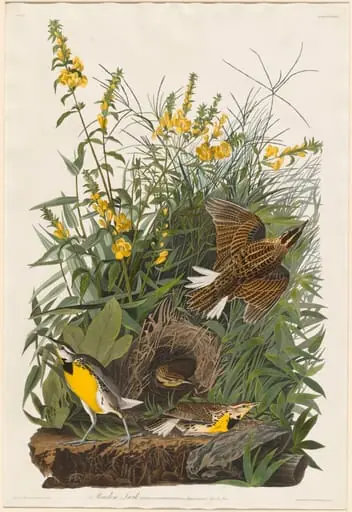
The image depicts a nest of three small birds, likely Nuttall’s Lesser Marsh Wren, nestled among tall, swaying grasses. The composition emphasizes the birds’ vulnerability and habitat, with no human presence or artificial elements. The focus on nesting behavior reflects the period’s scientific interest in avian life cycles, presenting the subject not as a specimen but as a living entity within its environment.
Technique & Style
Havell Jr. employed fine-line engraving and aquatint to render delicate textures—the wiry grasses, the woven nest, the soft plumage. Hand-coloring with water-based pigments added subtle gradations in browns, grays, and greens, enhancing realism without artificial vibrancy. Light is carefully modulated to suggest volume and depth, with shadows defining form and atmospheric space, characteristic of the naturalist tradition’s commitment to observational accuracy.
History & Provenance
The print originated from a larger ornithological publication, likely commissioned by naturalist Thomas Nuttall. Robert Havell Jr. inherited his father’s workshop and continued its legacy of producing high-quality natural history prints for American and European audiences. Though the Havell family had connections to Indian artistic traditions, this work remains firmly rooted in the North American naturalist movement of the 1830s.
Context
Produced during a surge in American natural history studies, the print aligns with efforts to catalog and illustrate native wildlife as the nation expanded westward. Scientific illustration was then a bridge between art and empirical research, with detailed prints serving both scholarly and public audiences. Havell’s work contributed to a growing visual archive that shaped early American understanding of biodiversity.
Legacy
Though overshadowed by later color lithography, Havell’s engravings remain valued for their technical rigor and fidelity to natural forms. This print exemplifies the transition from specimen-based taxonomy to habitat-centered observation in ornithological art. Its preservation in institutional collections underscores its role as a document of both scientific and artistic practice in early American natural history.
Artist & collection

Artist
The Havell family of Reading, Berkshire, England, included a number of notable engravers, etchers and painters, as well as writers, publishers, educators, and musicians.