Artwork
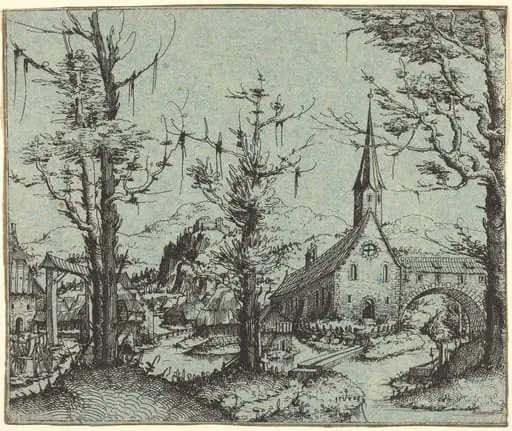
Landscape with a Village Church
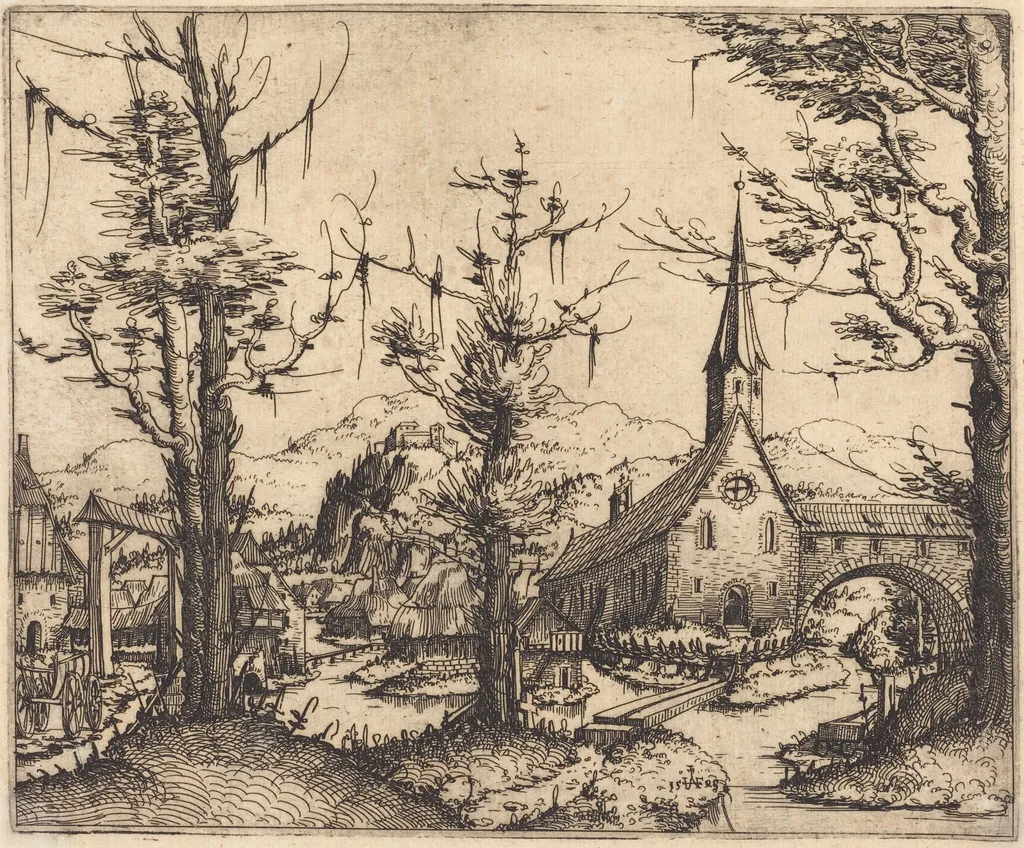
Landscape with a Village Church is an ink print by the Renaissance artist Augustin Hirschvogel. It dates from 1545 and is held in the collection of the National Gallery of Art. Created in 1545, this black‑and‑white print presents a modest village scene dominated by a simple church tower topped with a cross.
About this work
Overview
Created in 1545, this black‑and‑white print presents a modest village scene dominated by a simple church tower topped with a cross. Bare‑branched trees frame the foreground, while modest dwellings and cultivated fields extend into the distance, the composition rendered from a slightly oblique viewpoint that enhances its sense of depth.
Subject & Meaning
The central focus on the village church reflects the importance of communal religious life in rural 16th‑century Central Europe. By situating the sacred building amid everyday structures and natural surroundings, the image conveys a harmonious relationship between faith, habitation, and landscape, inviting contemplation of the ordinary yet enduring rhythms of village existence.
Technique & Style
The work is an etching, produced by incising lines into a metal plate with acid and then inking the recessed areas. This process yields fine, textured lines that suggest hand‑drawn detail and atmospheric effects. The style aligns with the Danube School’s emphasis on meticulous observation of nature, employing tonal variation to render light, shadow, and spatial recession.
History & Provenance
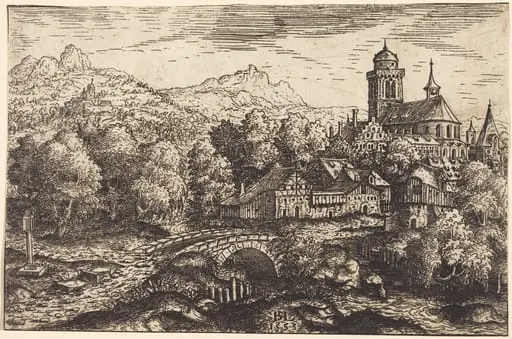
The print belongs to a series of thirty‑five small landscape etchings executed between 1545 and 1549 by Augustin Hirschvogel, a German artist noted for his work in mathematics and cartography. These prints established Hirschvogel’s reputation within the Danube School, a regional artistic movement active in Bavaria and Austria during the mid‑1500s.
Context
Hirschvogel’s landscapes reflect the Danube School’s interest in integrating detailed topographical observation with a lyrical atmosphere. The series, produced during a period of growing interest in scientific mapping and natural observation, demonstrates how printmaking could disseminate sophisticated visual studies of the countryside to a broader audience.
Artist & collection
Artist
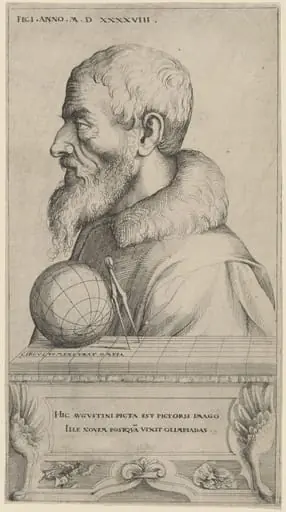
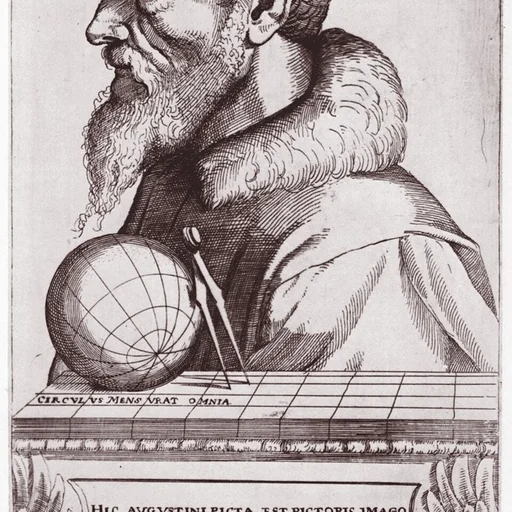
Augustin Hirschvogel (1503 – February 1553) was a German artist, mathematician, and cartographer known primarily for his etchings.