Artwork
Self-Portrait
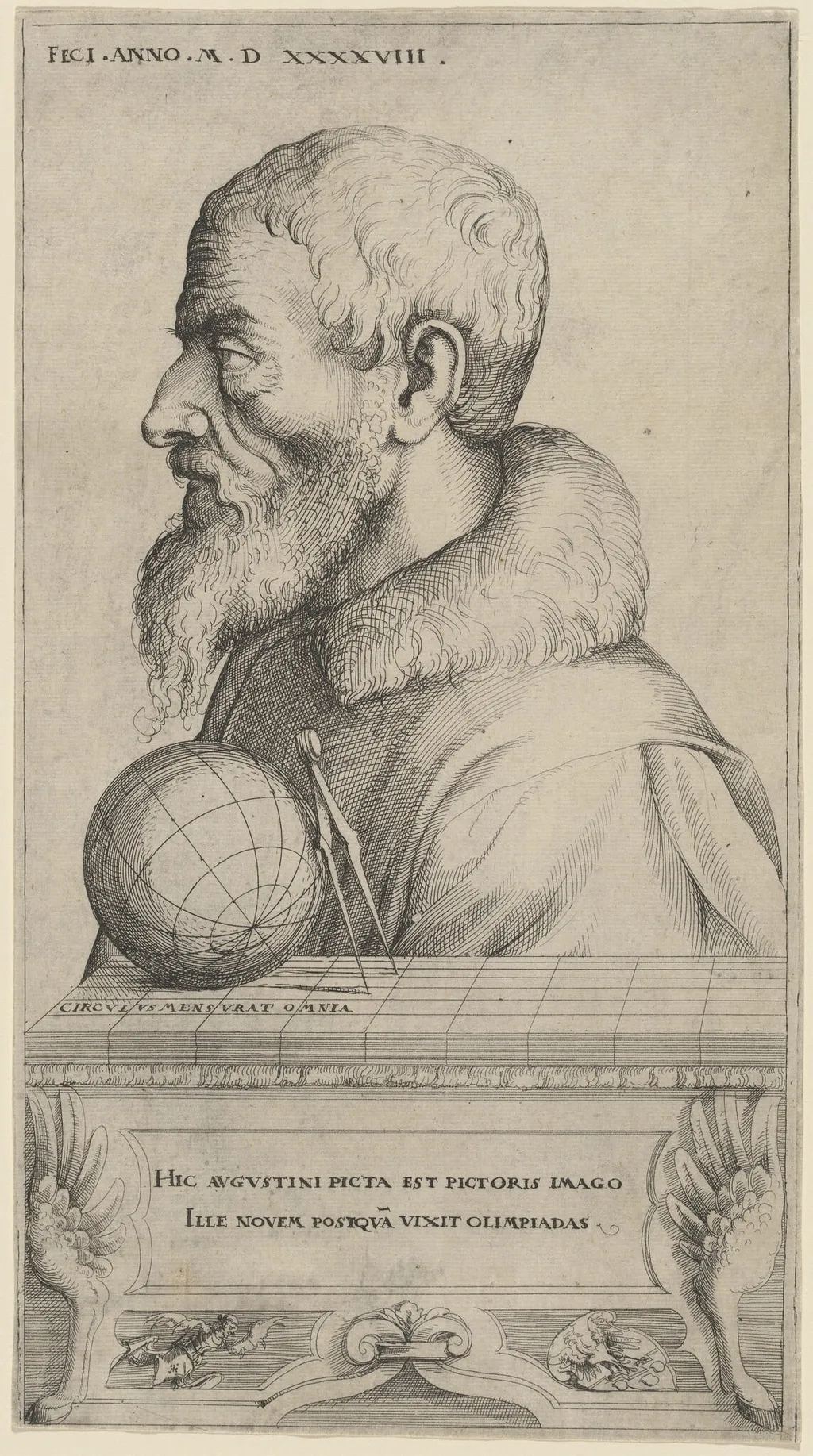
Self-Portrait is an ink print by the Renaissance artist Augustin Hirschvogel. It dates from 1548 and is held in the collection of the National Gallery of Art. Created in 1548, this etching presents a solitary figure of a man, rendered in stark monochrome.
About this work
The text at the bottom says this is a self-portrait of the artist.
This is a black-and-white drawing of a man’s head and shoulders. His face is wrinkled, with a long beard and deep lines. He’s wearing a fur collar and holding a globe under his arm. The lines on the globe look like latitude and longitude.
The text at the bottom says this is a self-portrait of the artist. The year 1548 is written at the top.
Look up etching to see how this kind of drawing was made.
Overview
Created in 1548, this etching presents a solitary figure of a man, rendered in stark monochrome. The portrait shows the sitter from the shoulders up, his aged face marked by deep lines and a long beard, while a fur-trimmed collar frames his shoulders. A small globe rests against his side, its surface marked with a network of latitude and longitude lines, emphasizing the artist’s scholarly interests.
Subject & Meaning
The work functions as a self-representation, with the artist depicting himself as both a learned individual and a traveler. The inclusion of the globe suggests an engagement with geography and cartography, fields in which the creator was active, while the fur collar conveys a degree of status. The somber expression and pronounced wrinkles underscore a reflective, perhaps introspective, self‑assessment.
Technique & Style
Executed through the intaglio process of etching, the image relies on incised lines that hold ink and transfer onto paper, producing fine detail and tonal variation. The artist’s hand is evident in the delicate cross‑hatching that models facial features and the crisp, linear rendering of the globe’s grid. The overall aesthetic aligns with the precise, observational style characteristic of mid‑16th‑century German printmaking.
History & Provenance
The portrait belongs to a series of printed works produced by the creator during a prolific period between 1545 and 1549, when he issued thirty‑five small landscape etchings alongside a few portrait pieces. Though the original paper carrier has changed hands over centuries, the impression remains documented in several European print collections, confirming its date of 1548 through the inscribed inscription.
Context
The artist operated within the artistic milieu of the Danube School, a network of painters and printmakers active in Bavaria and Austria during the early Renaissance. This movement emphasized natural observation and detailed rendering, traits reflected in the precise lines of the globe and the realistic treatment of facial texture. His dual roles as mathematician and cartographer informed the intellectual content of the portrait.
Artist & collection
Artist
Augustin Hirschvogel (1503 – February 1553) was a German artist, mathematician, and cartographer known primarily for his etchings.