Artwork
Emmerich
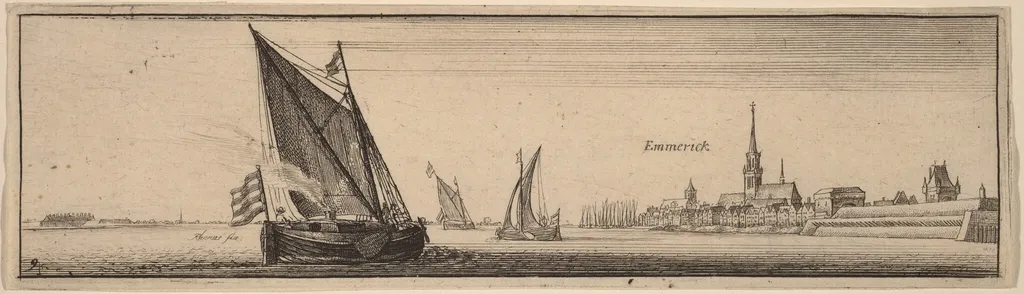
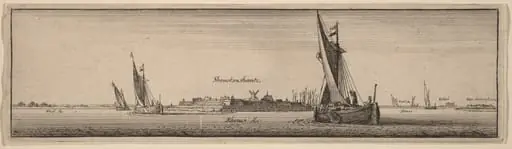
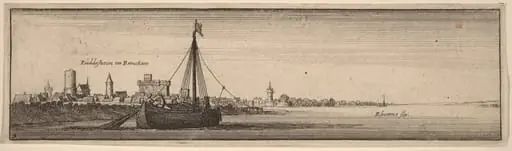
Emmerich is an ink print by the Baroque artist Wenceslaus Hollar. It dates from 1634 and is held in the collection of the National Gallery of Art.
About this work
Overview
Hollar, a Czech artist active in England, produced this work during his early years in London, where he developed a reputation for precise topographical prints.
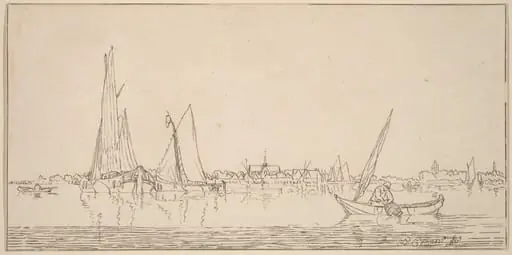
Created around 1634 by Wenceslaus Hollar, *Emmerich* is an etching on laid paper depicting a modest riverside town in the Lower Rhine region. Hollar, a Czech artist active in England, produced this work during his early years in London, where he developed a reputation for precise topographical prints. The image captures a quiet harbor scene with ships and buildings rendered in fine, controlled lines, characteristic of his observational style.
Subject & Meaning
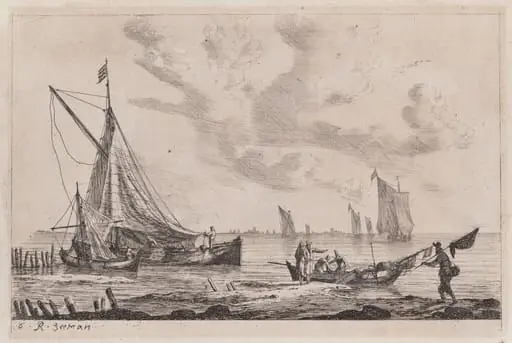
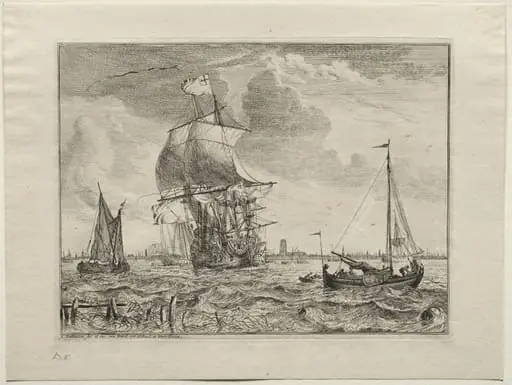
The etching portrays the German town of Emmerich, situated along the Rhine, with three vessels anchored near its shore. A prominent ship with striped sails and a fluttering flag dominates the foreground, while a church steeple and clustered dwellings define the skyline. The label identifies the location, underscoring Hollar’s interest in documenting places with geographic accuracy rather than idealizing them.
Technique & Style
Hollar employed etching to achieve intricate detail, using acid to bite fine lines into a metal plate. The waves, sails, and architectural textures are rendered with delicate, parallel strokes, demonstrating his mastery of line and tonal gradation. The composition balances maritime activity with static urban forms, reflecting a documentary approach that prioritizes clarity and spatial order over dramatic effect.
History & Provenance
Hollar created *Emmerich* shortly after arriving in England, where he worked under the patronage of the Earl of Arundel. The print likely served as part of a broader project to record European landscapes and cities. Though its early ownership is unrecorded, it aligns with Hollar’s known output from this period, which was widely circulated among collectors and scholars interested in topographical accuracy.
Context
In the 1630s, European artists increasingly turned to precise depictions of real places, driven by scientific curiosity and the rise of cartography. Hollar’s work fits within this trend, paralleling the efforts of Dutch and German printmakers who documented towns and harbors. His etchings were valued not as art for art’s sake, but as records of place, useful to travelers, merchants, and antiquarians.
Legacy
Hollar’s prints, including *Emmerich*, contributed to the development of topographical printmaking in Britain. His meticulous technique influenced later generations of engravers, and his extensive body of work remains a visual archive of 17th-century European landscapes. He was buried in Westminster Abbey in 1677, a testament to his standing among London’s artistic community.
Artist & collection
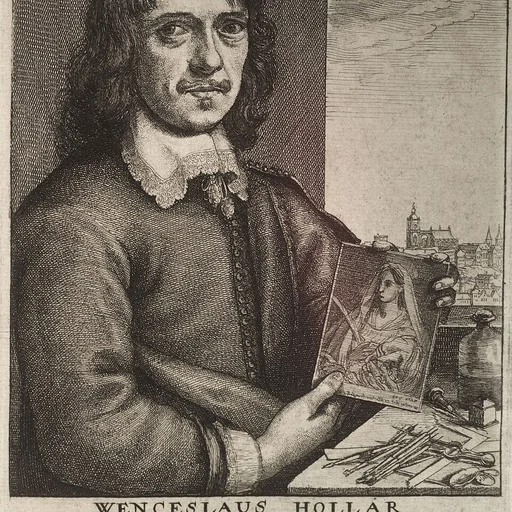
Artist
Wenceslaus Hollar (Czech: Václav Hollar (Czech pronunciation: ), German: Wenzel Hollar; 23 July 1607 – 25 March 1677) was a Czech engraver, etcher and painter.