Artwork
Sfântul Ierarh Nicolae
Sfântul Ierarh Nicolae is an unspecified painting by the Byzantine icon painting artist Hugo Kołłątaj. It is held in the collection of the Moldova National Museum Complex.
About this work
Overview
The work titled “Sfântul Ierarh Nicolae” presents a solitary figure clothed in a vivid red garment and a liturgical mitre, holding an open book. The subject’s long white beard and downward gaze convey a contemplative demeanor. Rendered as a realistic image, the composition emphasizes the material qualities of the robes and the texture of the manuscript.
Subject & Meaning
The figure is identifiable as a senior ecclesiastical person, likely a saintly hierarch, suggested by the ceremonial vestments and the presence of a book, a traditional symbol of theological authority. The downward glance may imply humility, prayerful reflection, or the act of reading sacred texts, aligning with the devotional purpose of such portraiture.
Technique & Style
The image employs a realistic approach, with careful modeling of light and shadow to convey volume, particularly in the folds of the red robe and the beard’s strands. Attention to surface detail, such as the book’s binding, reflects a concern for material fidelity, reminiscent of chiaroscuro methods that contrast illuminated areas with deeper tones to enhance three‑dimensionality.
Context
The title, rendered in Romanian, indicates a cultural setting within Eastern Orthodox tradition, where hierarchs are often venerated in visual art. The use of a red liturgical robe and mitre aligns with the iconographic conventions for high-ranking clergy in Romanian and broader Orthodox visual culture.
Legacy
While specific provenance details are not provided, the work contributes to the visual documentation of religious figures in Romanian art, offering insight into contemporary representations of sanctity and clerical identity within the region’s artistic heritage.
Artist & collection
Artist
This Polish folk painter worked in the late eighteenth and early nineteenth centuries, creating religious scenes with bold colors and simple shapes.
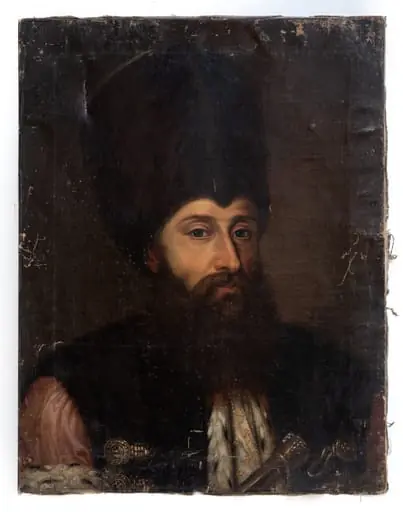 Alexandru Ipsilanti
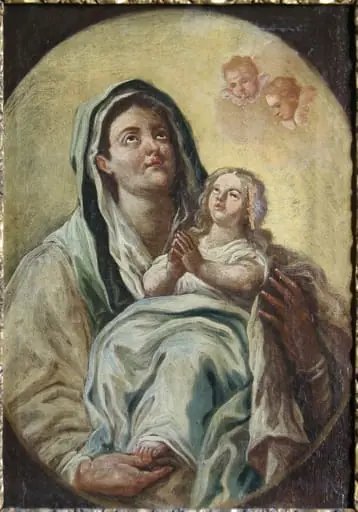 Fecioara Maria cu Pruncul Isus (în Reg. Inv.: Maria cu copilul Isus)
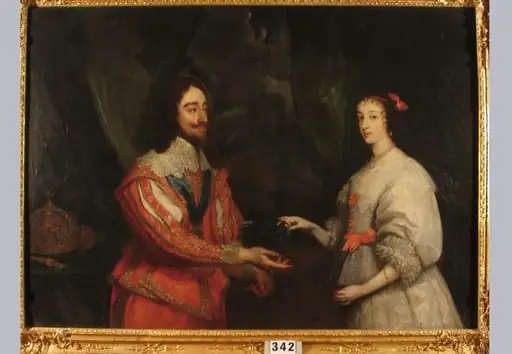 Regele Charles I Stuart al Angliei și soția sa Henrietta Maria de Franța (în Reg. Inv.: Carol I al Angliei și soția sa Henriette din Franța)
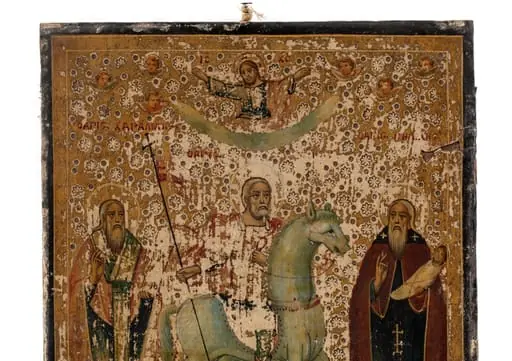 Sfântul Haralambie cu alți doi sfinți
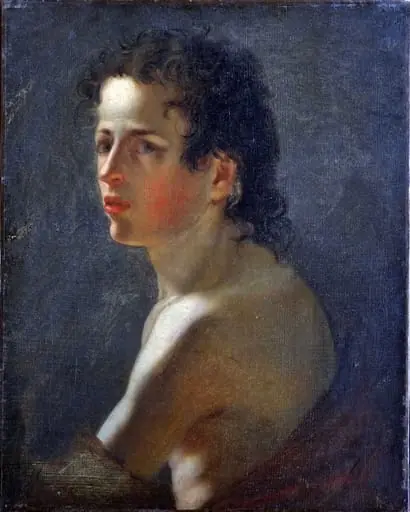 Portret de bărbat
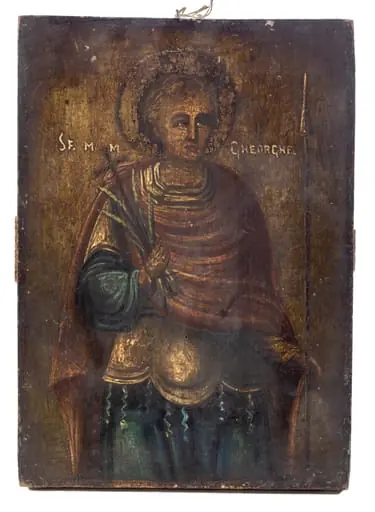 Sfântul Gheorghe
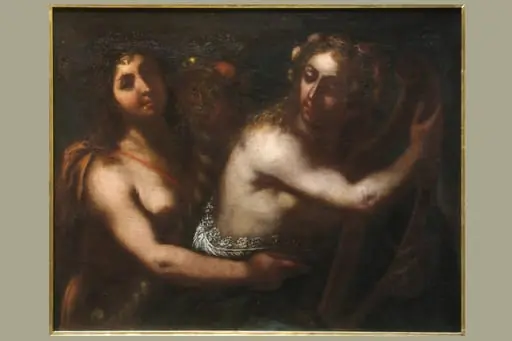 Vertumnus și Pomona (în Reg. Inv.: Vertumnus și Flora)
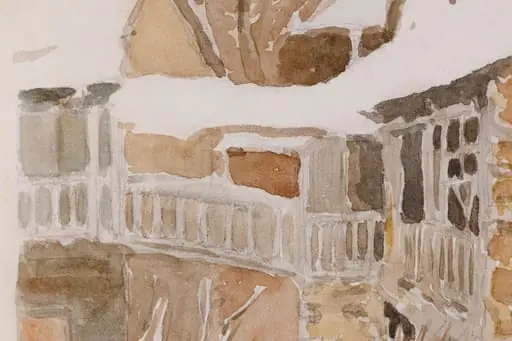 Iarnă
Iarnă
 Maica Domnului, Sfântul Nicolae, Sfântul Gheorghe, Sfântul Mihail
 Sfântul Serghie
 Sfinții Constantin și Elena
 Sfântul Mihail
 Nașterea Domnului (Nașterea lui Crist)
 Icoana cu tematica iconografică Botezul Domnului Iisus Hristos este realizată pe registre: în registrul central, Domnul Iisus Hristos primește Botezul, în râul Iordanului, din partea Sfântului Mare Prooroc și Înaintemergător Ioan Botezătorul, care se află în stânga Mântuitorului. Mântuitorul este înfășurat cu o pânză de culoare gri-cenușiu împrejurul șoldurilor și a coapselor, și are mâinile împreunate pe piept, în semn de supunere, ascultare, smerenie, de bună-voie venind la Botez. În dreapta Lui, este un înger evlavios, în picioare, care Îl așteaptă pe mal, cu un ștergar cenușiu-antracit gata să înveșmânteze Trupul Domnului. Sfântul Ioan Botezătorul este îmbrăcat cu o mantie roșie vermillon și un himation alb gri-punctiform sau o haină din păr. Cerurile albastre sunt deschise și din mijlocul unei mandorle izvorăște o rază de lumină, pe care se pogoară porumbelul, simbolul Sfântului Duh, pe creștetul Mântuitorului. Cromatica este specifică Nordului Transilvaniei: albastru ceruleum, roșu vermillon, galben-ocru, gri, antracit, alb, negru. Arcada sau aureola de ruje roșii încadrează armonios întreaga compoziție iconografică.
 Sfânta Mare Cuvioasă Parascheva de la Iași are crucea brun-bronzie în mâna dreaptă, binecuvântând, și o ramură de finic în mâna stângă. Este îmbrăcată în veșmânt roșu vermillon, cu interiorul căptușit cu gri și brun-bronziu. Sacosul este alb-zinc cu danteluță și guleraș gri-verzui. Sfânta Cuvioasă are părul negru lung, lăsat pe umeri, coroană roșie cu gri-verzui și aureolă. Fondul icoanei este cerul albastru cobalt, acajou-stacojiu și alb. Întreaga compoziție iconografică este încadrată de un chenar decorativ fitomorf, format dintr-o ghirlandă formată din două frunze mari de finic, dispuse acoperitor asemenea unei arcade-bolți. Fondul de ansamblu al icoanei este alb-zinc, cu linii ondulatorii paralele gri-verzui. Inscripția din româno-chirilică se traduce Paraschiva. Cromatica este armonioasă: roșu vermillon, orange, albastru cobalt, acajou stacojiu, verde forest, gri-verzui, bej-crem, bronziu, negru, alb zinc. Icoana este din Nordul Transilvaniei, Nicula.
 Icoana îl reprezintă pe Mântuitorul Iisus Hristos, copil fiind, redat semi-profil, înfășurat cu o mantie roșie vermillon, dar cu umerii goi de copilaș, ținând în mâini, globul pământesc cu crucea deasupra, asemnea unui chivot de biserică. Fondul icoanei este albastru cobalt, în centrul icoanei, creându-se un adânc veșnic. În marginile icoanei, fondul este alb-ivoriu, înconjurat de elemente decorative fitomorfe - 8 trandafiri, ruje, roșii, cu frunze verzi. În registrul inferior este galben-solar.
 Prohodul lui Isus