Artwork
Sfinții 40 de Mucenici
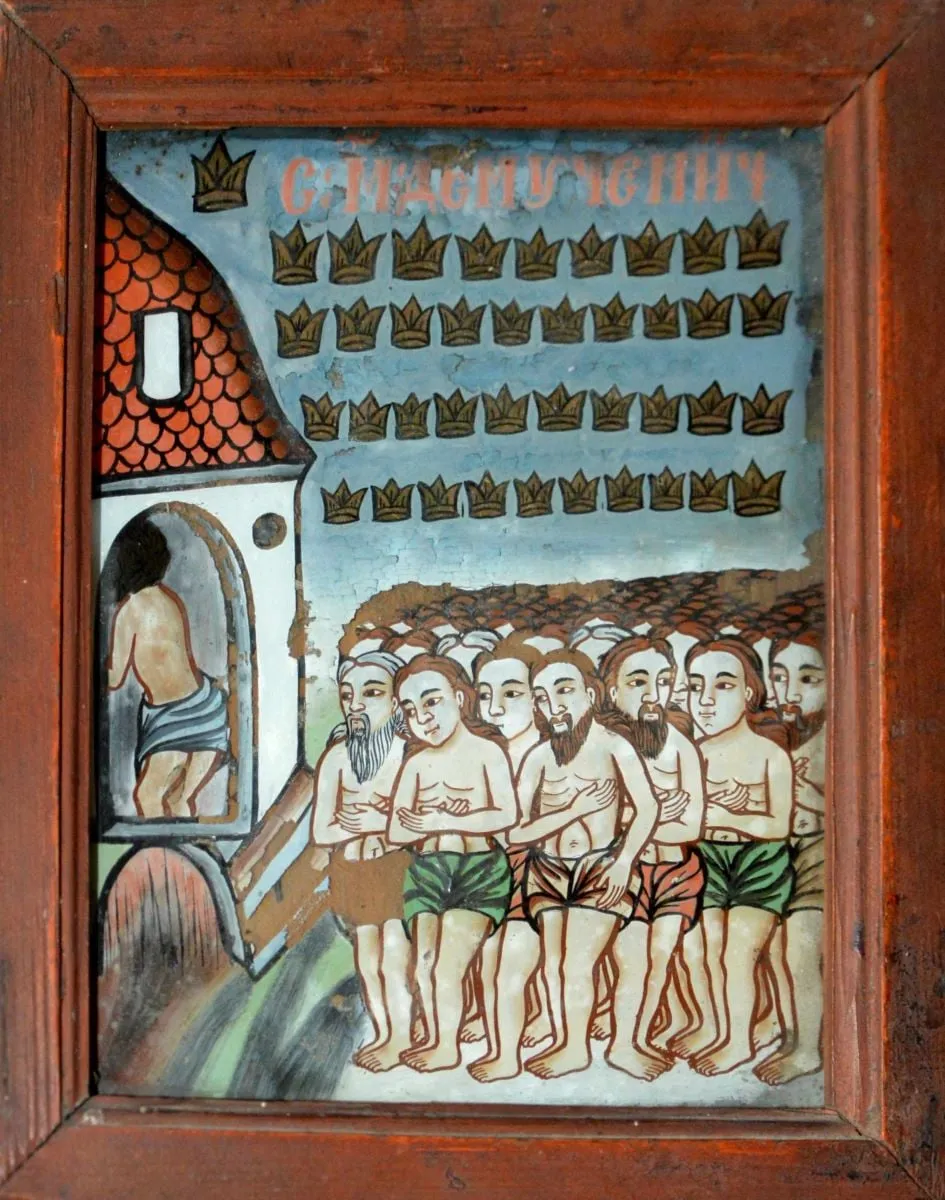
Sfinții 40 de Mucenici is an unspecified painting by the Baroque artist Ioan Pop de la Făgăraș. It is held in the collection of the Alba Iulia Orthodox Archdiocese. This painting depicts forty bare-chested men seated in a row, their hands linked in unity.
About this work
Overview
The composition is restrained, lacking ornate detail, and emphasizes collective presence over individual expression.
This painting depicts forty bare-chested men seated in a row, their hands linked in unity. Behind them, a flat blue wall bears repeated crown motifs. To the left, a figure stands partially within a modest thatched structure. The composition is restrained, lacking ornate detail, and emphasizes collective presence over individual expression. The work is attributed to Ioan Pop de la Făgăraș, a regional painter active in the 19th century.
Subject & Meaning
The figures are understood to represent the Forty Martyrs of Sebaste, Christian soldiers who died for their faith in the early fourth century. Their linked hands suggest solidarity in suffering, while the crowns symbolize martyrdom and heavenly reward. The solitary figure near the building may signify a witness or guardian, reinforcing the sacred nature of the scene without introducing narrative complexity.
Technique & Style
The painting employs a simplified, almost folkloric style with flat planes of color and minimal modeling. Figures are rendered with uniformity, their features reduced to essential lines. The blue background and repetitive crowns create a rhythmic, symbolic backdrop rather than a spatial environment. Brushwork is direct and unadorned, prioritizing clarity and devotional function over illusionistic depth.
History & Provenance
Created in the 19th century, the work originates from a religious context in Transylvania, likely commissioned for a local church or private devotion. It reflects the enduring tradition of icon painting in Romanian Orthodox communities, adapted with regional stylistic traits. The attribution to Ioan Pop de la Făgăraș is based on stylistic comparison with other documented works from his oeuvre.
Context
This image belongs to a broader tradition of Orthodox iconography that visualized saints as models of steadfast faith. In rural Transylvania, such depictions served both liturgical and educational roles, reinforcing communal identity through familiar sacred narratives. The absence of elaborate architecture or naturalism aligns with local artistic practices that favored symbolic clarity over realism.
Legacy
The painting exemplifies how regional artists adapted canonical religious themes using accessible visual language. Its enduring presence in local collections underscores its role in sustaining devotional practices. While not widely known beyond its region, it remains a significant artifact of 19th-century Romanian religious art, reflecting the interplay between orthodoxy and folk expression.
Artist & collection
Artist
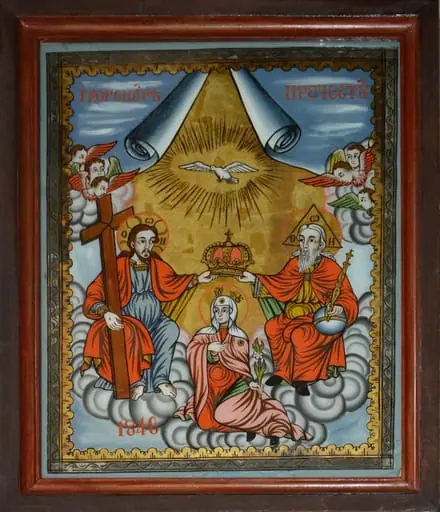
Ioan Pop de la Făgăraș painted religious scenes in the mid-1800s, like *Încoronarea Fecioarei* (1846) and *Duminica Floriilor*.
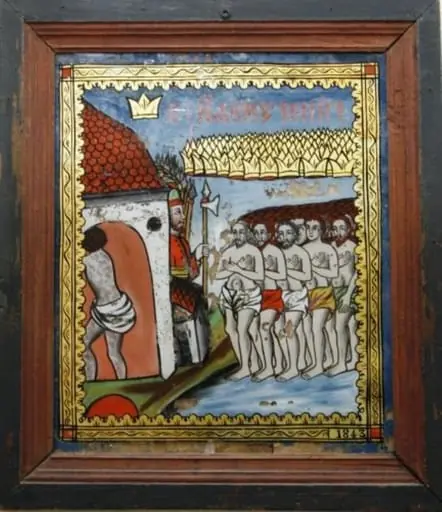 Sfinții 40 de mucenici
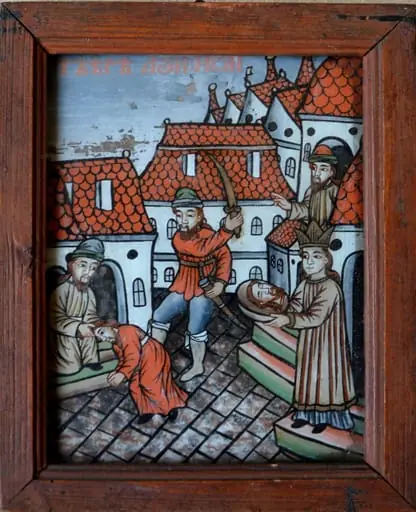 Tăierea capului Sf. Ioan Botezătorul
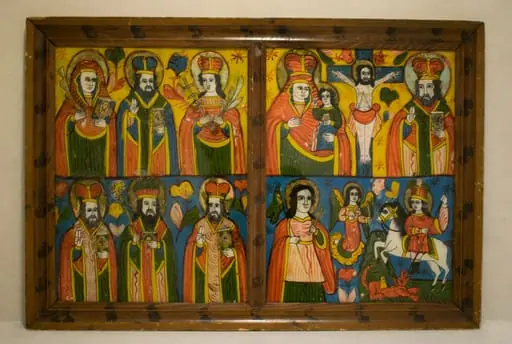 Icoana este pictată în oglindă, pe un suport de sticlă de formă dreptunghiulară în ax orizontal. Sunt reprezentate patru scene, despărțite orizontal printr-o linie neagră iar vertical printr-o stinghie îngustă de lemn, datorită lățimii mari a sticlei. În primul câmp apare un sfânt ierarh, tânăr(posibil sf. Nicolae, deși nu e reprezentarea canonică),, binecuvîntînd cu dreapta, în stânga ținînd Evanghelia, flancat de două sfinte. Cea din dreapta corespunde reprezentării sf. Paraschiva, cu o cruce în mâna dreaptă și o ramură în stânga. Cea din dreapta, cu o carte în stânga și o ramură în cealaltă, ar corespunde Maicii Domnului. A doua scenă îl are în centru pe Isus Hristos răstignit pe cruce, de o parte și de alta pe Maica Domnului Hodighitria cu Pruncul, iar de cealaltă pe Sfântul Ioan Evanghelistul în postura de ierarh.Registrele de jos: stânga. Sfinții trei ierarhi(Grigorie, Vasile și Ioan) în veșminte arhierești, cu mitră pe cap, dreapta: sfântul Gheorghe, în costum ostășesc, omorînd balaurul(de formă canină) Alături de acesta mai apare o sfântă cu o cruce în mână și un steag în cealaltă, probabil o confuzie(fata de împărat pe care o salvează sfântul asimilată unei sfinte. În fața calului, pe un nor, Arhanghelul Gavriil. Chipurile sunt expresive, contururile destul de precise, compoziția foarte încărcată, de la densitatea personajelor la abundența detaliilor(falduri dese, realizate prin linii drepte și ondulate, transversale și verticale, câmpul umplut cu motive florale și astrale). Câmp de culoare galbenă în registrele superioare și de culoare albastră în cele inferioare, împodobit cu stele albe și roșii și motive florale. Paleta cromatică este variată:alb, roșu, galben, verde, albastru La aureole, cărți, ramuri, etc, este folosită foița de aur. Rama lăcuită, de culoare brun roșcat, decorată cu puncte mari,negre. Dosul este alcătuit din două bucăți de placaj.
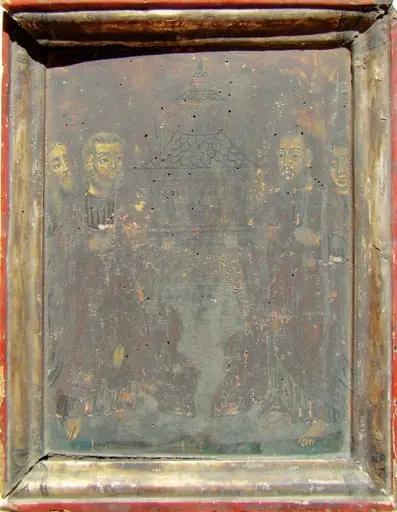 Soborul Sfinților Apostoli
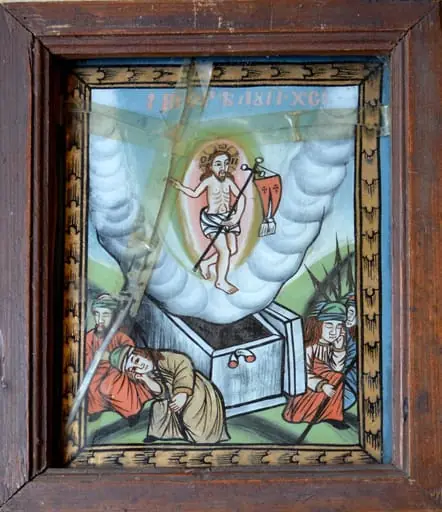 Învierea Domnului
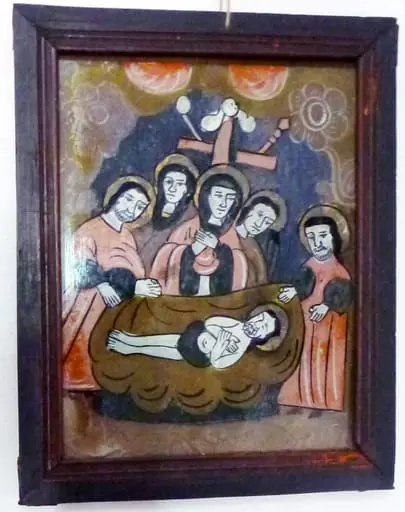 Prohodul Domnului
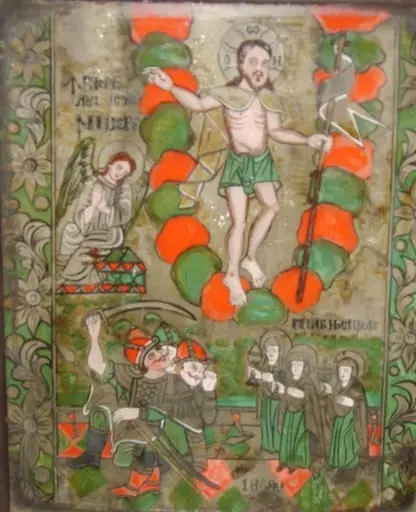 Învierea lui Iisus
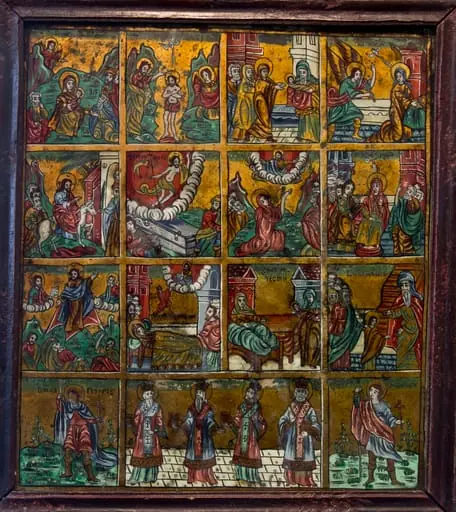 Prăznicar – Scene din viața lui Iisus