Artwork
Untitled
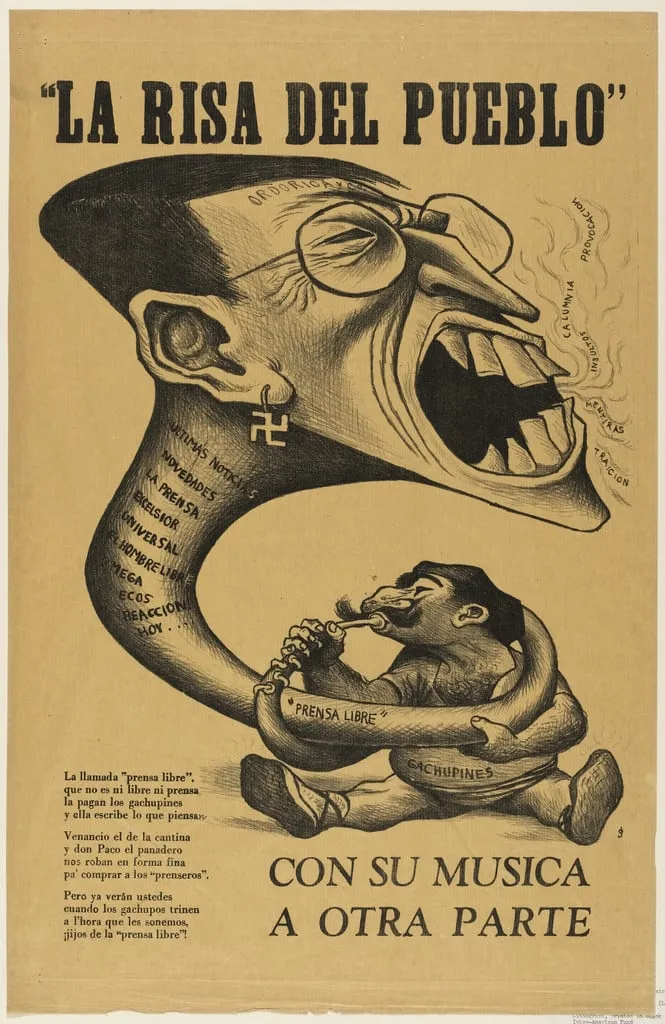
Untitled is an ink print by Isidoro Ocampo. It dates from 1939 and is held in the collection of the Museum of Modern Art.
About this work
Overview
Though best known for muralism, Ocampo contributed significantly to graphic arts through institutions like the Taller de Gráfica Popular.
Isidoro Ocampo created this 1939 lithograph during a period of intense engagement with Mexico’s printmaking collectives. Though best known for muralism, Ocampo contributed significantly to graphic arts through institutions like the Taller de Gráfica Popular. His output was limited by teaching and organizational duties, yet this work exemplifies the politically charged aesthetic of his circle, using printmaking as a tool for social commentary rather than decoration.
Subject & Meaning
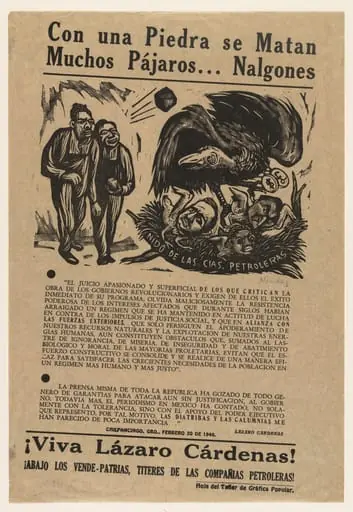
The image contrasts a monstrous, laughing human-animal head with a small, chained figure holding a sign reading 'prensa libre.' The exaggerated features and chaotic expression suggest ridicule toward institutional power, while the chained figure symbolizes suppressed voices. The floating text within the head implies internalized propaganda. The work critiques the illusion of press freedom under authoritarian structures, using grotesque humor to expose hypocrisy.
Technique & Style
Executed in lithography, the print employs bold, high-contrast lines and dense ink application to amplify its satirical tone. The artist uses distortion and scale to heighten emotional impact, with the colossal head dominating the composition. Text is integrated as visual element, not mere caption, blending typography with imagery. The rough, expressive quality reflects the Taller’s commitment to accessible, handcrafted political art over refined aesthetics.
History & Provenance
Produced in 1939, the work emerged from Ocampo’s active years within Mexico’s printmaking networks, alongside figures like Leopoldo Méndez. It was likely circulated as a political broadside or educational print, common in the Taller’s output. Few of Ocampo’s prints survive in public collections, partly due to his limited production and the ephemeral nature of activist graphics. Its current whereabouts reflect the fragmented archival history of mid-century Mexican political prints.
Context
In late 1930s Mexico, artists aligned with the post-revolutionary state used graphic arts to promote literacy, civic values, and critique corruption. The Taller de Gráfica Popular, co-founded by Ocampo, produced posters for labor unions, schools, and political campaigns. This piece responds to tensions between state rhetoric and actual press censorship, reflecting broader debates about democracy, media control, and the role of art in public life.
Legacy
Ocampo’s lithograph remains a representative example of Mexican political printmaking’s rhetorical power. Though not widely exhibited today, its visual language influenced later generations of activist artists in Latin America. The fusion of satire, symbolism, and social critique in this work continues to inform contemporary practices that use graphic art to interrogate power, making it a quiet but enduring contribution to the region’s visual resistance traditions.
Artist & collection
Artist
Isidoro Ocampo (20 June 1910, Veracruz — 4 February 1983, Mexico City) was a Mexican artist during the Mexican Muralism era, best known for his graphic work.