Artwork
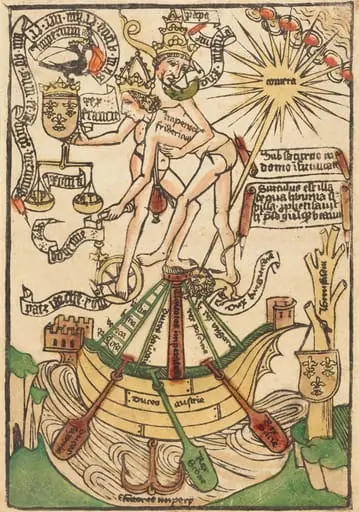
Allegory of the Emperor and the Pope
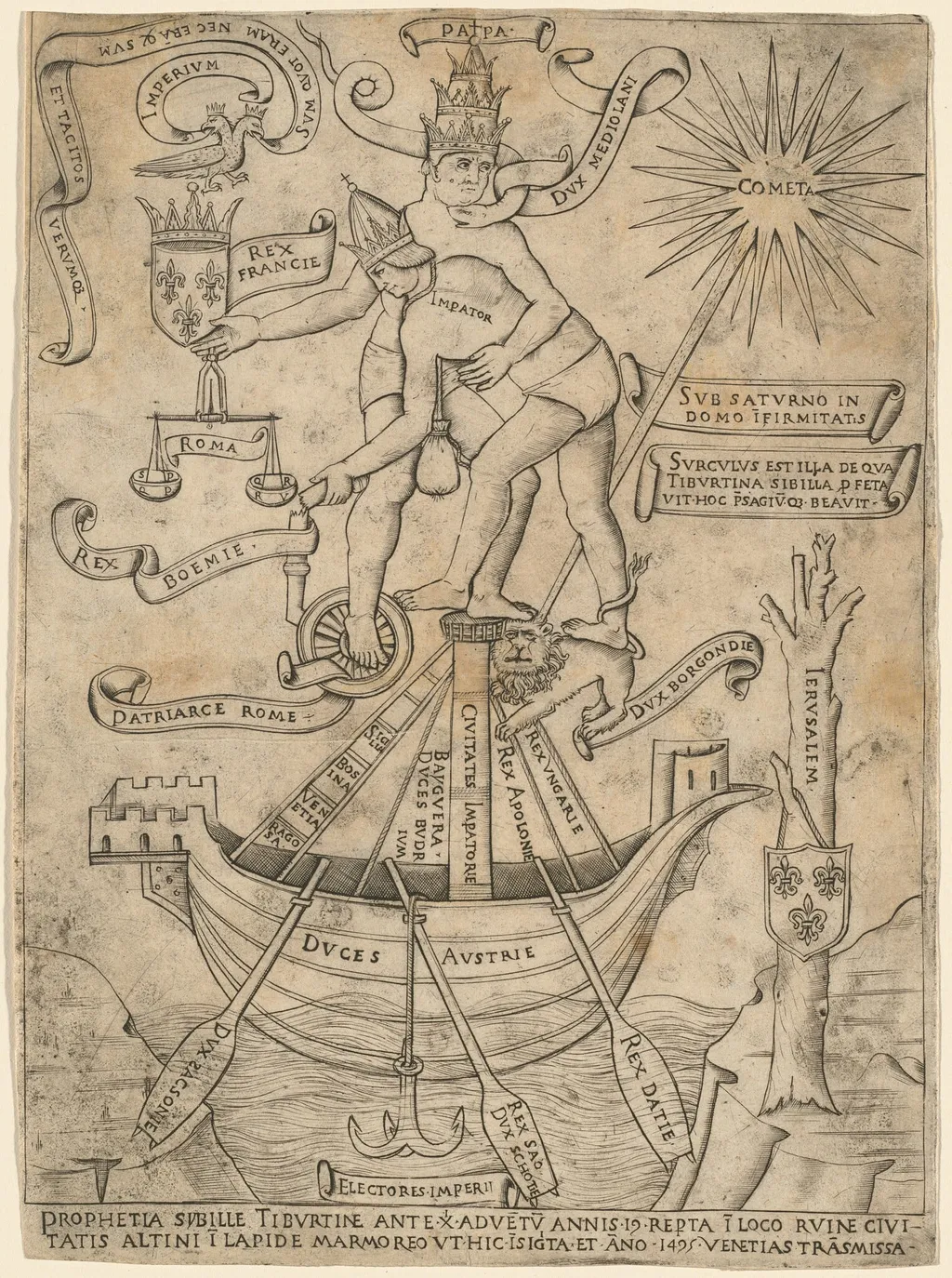
Allegory of the Emperor and the Pope is an ink print by the Renaissance artist Italian 15th Century. It dates from 1495 and is held in the collection of the National Gallery of Art.
About this work
The engraving features intricate details, including a sunburst in the top-right corner and a hand emerging from the water on the right side.
This engraving depicts a complex scene with a man and a woman standing on a boat, surrounded by various symbols and objects. The man, wearing a crown, holds a scepter in his right hand and a shield with a fleur-de-lis in his left. The woman, also crowned, grasps a scepter and a banner with the words "Rex Francie" (King of France). The boat is adorned with a lion's head at the bow and a castle at the stern.
The engraving features intricate details, including a sunburst in the top-right corner and a hand emerging from the water on the right side. The overall composition is dense and symbolic, inviting the viewer to decipher its meaning.
This engraving is an example of Renaissance art, specifically from the Italian 15th Century.
Overview
The print titled *Allegory of the Emperor and the Pope* is an engraving that presents a densely populated scene on a boat. Central figures include a crowned man holding a scepter and a shield bearing a fleur‑de‑lis, and a crowned woman clutching a scepter and a banner inscribed “Rex Francie.” The vessel is decorated with a lion’s head at the prow and a castle at the stern, while a sunburst occupies the upper right and a hand emerges from the water on the right.
Subject & Meaning
The composition juxtaposes imperial and papal authority with royal French symbolism, suggesting a political commentary on the balance of power among the emperor, the pope, and the French monarchy. The fleur‑de‑lis, the “Rex Francie” banner, and the lion’s head function as allegorical markers, inviting viewers to interpret the relationships and tensions between secular and ecclesiastical rule during the Renaissance.
Technique & Style
Executed as an engraving, the work demonstrates the fine line work and intricate cross‑hatching typical of Renaissance printmaking. The artist achieves depth through dense shading, while the crowded arrangement of symbols reflects the period’s penchant for allegorical complexity. The inclusion of a sunburst and a hand emerging from water adds dramatic contrast and narrative intrigue.
History & Provenance
The print originates from the Renaissance era, a time when allegorical prints were used to disseminate political ideas. While the specific artist and date are not recorded in the supplied data, the work’s iconography aligns with late‑15th to early‑16th‑century European print traditions that circulated among courts and intellectual circles.
Context
During the Renaissance, visual allegories served as vehicles for commentary on the shifting dynamics between secular rulers and the papacy. The presence of French royal symbols alongside imperial and papal regalia reflects contemporary diplomatic negotiations and the contested authority of the Holy Roman Empire, the French crown, and the Vatican.
Artist & collection

Artist
This anonymous Italian engraver from the 1490s carved images that could be peeled apart like paper dolls—each knot in the "First Knot" print was cut from a single sheet so you could lift the loops right off the page.

![The Destruction of the Egyptian Idols [verso], by Italian 15th Century](https://artifactworldgallery.com/img/italian-15th-century--the-destruction-of-the-egyptian-idols-verso--646d3c2b8098cfee-w320.webp)
![The Flight into Egypt [recto], by Italian 15th Century](https://artifactworldgallery.com/img/italian-15th-century--the-flight-into-egypt-recto--8f4d5275d7f90f98-w320.webp)
![The Triumphal Chariot of Maximilian I (The Great Triumphal Car) [plate 1 of 8], by Albrecht Dürer](https://artifactworldgallery.com/img/albrecht-durer--the-triumphal-chariot-of-maximilian-i-the-great-triumphal-ca--4840429519ebb12d-w320.webp) The Triumphal Chariot of Maximilian I (The Great Triumphal Car) [plate 1 of 8]
The Triumphal Chariot of Maximilian I (The Great Triumphal Car) [plate 1 of 8] The Abduction of Proserpina by Pluto (2nd version)
!["Do Not Turn Back When You Arrive at the End" [fol. 26 verso / 27 recto], by French early 16th Century](https://artifactworldgallery.com/img/french-early-16th-century--do-not-turn-back-when-you-arrive-at-the-end-fol-26-verso-27--e11e5d3478112a7e-w320.webp) "Do Not Turn Back When You Arrive at the End" [fol. 26 verso / 27 recto]
"Do Not Turn Back When You Arrive at the End" [fol. 26 verso / 27 recto]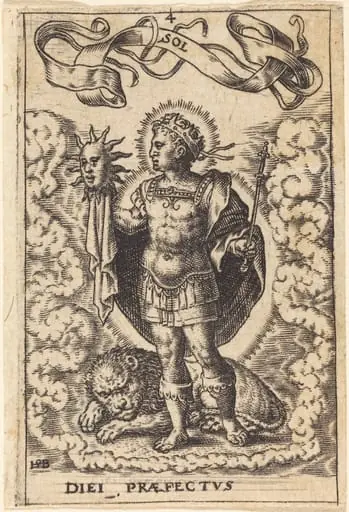 Sun
Sun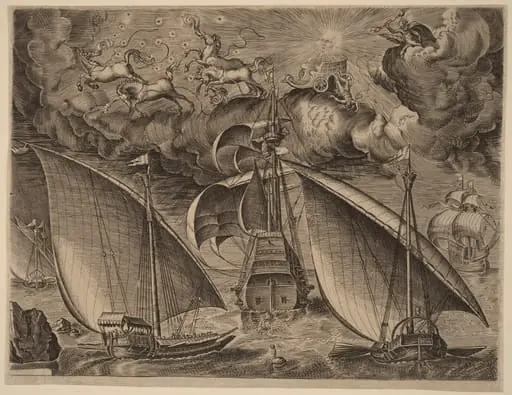 Two Galleys behind an Armed Three-Master with Phaethon and Jupiter in the Sky
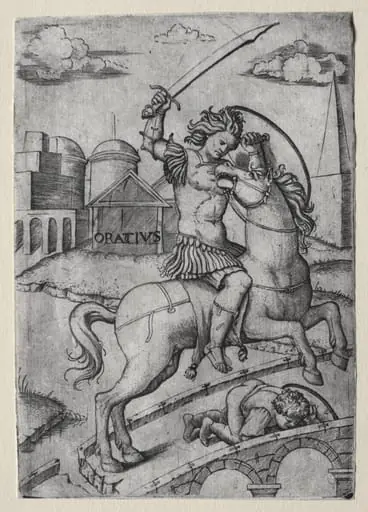 Horatius Cocles Defending the Sublician Bridge
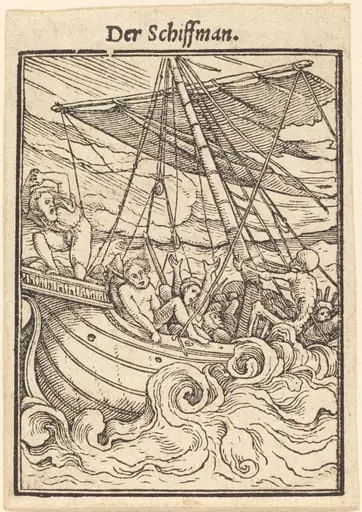 Der Schiffman (The Sailor)
 Rudolph II in Chariot Drawn by Lion and Eagle
 Satyr with Twisted Legs
 Mars
Mars Saint Rupertus
 Allegory of the Meeting of Pope Paul II and Emperor Frederick III