Artwork
Madonna and Child with Saints John and Joseph [recto]
![Madonna and Child with Saints John and Joseph [recto], by Italian 17th Century, chalk, 1601](https://artifactworldgallery.com/img/italian-17th-century--madonna-and-child-with-saints-john-and-joseph-recto--9af1da01f3814a36-w1024.webp)
Madonna and Child with Saints John and Joseph [recto] is a chalk drawing by the Baroque artist Italian 17th Century. It dates from 1601 and is held in the collection of the National Gallery of Art.
About this work
Overview
This red chalk drawing on laid paper presents a preliminary study of the Virgin Mary with the Christ Child, accompanied by Saints John the Baptist and Joseph.
This red chalk drawing on laid paper presents a preliminary study of the Virgin Mary with the Christ Child, accompanied by Saints John the Baptist and Joseph. Executed with swift, fluid strokes, the composition emphasizes motion and posture over refined detail. The paper’s texture remains visible, and areas of negative space are left intentionally bare, suggesting an exploratory phase rather than a finished work.
Subject & Meaning
The grouping centers on the Virgin and Child, flanked by two male saints who observe or gesture toward them. Their arrangement is informal, lacking the symmetry typical of devotional altarpieces. This suggests the drawing served as a compositional trial, testing relationships between figures rather than conveying a fixed theological message. The focus is on human presence and interaction.
Technique & Style
Red chalk was used with minimal pressure, producing light, agile lines that capture the flow of drapery and subtle shifts in posture. The artist avoided modeling or shading, relying instead on contour and gesture to suggest volume. The absence of fine detail and the open areas of paper reflect a working method aimed at rapid exploration of form and spatial dynamics.
History & Provenance
The drawing’s origin is tied to early Renaissance workshop practices, where such sketches were used to plan larger compositions. While its exact provenance is undocumented, its material and technique align with studies attributed to artists active in central Italy during the late 15th or early 16th century. It likely circulated among apprentices or was retained by the artist for future reference.
Context
During this period, preparatory drawings in chalk were standard for composing religious scenes before painting or sculpture. Artists tested groupings and gestures on paper to resolve spatial and emotional dynamics. This sketch reflects a broader shift toward naturalistic human expression, prioritizing movement and psychological presence over rigid iconographic conventions.
Legacy
Such drawings became foundational to the development of Renaissance compositional planning. Though not intended for public display, they reveal the artist’s process and inform later interpretations of how sacred narratives were constructed visually. Today, they are valued as intimate records of creative decision-making, bridging concept and final form.
Artist & collection

Artist
This Italian artist worked in the 17th century, making engravings, ink drawings, and oil paintings.

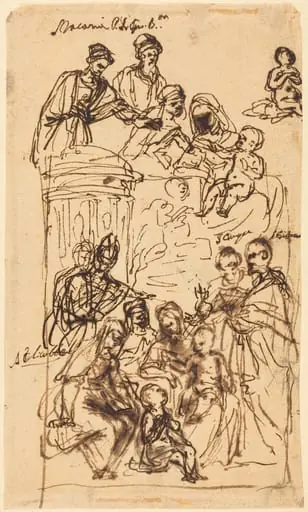 The Madonna and Child with Saints
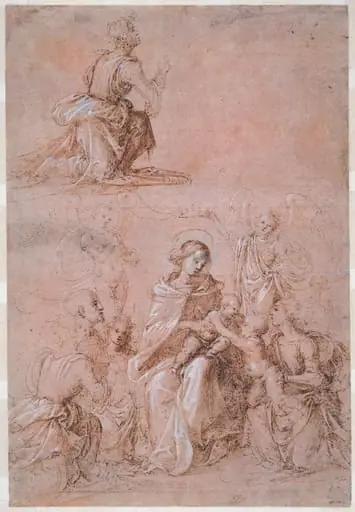 The Virgin and Child Surrounded by Saints and Angels
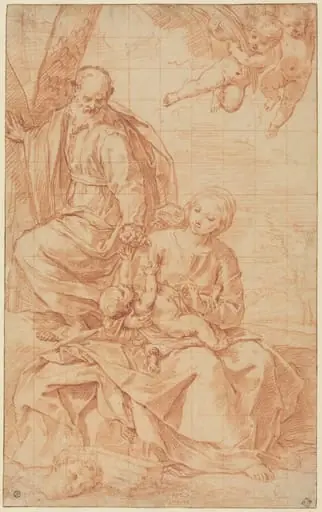 The Rest on the Flight into Egypt, or The Miracle of the Palm Tree
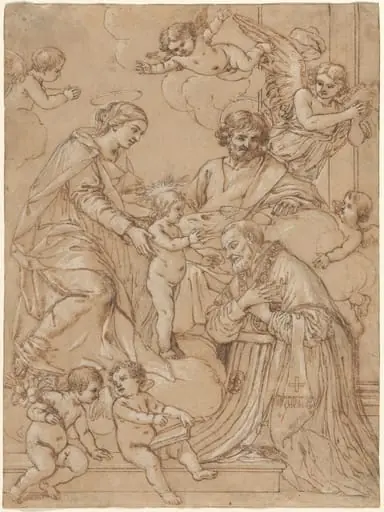 The Holy Family with Saint Philip Neri in Adoration, an Angel, and Putti
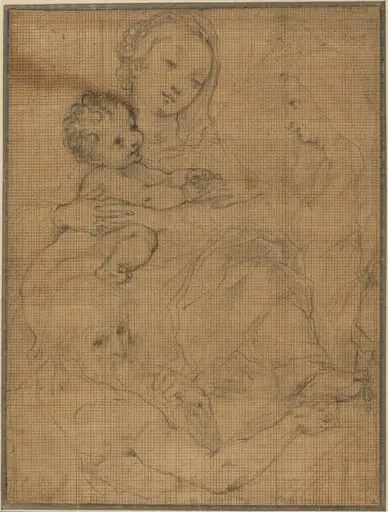 Mystic Marriage of Saint Catherine with Saint Jerome
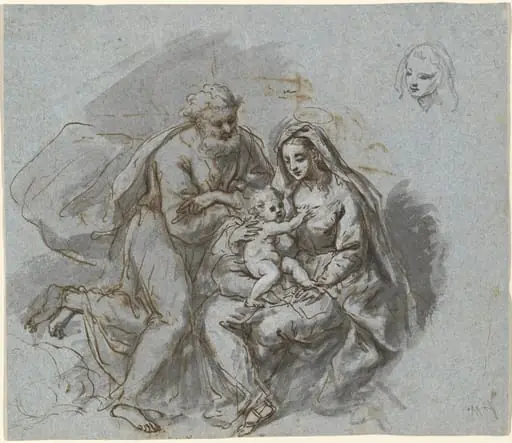 The Holy Family
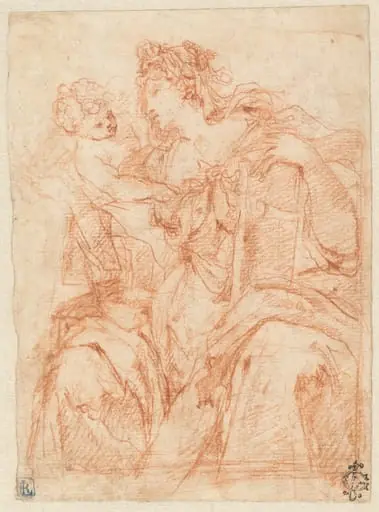 Study for the Sibyl of the Casa Budrioli
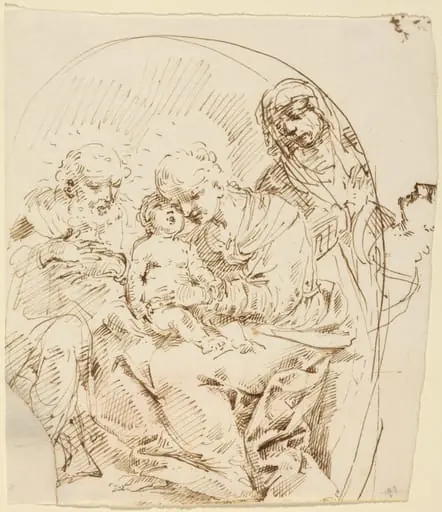 Holy Family with Saint Anne and Female Head in Profile
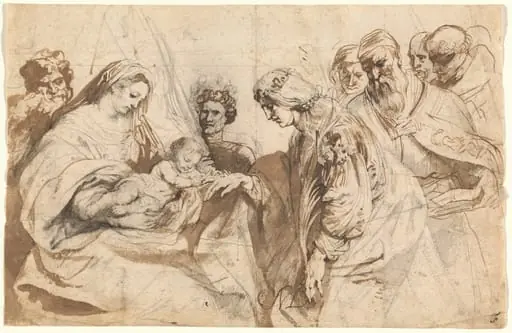 The Mystic Marriage of Saint Catherine
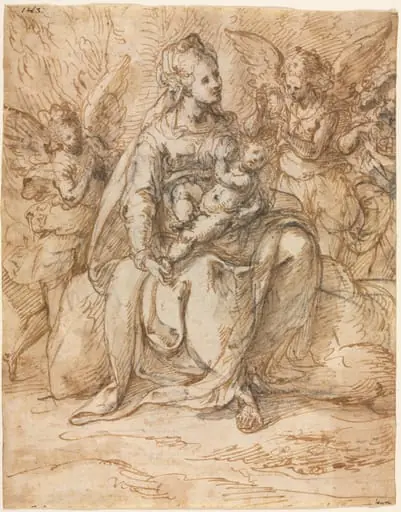 Madonna and Child with Angels
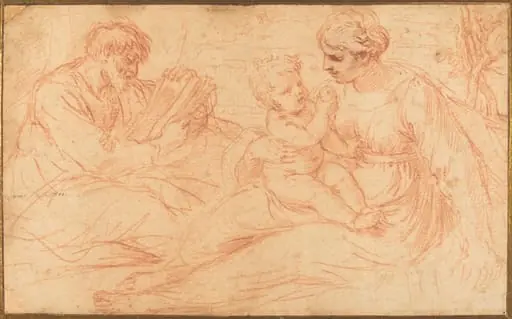 The Holy Family
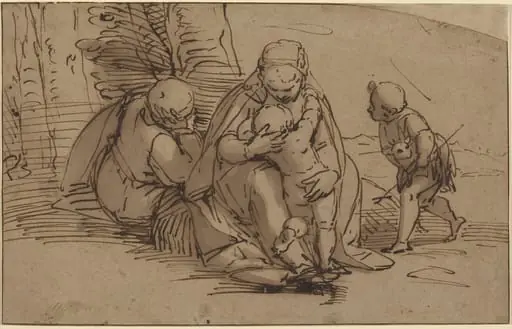 Holy Family with Infant Saint John