Artwork
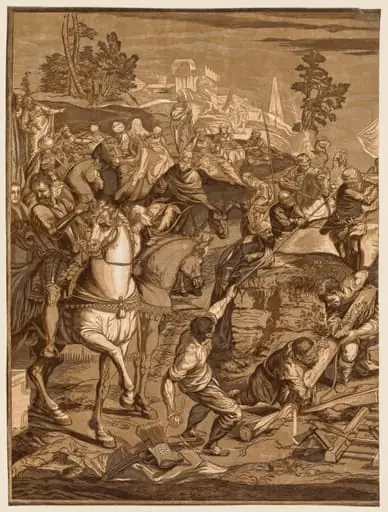
The Crucifixion [left plate]
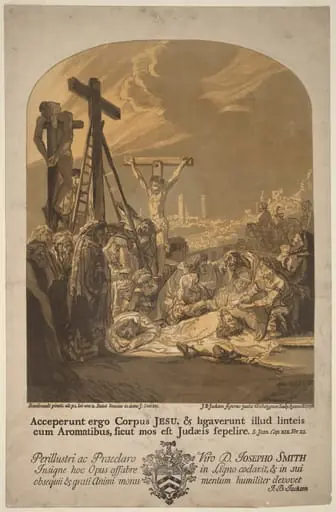
![The Crucifixion [left plate], by John Baptist Jackson, ink, 1741](https://artifactworldgallery.com/img/john-baptist-jackson--the-crucifixion-left-plate--3dc106b1e6500937-w1024.webp)
The Crucifixion [left plate] is an ink print by the Baroque artist John Baptist Jackson. It dates from 1741 and is held in the collection of the National Gallery of Art.
About this work
Overview
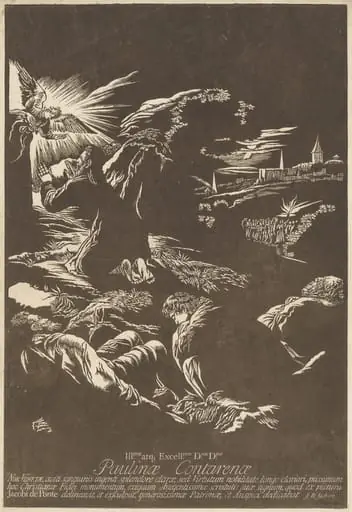
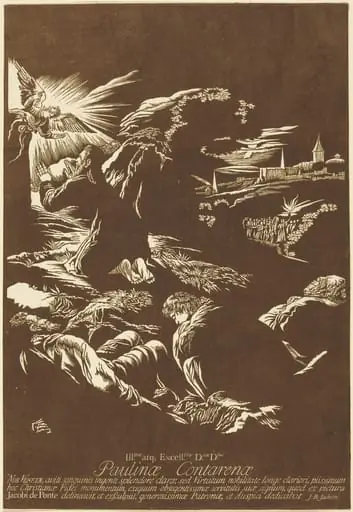
John Baptist Jackson, an eighteenth‑century British printmaker, produced a chiaroscuro woodcut titled *The Crucifixion* in 1741. Executed as a trial proof of the key block, the print belongs to the religious genre and is rendered entirely in black, employing deep contrasts to model the scene.
Subject & Meaning
The image centers on the crucified Christ, whose figure dominates a darkened backdrop. Around the cross a crowd of mourners—some kneeling, others standing—expresses grief and despair, their contorted faces conveying a solemn reverence for the event.
Technique & Style
Jackson’s method combines chiaroscuro woodcut with oil‑based inks, allowing subtle overprinting and a broad tonal range despite the monochrome palette. Heavy embossing accentuates highlights, while bold line work and pronounced shadows create depth reminiscent of Baroque dramatic lighting.
History & Provenance
Active in Paris and Venice, Jackson frequently reproduced oil paintings as prints, adapting their compositions for the woodcut medium. This particular proof serves as a test of the key block before the full edition was printed, illustrating his experimental approach to print production.
Context
The work reflects the Baroque period’s fascination with intense emotional expression and theatrical composition. Its stark chiaroscuro and emphasis on human suffering align with contemporary religious imagery intended to evoke contemplation among viewers.
Artist & collection

Artist
John Baptist Jackson (1701–1780) was a British artist, a woodcut printmaker of the eighteenth century.

![The Marriage at Cana [left plate], by John Baptist Jackson](https://artifactworldgallery.com/img/john-baptist-jackson--the-marriage-at-cana-left-plate--22bae83d46cc40b5-w320.webp)