Artwork
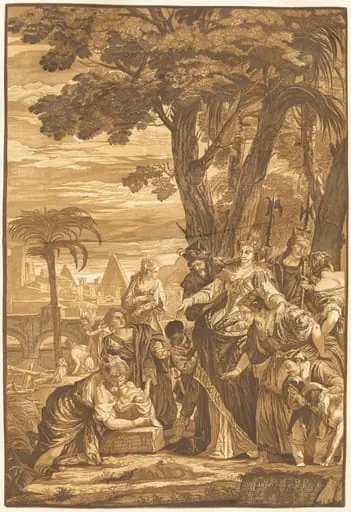
The Finding of Moses
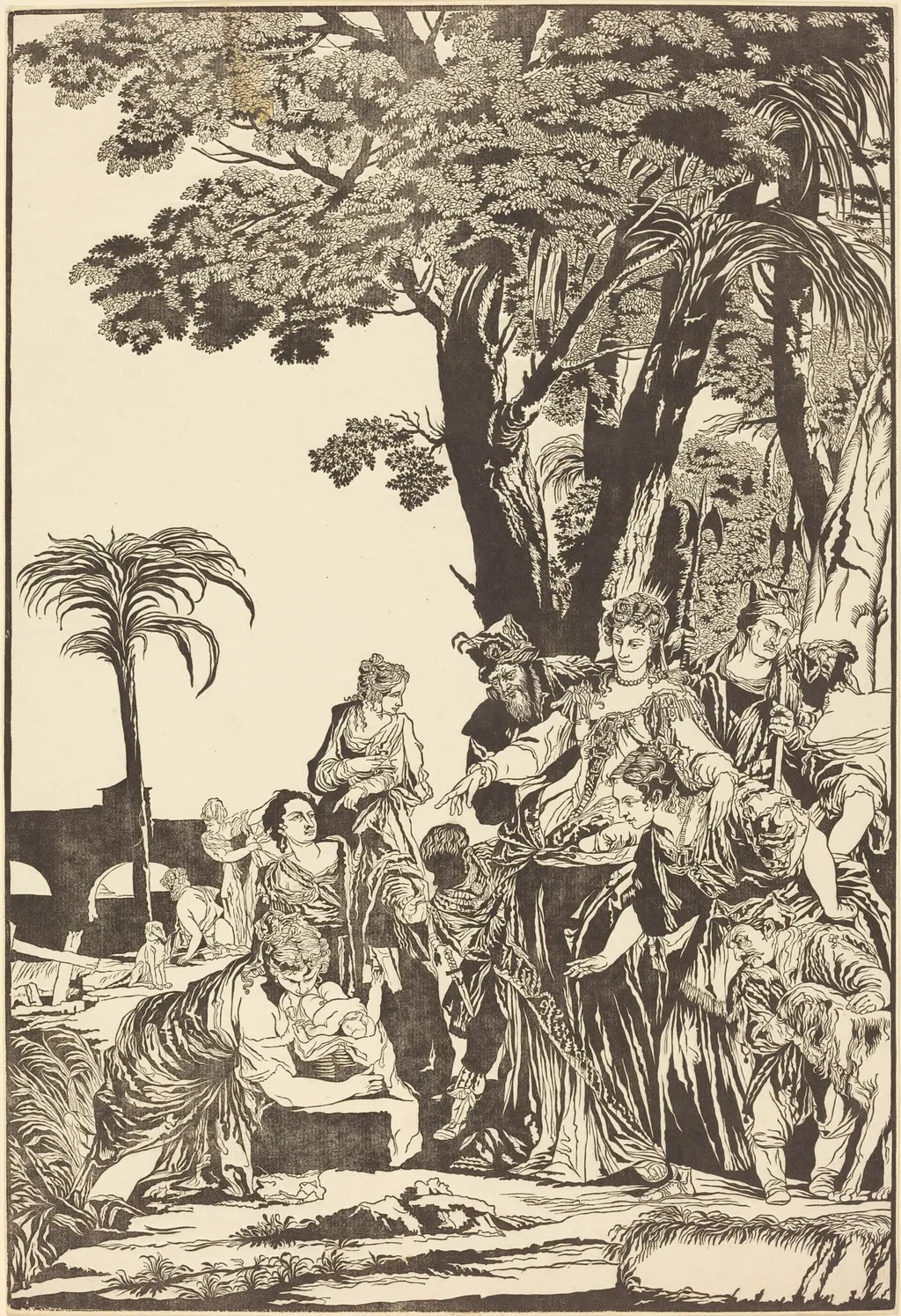
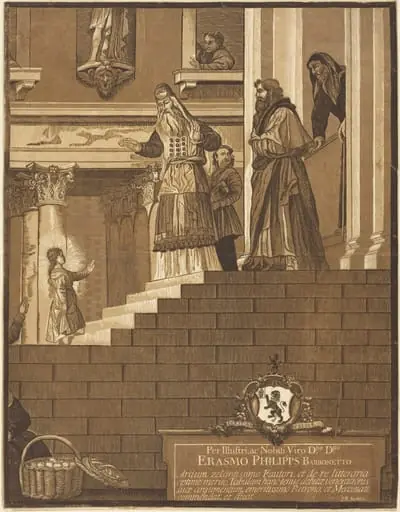
The Finding of Moses is an ink print by the Baroque artist John Baptist Jackson. It dates from 1741 and is held in the collection of the National Gallery of Art.
About this work
Overview
The Finding of Moses is a 1741 chiaroscuro woodcut in black by John Baptist Jackson, a British printmaker known for innovative woodcut techniques. This trial proof of the key block showcases his characteristic use of chiaroscuro.
Subject & Meaning
The print depicts a pivotal moment from the biblical story of Moses, where a group gathers around the infant Moses in a basket. The scene conveys reverence and awe among the figures, with a sense of impending drama.
Technique & Style
Jackson employed chiaroscuro to create depth and three-dimensionality, with heavy shadows in the background contrasting with the illuminated figures. His technique added volume to the forms, enhancing the dramatic effect.
History & Provenance
Created in 1741, this woodcut reflects Jackson's experience working in Paris and Venice. As a trial proof of the key block, it represents an early stage in the print's production process.
Context
Part of 18th-century European printmaking, this work sits within the broader tradition of biblical themes in art. Jackson's innovations in woodcutting contributed to the medium's evolution during this period.
Legacy
While specific lasting impacts of *The Finding of Moses* are not detailed, Jackson's chiaroscuro woodcuts, including this piece, influenced subsequent generations of printmakers in their use of shading and depth techniques.
Artist & collection

Artist
John Baptist Jackson (1701–1780) was a British artist, a woodcut printmaker of the eighteenth century.

![The Marriage at Cana [left plate], by John Baptist Jackson](https://artifactworldgallery.com/img/john-baptist-jackson--the-marriage-at-cana-left-plate--22bae83d46cc40b5-w320.webp)
![The Crucifixion [left plate], by John Baptist Jackson](https://artifactworldgallery.com/img/john-baptist-jackson--the-crucifixion-left-plate--3dc106b1e6500937-w320.webp)
![The Crucifixion [right plate], by John Baptist Jackson](https://artifactworldgallery.com/img/john-baptist-jackson--the-crucifixion-right-plate--72960250aa8adc6f-w320.webp)
![The Crucifixion [center plate], by John Baptist Jackson](https://artifactworldgallery.com/img/john-baptist-jackson--the-crucifixion-center-plate--f8880f1dfff50dc3-w320.webp)
![The Entombment [recto], by John Baptist Jackson](https://artifactworldgallery.com/img/john-baptist-jackson--the-entombment-recto--a6e32e731f5b1bab-w320.webp)