Artwork
The Mystic Marriage of Saint Catherine
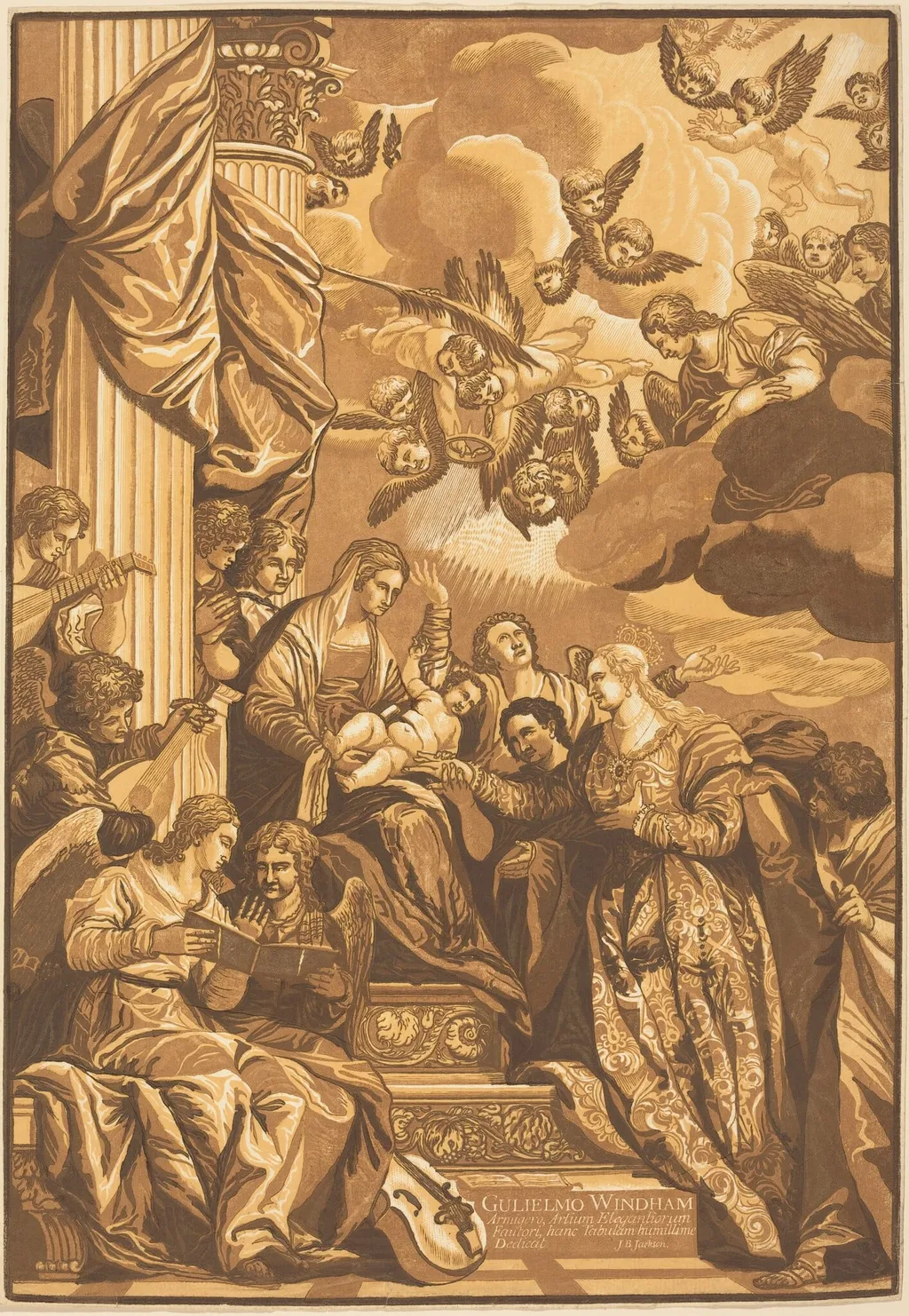
The Mystic Marriage of Saint Catherine is an ink print by the Baroque artist John Baptist Jackson. It dates from 1740 and is held in the collection of the National Gallery of Art.
About this work
Overview
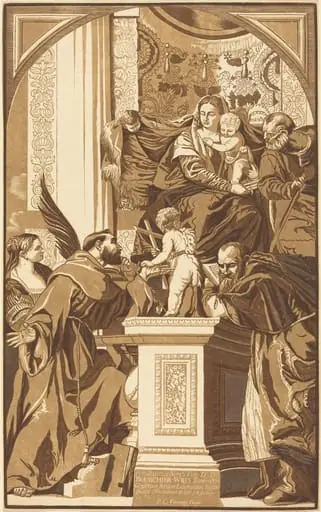
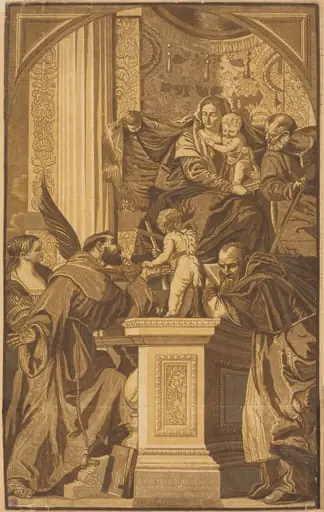
Created in 1740 by John Baptist Jackson, this chiaroscuro woodcut in brown tones depicts the mystical union of Saint Catherine with the Christ Child.
Created in 1740 by John Baptist Jackson, this chiaroscuro woodcut in brown tones depicts the mystical union of Saint Catherine with the Christ Child. Executed as a trial proof, it reflects Jackson’s experimentation with printmaking techniques during his time in Paris and Venice. Unlike many contemporaries, he drew inspiration from oil paintings rather than drawings, adapting their compositional depth into relief printing.
Subject & Meaning
The scene illustrates Saint Catherine’s spiritual betrothal to Christ, symbolized by the infant placing a ring on her finger. Surrounding figures include angels and possibly other saints, their gazes directing attention to the sacred moment. The celestial setting—clouds and hovering angels—elevates the event beyond the earthly, reinforcing its theological significance as a vision of divine grace.
Technique & Style
Jackson employed multiple woodblocks to achieve tonal gradations in brown ink, layering impressions to simulate the chiaroscuro effects of Baroque painting. Heavy embossing accentuates contours and drapery, adding tactile dimension. The absence of color beyond browns and the nuanced light-shade transitions reveal his focus on volume and spatial depth, achieved through precise carving and controlled overprinting.
History & Provenance
As a trial proof, this impression likely served as a test before final edition printing, offering insight into Jackson’s working process. Its survival suggests it was retained by the artist or an early collector. Jackson’s prints were circulated among European connoisseurs, though few of his works remain in public collections, making this piece a rare document of 18th-century print experimentation.
Context
In mid-18th-century Europe, religious imagery remained central to print culture, even as secular themes gained ground. Jackson’s adaptation of painted compositions into woodcuts aligned with a broader trend of translating high art into accessible formats. His work bridged Italian chiaroscuro traditions and British printmaking, reflecting transnational artistic exchange during the Baroque’s later phase.
Legacy
Jackson’s technical innovations in chiaroscuro woodcut influenced later printmakers seeking painterly effects in relief printing. Though not widely known today, his approach demonstrated the potential of woodcut beyond mere reproduction, elevating it as a medium capable of nuanced expression. This trial proof stands as a testament to his quiet but significant contribution to print history.
Artist & collection

Artist
John Baptist Jackson (1701–1780) was a British artist, a woodcut printmaker of the eighteenth century.

![The Marriage at Cana [left plate], by John Baptist Jackson](https://artifactworldgallery.com/img/john-baptist-jackson--the-marriage-at-cana-left-plate--22bae83d46cc40b5-w320.webp)