Artwork
Shrimpers
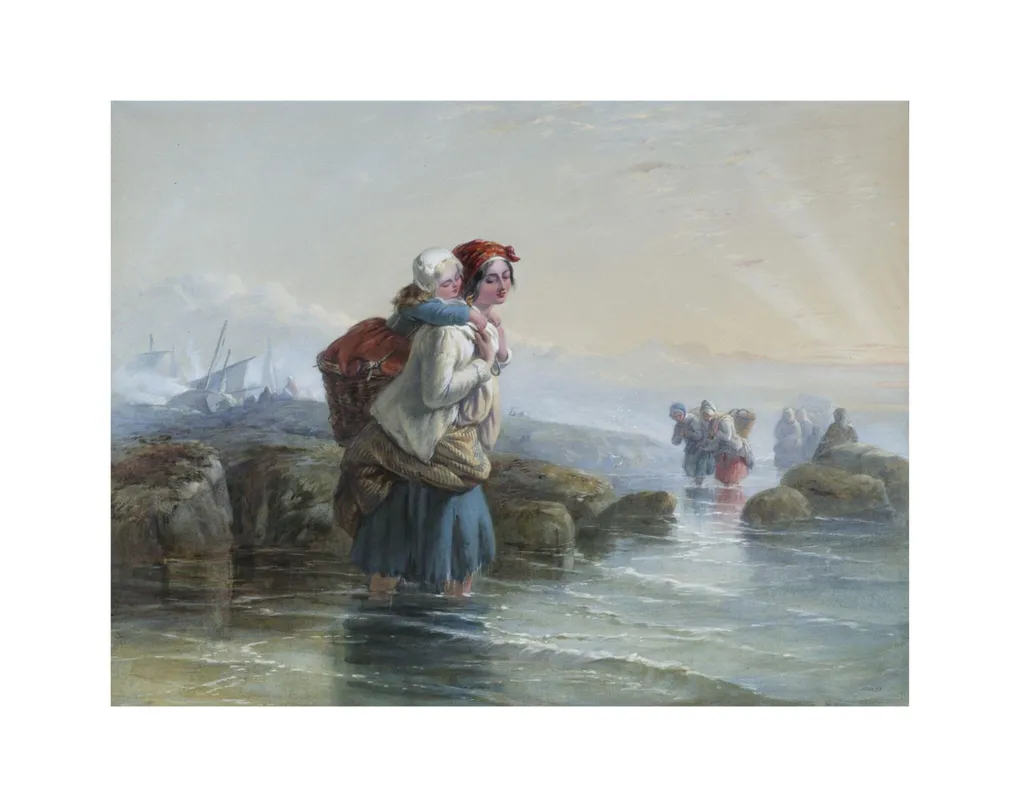
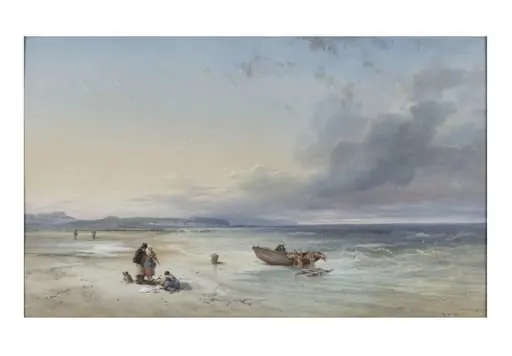
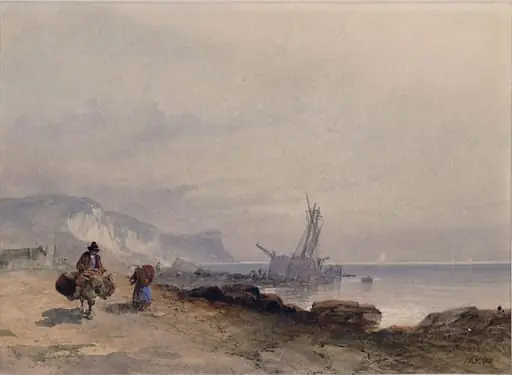
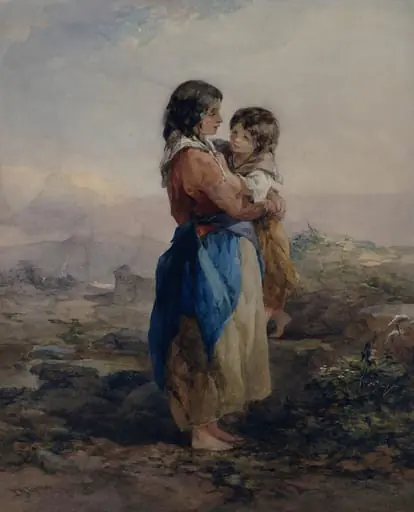
Shrimpers is a watercolor work on paper by the Impressionist artist Joseph John Jenkins. It dates from 1850 and is held in the collection of the Victoria and Albert Museum.
About this work
Overview
Joseph John Jenkins’s watercolor *Shrimpers* captures a quiet coastal moment in Boulogne, France, focusing on the daily rhythms of fishing communities.
Joseph John Jenkins’s watercolor *Shrimpers* captures a quiet coastal moment in Boulogne, France, focusing on the daily rhythms of fishing communities. Executed in translucent washes, the work reflects Jenkins’s sustained interest in northern French shores, particularly the lives of those who depended on the sea. His technical precision and attention to ordinary scenes align with broader 19th-century artistic trends favoring localized, observational subjects.
Subject & Meaning
The painting portrays a woman carrying a child and a basket along a rocky shoreline, accompanied by figures wading in shallow surf. Distant ships suggest the economic undercurrents of the scene. No dramatic action is depicted; instead, the work conveys endurance and routine. The figures’ modest attire and unposed gestures emphasize authenticity, reflecting Jenkins’s commitment to portraying labor without romanticization.
Technique & Style
Jenkins employed watercolor with a restrained palette of muted earth tones and soft blues, allowing light to unify the composition. His skillful layering created subtle transitions between sky, sea, and land, producing a hazy, atmospheric effect. The brushwork is deliberate yet fluid, avoiding sharp outlines to enhance the sense of calm and naturalism characteristic of his approach to the medium.
History & Provenance
Created during a period when Jenkins was active in London’s watercolor circles, the work was likely exhibited through the Old Watercolour Society, of which he served as Secretary. His role in organizing 'Press Views'—early previews for critics—helped shape public engagement with watercolor as a serious medium. While the painting’s exact exhibition history is undocumented, it fits within his broader body of coastal studies from the 1850s–70s.
Context
Jenkins’s focus on French coastal laborers coincided with a wider European interest in Realism and ethnographic observation. Artists increasingly turned from idealized subjects to depictions of working-class life, influenced by social change and improved travel. His choice of Boulogne reflects both accessibility from England and the region’s reputation for distinctive maritime culture, placing his work within transnational artistic currents of the time.
Legacy
Jenkins contributed to elevating watercolor from a sketching tool to a respected exhibition medium. His consistent subject matter—coastal laborers in Brittany and northern France—helped define a niche within 19th-century British art. Though less widely known today, his work exemplifies how professional artists navigated commercial pressures while maintaining a commitment to observational truth.
Artist & collection

Artist
Joseph John Jenkins was a British engraver and watercolor painter. He is best known for his portraits and landscapes paintings.