Artwork
Temple of Ramses the Great B.C.1420. Temple of Sedingar B.C.1490
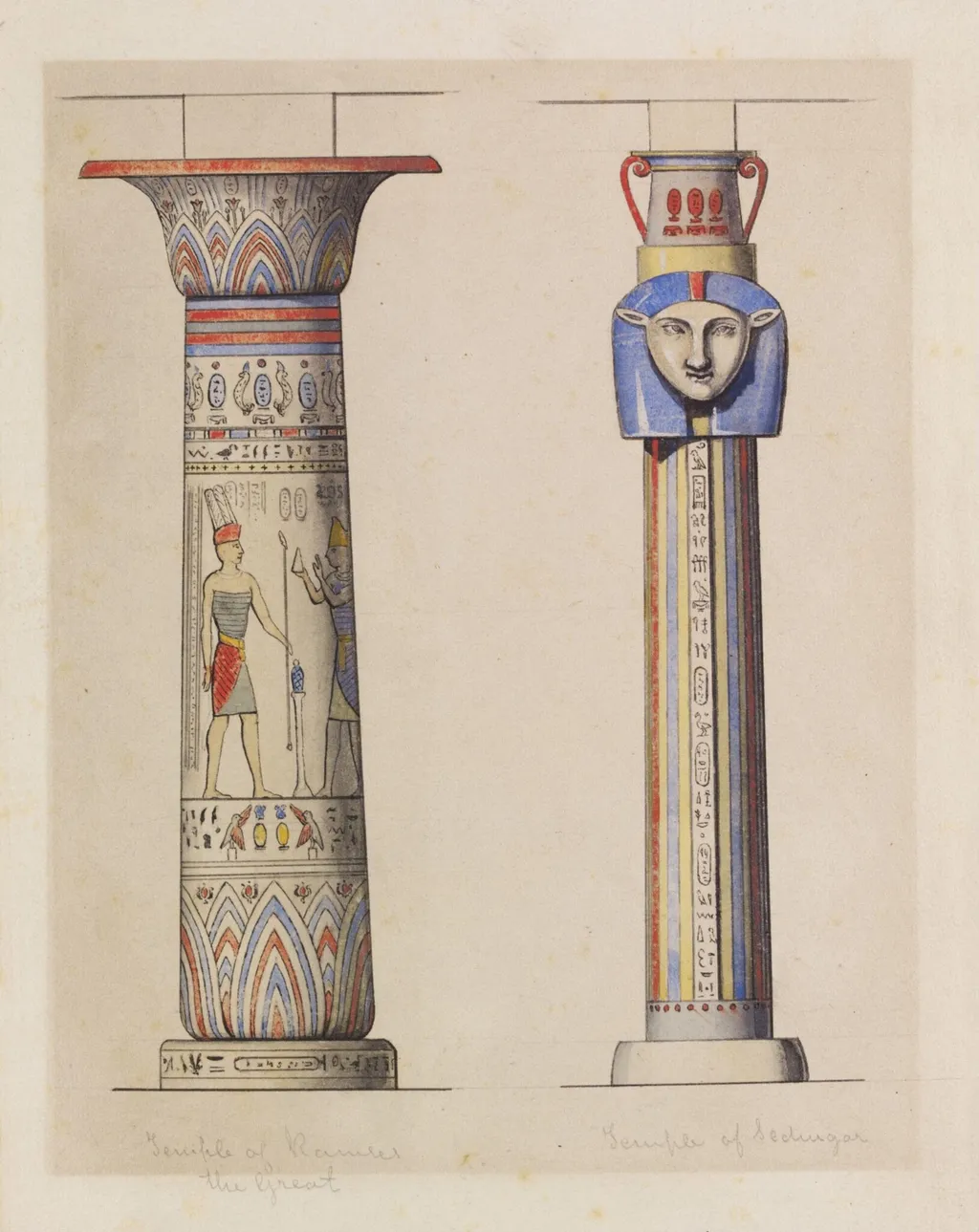
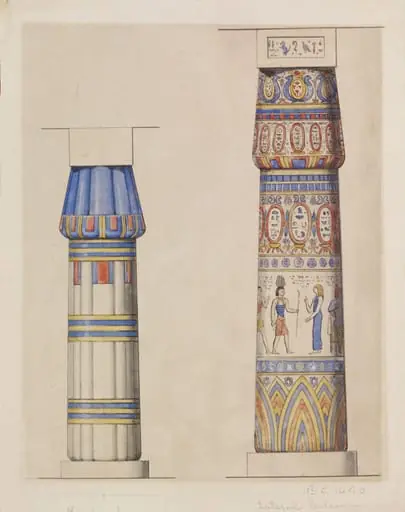
Temple of Ramses the Great B.C.1420. Temple of Sedingar B.C.1490 is a watercolor work on paper by the Impressionist artist Owen Jones. It dates from 1853 and is held in the collection of the Victoria and Albert Museum.
About this work
The left column has a painted scene of two standing figures dressed in simple robes, holding objects.
This drawing shows two colorful temple columns. The left column has a painted scene of two standing figures dressed in simple robes, holding objects. The right column features a blue-skinned face with a red-and-gold headdress. Both columns have bright red tops and are decorated with patterns and hieroglyphics.
The artist labeled these as temples from ancient Egypt, one from around 1420 B.C. and the other from 1490 B.C. The drawing looks like it was made to record what these temples might have looked like.
Check out the Victoria and Albert Museum to see more works like this.
Overview
Owen Jones created this watercolour in 1853 as part of his documentation for the Egyptian Court at the Crystal Palace in Sydenham. The work presents two reconstructed temple columns, each associated with a different pharaonic era: one attributed to Ramses II circa 1420 BCE, the other to a ruler linked with Sedingar around 1490 BCE. The drawing serves as a scholarly reconstruction, aiming to visualize ancient Egyptian architectural ornamentation for a Victorian audience unfamiliar with original monuments.
Subject & Meaning
The two columns represent distinct religious structures from New Kingdom Egypt. The left column depicts two standing figures in simple robes, likely deities or royal attendants, holding ritual objects. The right column features a blue-skinned face, possibly a divine representation such as Amun or Osiris, adorned with a red-and-gold headdress. These images reflect Egyptian iconography tied to kingship and the divine, intended to convey spiritual authority through visual symbolism.
Technique & Style
Jones employed precise watercolour washes and fine line work to replicate the polychrome decoration of Egyptian temple architecture. Bright red capitals, intricate hieroglyphic bands, and stylized figures are rendered with academic clarity. The palette emphasizes saturated hues—cobalt blue, gold, crimson—to mimic the original pigments, while maintaining a documentary tone. The composition is structured, prioritizing accuracy over artistic flourish.
History & Provenance
Created in 1853, the watercolour was produced during Jones’s involvement with the Egyptian Court at the Crystal Palace, a public exhibition designed to educate visitors on ancient Egyptian culture. The work was likely based on earlier archaeological surveys and sketches from Egypt, though not from direct on-site observation. It entered the Victoria and Albert Museum’s collection as part of Jones’s broader archive of architectural studies.
Context
In mid-19th century Britain, public fascination with Egyptology surged following Napoleon’s campaigns and the decipherment of hieroglyphs. Jones’s work responded to this interest by translating fragmented archaeological data into accessible, visually compelling reconstructions. His drawings helped shape contemporary perceptions of ancient Egypt, blending scholarly rigor with the Victorian appetite for exoticism and order.
Legacy
Jones’s watercolours, including this one, became foundational references for later reconstructions of Egyptian monuments. Though some attributions have since been revised, his method of combining precise detail with colour reconstruction influenced architectural illustration and museum display practices. The piece remains a key example of how 19th-century scholarship sought to revive and interpret the visual language of antiquity.
Artist & collection
Artist
English architect and designer Owen Jones spent the 1830s in Egypt and later sketched its temples in crisp watercolours.