Artwork
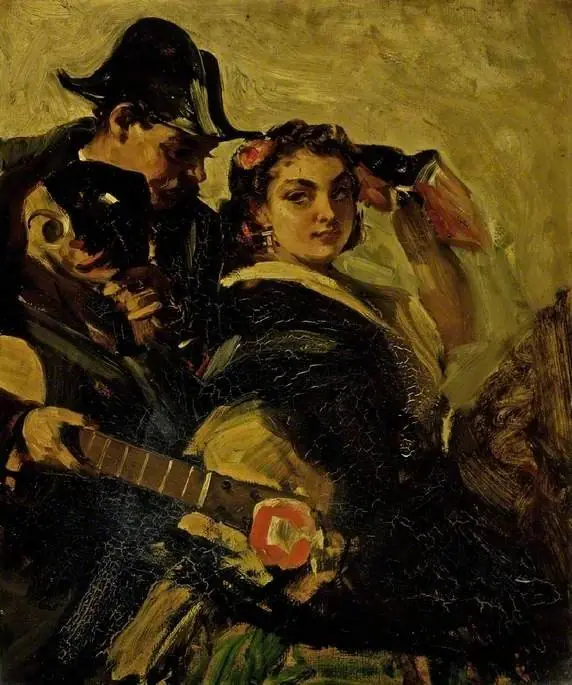
The Guitar Player
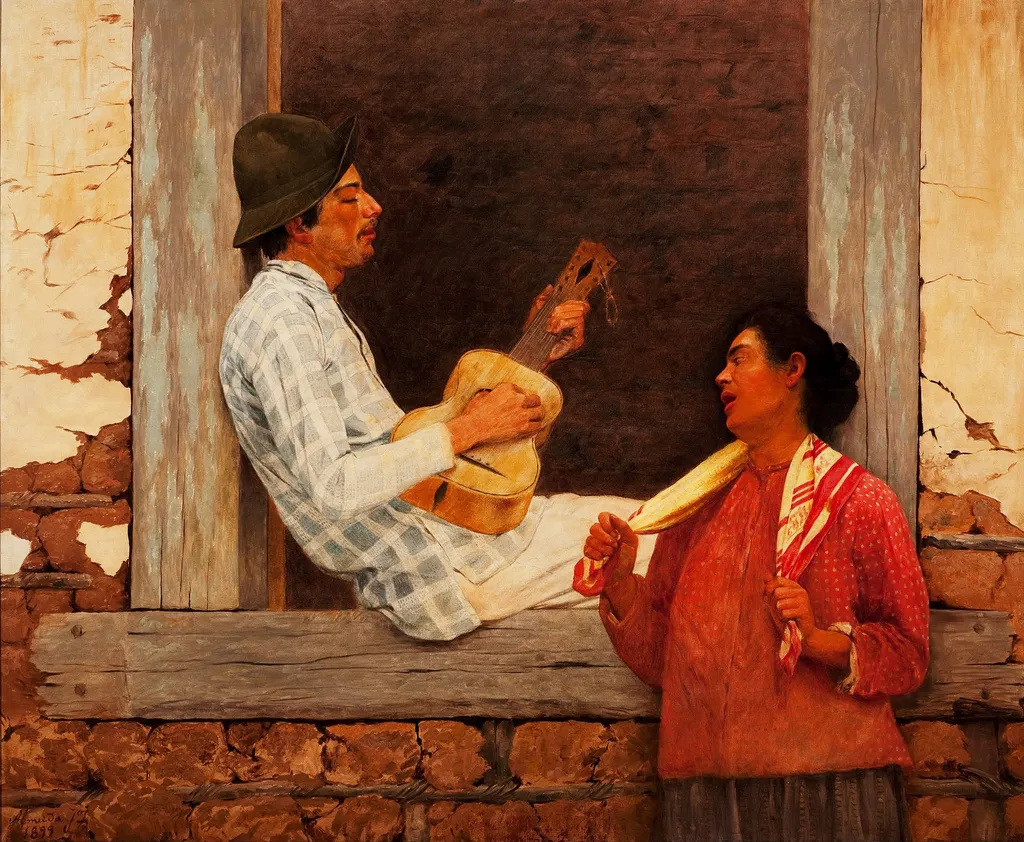
The Guitar Player is an oil painting by the Realist artist José Ferraz de Almeida Júnior. It is held in the collection of the Pinacoteca de São Paulo.
About this work
Overview
It captures a quiet, intimate moment between two figures in a rural setting, rendered with attention to everyday detail and naturalistic lighting.
Painted in 1900 by Brazilian artist José Ferraz de Almeida Júnior, *The Guitar Player* is an oil-on-canvas work that reflects the artist’s engagement with European Realism. It captures a quiet, intimate moment between two figures in a rural setting, rendered with attention to everyday detail and naturalistic lighting. The painting is held in the Pinacoteca do Estado de São Paulo, where it stands as an early example of Brazilian Realist painting.
Subject & Meaning
The scene depicts a man playing guitar at a weathered stone window, his gaze directed toward a woman standing below. She holds a handkerchief to her mouth, listening intently. Their interaction suggests a moment of shared emotion, possibly romantic or nostalgic. The setting, stripped of grandeur, emphasizes ordinary human connection, aligning with Realist values that prioritized authentic, unidealized life over theatrical narratives.
Technique & Style
Almeida Júnior employs chiaroscuro to model form and direct attention: the woman’s face is softly illuminated, while the man’s guitar remains in shadow, creating visual tension. Brushwork is restrained yet precise, capturing the texture of peeling plaster, coarse fabric, and worn stone. The composition is asymmetrical, with the figures positioned to draw the eye diagonally across the space, enhancing the sense of a fleeting, candid moment.
History & Provenance
Created in 1900, the painting entered the collection of the Pinacoteca do Estado de São Paulo shortly after its completion. It was among the first Brazilian works to adopt the Realist aesthetic, influenced by French painters like Courbet and Millet. Its preservation in a major public institution reflects its early recognition as a significant contribution to Brazil’s national art canon.
Context
In early 20th-century Brazil, artists were increasingly turning away from academic idealism toward depictions of rural and working-class life. Almeida Júnior’s focus on a humble, unposed scene aligns with this shift. The painting’s setting—crumbling architecture, simple clothing, and natural light—echoes broader social interests in regional identity and the dignity of everyday labor during a period of national self-definition.
Legacy
Though not widely reproduced, *The Guitar Player* remains a touchstone in Brazilian art history for its quiet emotional depth and technical restraint. It helped establish Realism as a viable mode for Brazilian painters seeking to represent their own social landscape. Its influence is seen in later generations who continued to explore intimate, unadorned scenes of Brazilian life.
Own this work as a print
Artist & collection

Artist
José Ferraz de Almeida Júnior (8 May 1850 – 13 November 1899) was a Brazilian artist and designer; one of the first there to paint in the Realistic tradition of Gustave Courbet and Jean-François Millet.