Artwork
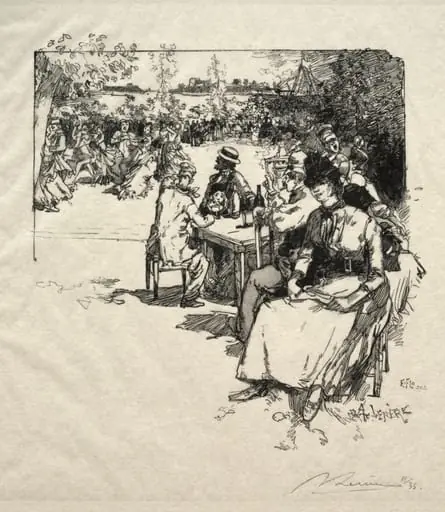
Au coq des bruyeres
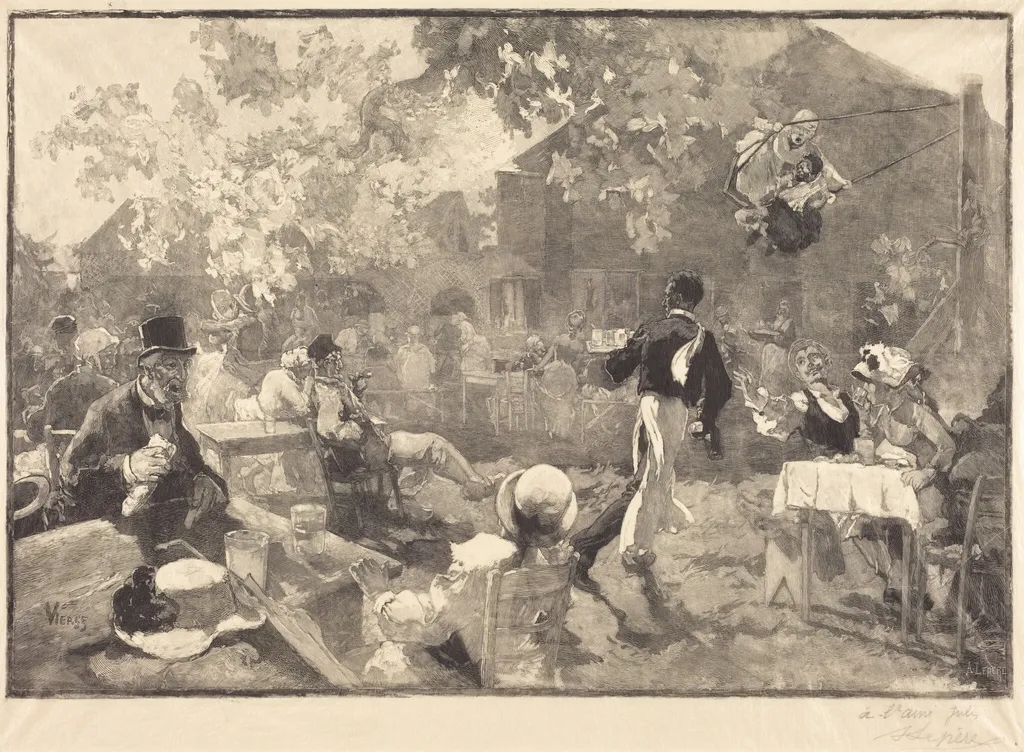
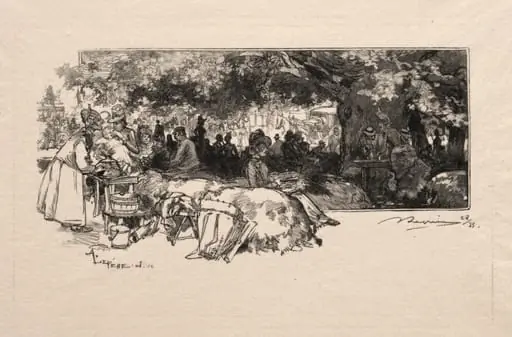
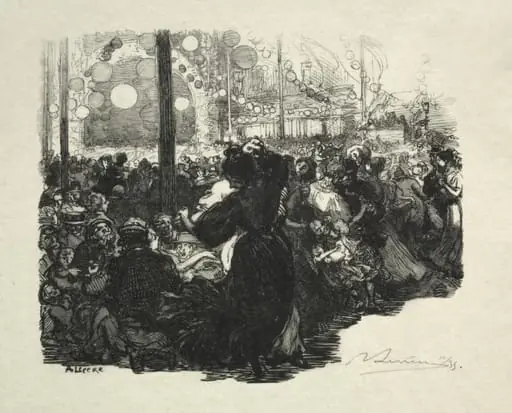
Au coq des bruyeres is an ink print by the Impressionist artist Auguste Lepère. It dates from 1888 and is held in the collection of the National Gallery of Art.
About this work
Overview
Louis-Auguste Lepère’s *Au coq des bruyères* is an 1888 wood engraving printed on tissue paper. The work exemplifies Lepère’s role in revitalizing the wood engraving technique in late 19th-century Europe, a period marked by renewed interest in printmaking. Executed with precision, the image captures an interior scene through dense, controlled linework characteristic of the medium.
Subject & Meaning
The nocturnal setting, suggested by bare trees and a distant mountain visible through a window, reinforces a mood of late-night dissipation.
The composition depicts a dimly lit, disorderly gathering, likely set in an informal social space. A central figure in a top hat sits at a table, drink in hand, while others converse or recline in various states of repose. A woman near the rear pours a beverage, and discarded garments and empty glasses litter the floor. The nocturnal setting, suggested by bare trees and a distant mountain visible through a window, reinforces a mood of late-night dissipation.
Technique & Style
Lepère employed fine, meticulous lines to construct tonal depth and intricate details, a hallmark of wood engraving. The medium’s constraints—carving against the grain on end-grain wood—demand deliberate mark-making, yielding a textured, almost sketch-like quality. This approach aligns with the revivalist ethos of the era, where artists sought to exploit the expressive potential of traditional printmaking methods.
History & Provenance
Created in 1888, *Au coq des bruyères* reflects Lepère’s engagement with the wood engraving revival, a movement that sought to restore the technique’s prominence in European printmaking. The work’s early history and subsequent ownership remain undocumented in public records, though its survival on delicate tissue paper underscores the fragility of such impressions.
Context
The late 19th century witnessed a resurgence of wood engraving, driven by artists and illustrators who valued its capacity for fine detail and reproducibility. Lepère’s work emerged amid this broader revival, as printmakers experimented with the medium’s possibilities beyond commercial illustration. His compositions often merged narrative scenes with technical rigor, situating him within a generation redefining printmaking’s artistic boundaries.
Artist & collection
Artist
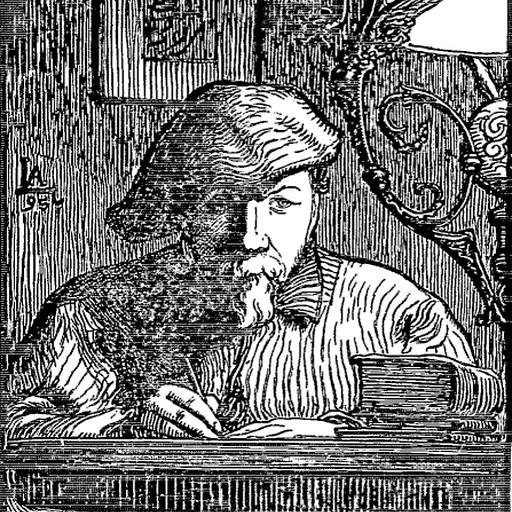
Louis-Auguste Lepère (30 November 1849 – 20 November 1918) was a French painter and etcher. Lepère is also considered a leader in the creative revival of wood engraving in Europe.