Artwork
The Climbers (Three Figures from Michelangelo's Battle of Cascina)
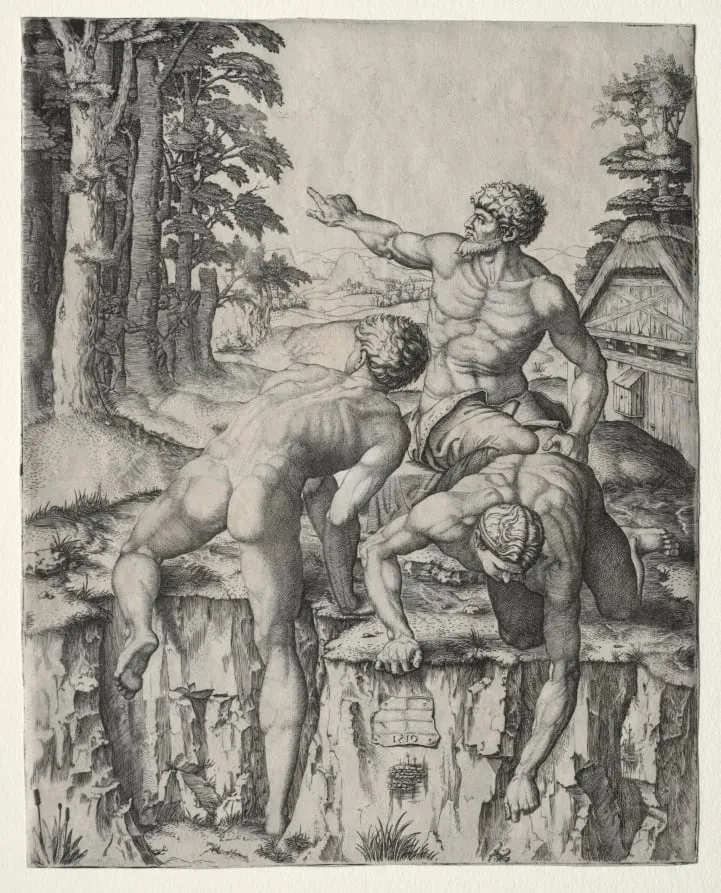
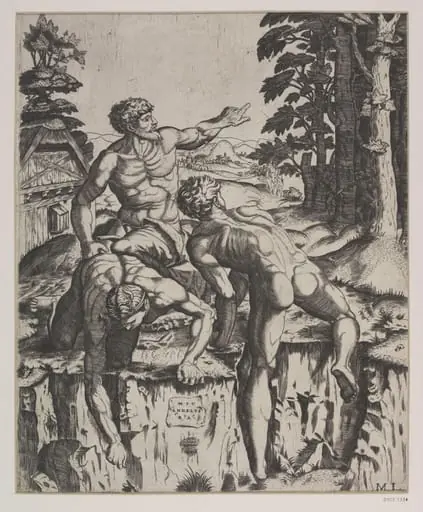
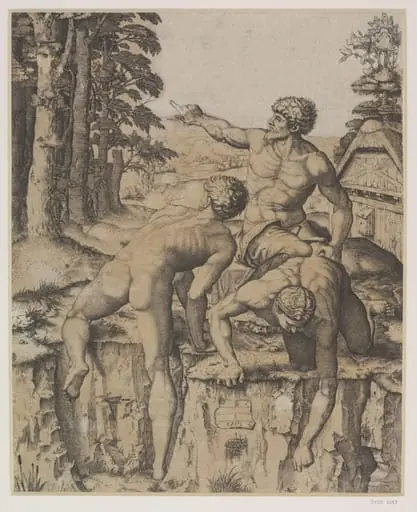
The Climbers (Three Figures from Michelangelo's Battle of Cascina) is a print by the Renaissance artist Marcantonio Raimondi. It dates from 1510 and is held in the collection of the Cleveland Museum of Art.
About this work
Overview
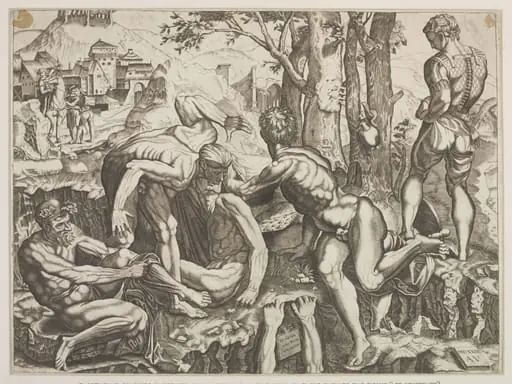
This 1510 engraving by Marcantonio Raimondi reproduces three figures from Michelangelo’s unfinished cartoon for the Battle of Cascina.
This 1510 engraving by Marcantonio Raimondi reproduces three figures from Michelangelo’s unfinished cartoon for the Battle of Cascina. Though the original mural was never executed, Raimondi’s print preserves a fragment of the lost composition, offering one of the clearest visual records of Michelangelo’s early draft. The engraving reflects the intense interest among contemporaries in Michelangelo’s dynamic figure studies.
Subject & Meaning
The three figures depict soldiers in mid-motion, scrambling up a riverbank during a sudden alarm. Their torsions and taut musculature convey urgency and physical exertion, embodying Michelangelo’s fascination with the human body under strain. The scene captures a moment of chaotic readiness rather than combat, emphasizing human effort over narrative climax.
Technique & Style
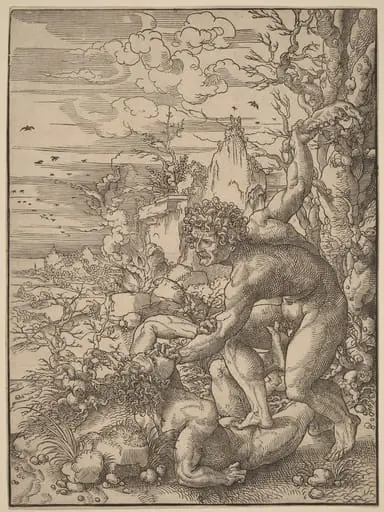
Raimondi employed fine, controlled lines to replicate Michelangelo’s sculptural forms, capturing the tension in limbs and the weight of bodies. He adapted the landscape background from a print by Lucas van Leyden, blending Northern detail with Italian figure composition. The precision of the engraving suggests deliberate study, not mere imitation, highlighting Raimondi’s technical mastery.
History & Provenance
Michelangelo’s cartoon, created for the Palazzo Vecchio commission in 1504, was displayed in Florence and widely copied before its eventual destruction. Raimondi’s engraving, made just six years later, is among the earliest and most faithful records of its content. It circulated widely, helping disseminate Michelangelo’s style beyond Florence and into broader Renaissance print culture.
Context
During the early 16th century, Florence was a hub for artistic rivalry and exchange. Michelangelo’s cartoon was a focal point for artists studying anatomy and movement. Raimondi’s print emerged amid a flourishing print industry that sought to replicate and distribute influential drawings, making high art accessible to a wider circle of practitioners and collectors.
Legacy
Raimondi’s engraving preserved key elements of a lost work, influencing generations of artists who never saw the original cartoon. It became a reference for figure study and compositional dynamism, reinforcing Michelangelo’s reputation as a model of anatomical expression. The print remains a vital link between the ephemeral nature of preparatory drawings and the enduring impact of Renaissance ideals.
Artist & collection

Artist
Marcantonio Raimondi, often called simply Marcantonio (c. 1470/82 – c. 1534), was an Italian engraver, known for being the first important printmaker whose body of work consists largely of prints copying paintings. He…