Artwork
The Wine Press
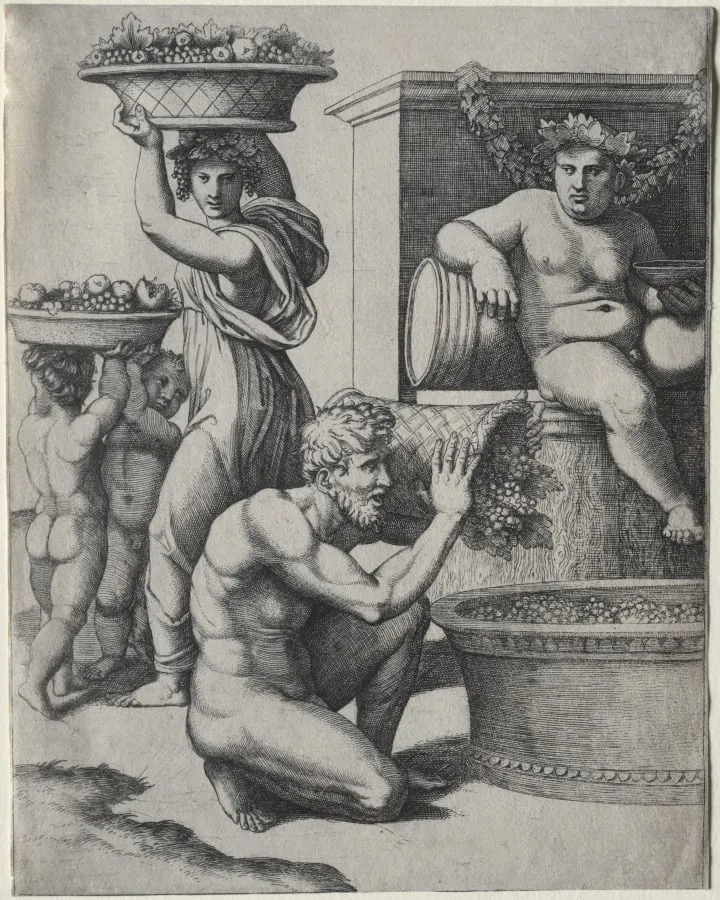
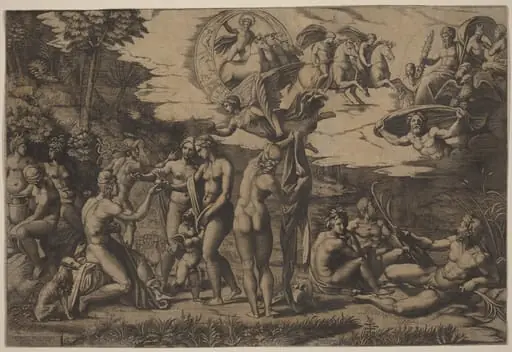
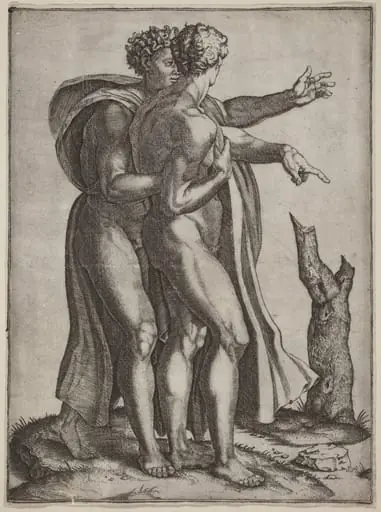
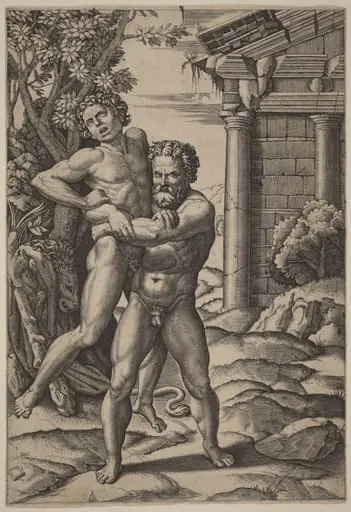
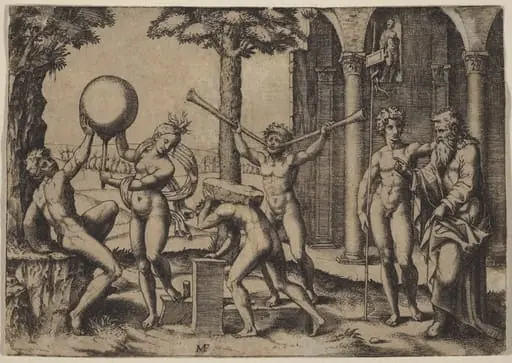
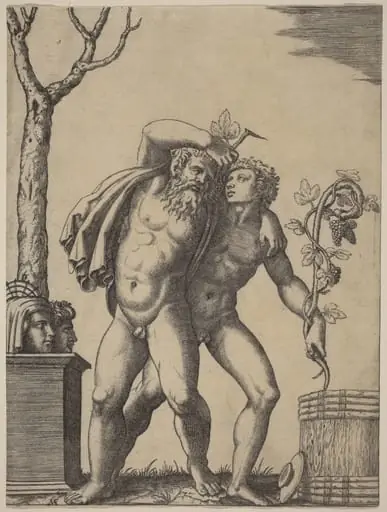
The Wine Press is a print by the Renaissance artist Marcantonio Raimondi. It dates from 1518 and is held in the collection of the Cleveland Museum of Art.
About this work
Overview
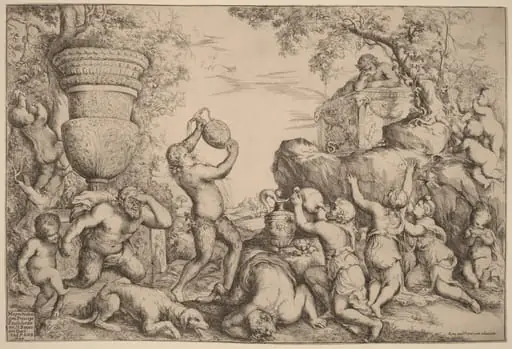
This print depicts a bacchanalian scene centered on Silenus, the drunken companion of Bacchus, seated on a throne while harvesters gather and press grapes.
This print depicts a bacchanalian scene centered on Silenus, the drunken companion of Bacchus, seated on a throne while harvesters gather and press grapes. Though executed by Marcantonio Raimondi as an engraving, the design originates from Raphael, who created the composition. The work belongs to a series of prints made after Raphael’s drawings, intended to disseminate his artistic ideas through reproducible imagery.
Subject & Meaning
The scene draws from classical mythology, portraying the ritual of wine-making as a sacred act under the watch of Silenus. The presence of laborers and the god suggests a fusion of divine favor and human toil, aligning with Renaissance ideals that linked earthly pleasures with elevated culture. Such imagery would have appealed to patrons like the Duke of Ferrara, who used classical themes to signal erudition and refined taste.
Technique & Style
Raphael’s figures are rendered with sculptural weight and dynamic tension, echoing the relief carvings of Roman sarcophagi he studied in Rome. Raimondi translated these forms into precise engraved lines, emphasizing volume through controlled hatching and contrast. The modeling of flesh and drapery reflects an interest in chiaroscuro, though not yet the soft transitions of sfumato; instead, the effect is more linear and monumental.
History & Provenance
The print likely derives from a lost painting by Raphael commissioned for the Duke of Ferrara’s palace, possibly part of a decorative cycle celebrating Bacchic themes. Raimondi’s engraving preserved the composition after the original painting vanished, becoming one of the earliest and most influential reproductive prints of the High Renaissance. Its circulation helped establish Raphael’s reputation beyond Italy.
Context
In early 16th-century Italy, classical antiquity was a vital source for artistic renewal. Raphael’s engagement with Roman sarcophagi reflected a broader humanist trend, where ancient forms were reinterpreted to convey moral and aesthetic ideals. Engraving allowed such imagery to reach collectors and artists across Europe, transforming private commissions into public cultural artifacts.
Legacy
Raimondi’s engraving after Raphael’s design became a model for later reproductive prints, influencing how classical themes were visualized in Northern Europe. It contributed to the standardization of compositional types and the rise of print as a medium for artistic authority. The work remains a key example of collaboration between painter and engraver in the service of disseminating Renaissance ideals.
Artist & collection

Artist
Marcantonio Raimondi, often called simply Marcantonio (c. 1470/82 – c. 1534), was an Italian engraver, known for being the first important printmaker whose body of work consists largely of prints copying paintings. He…