Artwork
Le Petit Pont, Paris
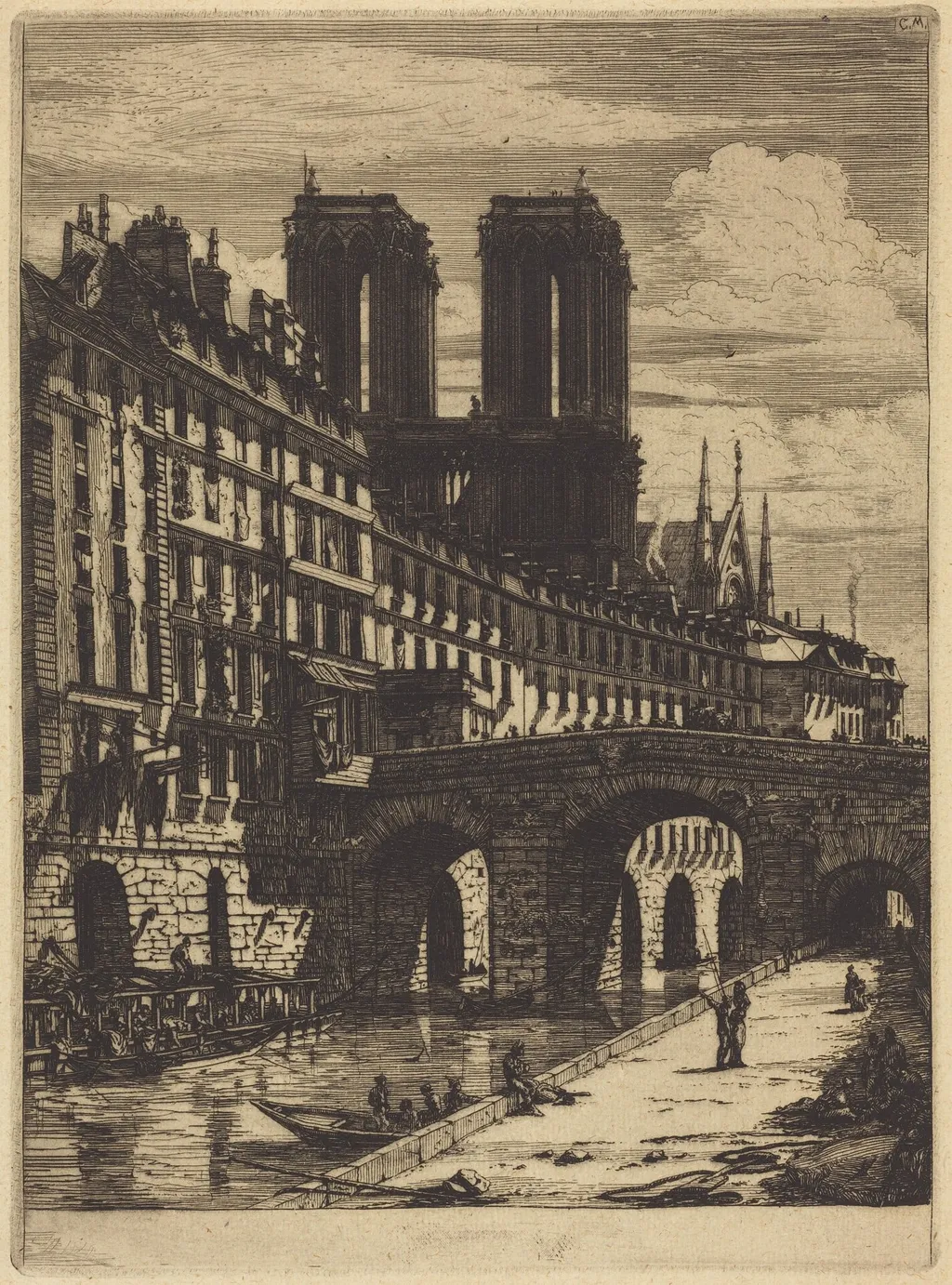
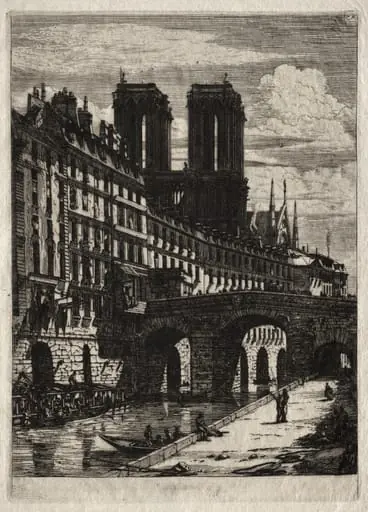
Le Petit Pont, Paris is an ink print by the Impressionist artist Charles Meryon. It dates from 1850 and is held in the collection of the National Gallery of Art.
About this work
Overview
It belongs to a series of urban views Meryon produced during the mid-nineteenth century, capturing Parisian architecture with meticulous detail.
Le Petit Pont, Paris is an 1850 print by Charles Meryon, executed in etching and engraving on green laid paper. It belongs to a series of urban views Meryon produced during the mid-nineteenth century, capturing Parisian architecture with meticulous detail. His choice of medium was partly influenced by his color blindness, which led him to focus on tonal contrasts and line work rather than color. The print reflects his deep engagement with the city’s structural character.
Subject & Meaning
The scene depicts a narrow bridge crossing the Seine, flanked by dense urban structures: a grand building with a clock tower on one side and a church with twin spires rising behind modest dwellings on the other. Figures move along the bridge, suggesting daily life in a bustling quarter. The composition emphasizes the weight of architecture over human presence, conveying a quiet solemnity. The calm river and small boats add a sense of stillness amid urban density.
Technique & Style
Meryon employed fine, controlled etching and engraving lines to render textures—brickwork, window frames, water ripples—with exceptional precision. The green paper substrate subtly enhances the tonal range of the ink, deepening shadows and lending warmth to mid-tones. His technique avoids broad washes, relying instead on dense cross-hatching and delicate stippling to suggest depth and atmosphere. This method was typical of pre-photographic printmaking, prioritizing clarity and detail over expressive brushwork.
History & Provenance
Created in 1850, the print is part of Meryon’s broader project to document Paris’s medieval and early modern architecture before widespread modernization. He produced these works independently, often selling them directly to collectors. Le Petit Pont was not widely exhibited during his lifetime but gained recognition posthumously as part of a growing appreciation for his singular vision of the city’s forgotten corners and enduring stone structures.
Context
In mid-nineteenth-century Paris, rapid urban renewal under Haussmann threatened historic neighborhoods. Meryon’s prints served as quiet records of structures soon to be altered or demolished. Unlike contemporaries who favored grand vistas, he focused on intimate, often overlooked sites—narrow bridges, alleyways, and crumbling facades. His work resonated with a growing interest in historical preservation and the poetic weight of decay.
Legacy
Meryon’s etchings, including Le Petit Pont, established a new standard for architectural printmaking in France. His influence extended to later artists and writers drawn to the melancholy beauty of urban decay. Though largely forgotten after his death, his work was revived in the early twentieth century and is now held in major museum collections as a defining record of Paris’s architectural soul before industrial transformation.
Artist & collection
Artist
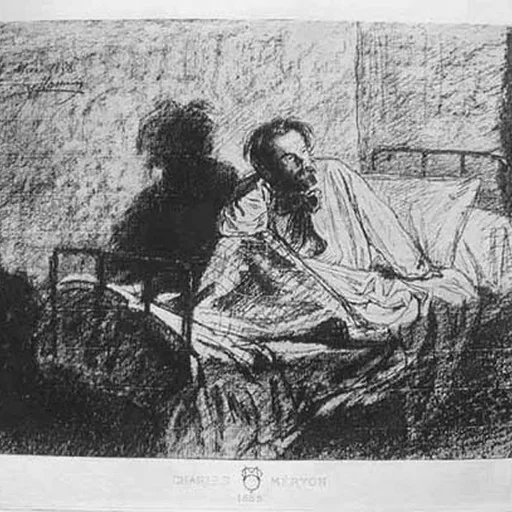
Charles Meryon (sometimes Méryon, 23 November 1821 – 14 February 1868) was a French artist who worked almost entirely in etching, as he had colour blindness.

 Etchings of Paris: The Little Bridge
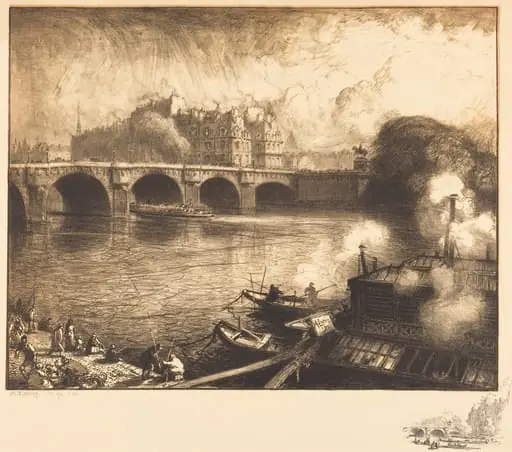 Le Pont Neuf
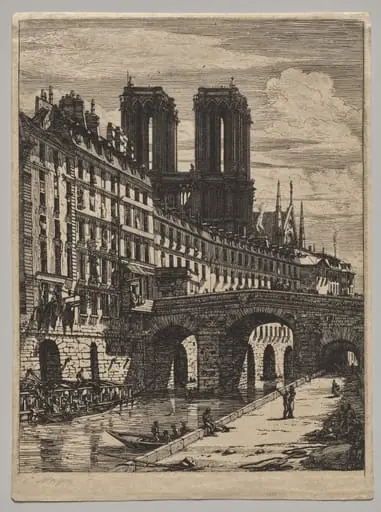 Petit Pont, Paris
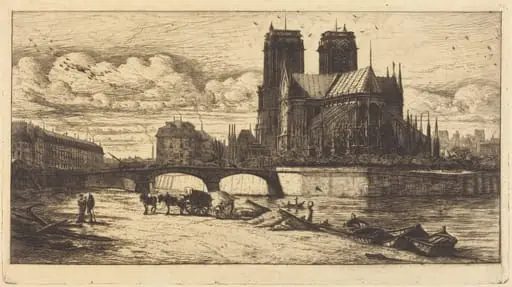 L'abside de Notre-Dame de Paris (The Apse of the Cathedral of Notre-Dame, Paris)
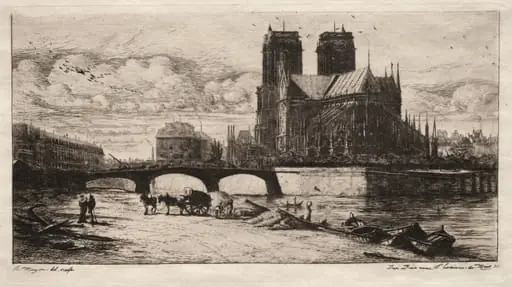 Etchings of Paris: The Apsis of the Cathedral of Notre Dame
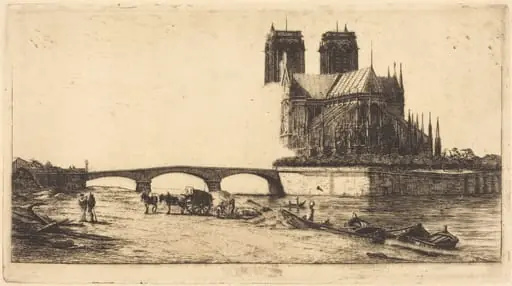 L'abside de Notre-Dame de Paris (The Apse ofthe Cathedral of Notre-Dame, Paris)
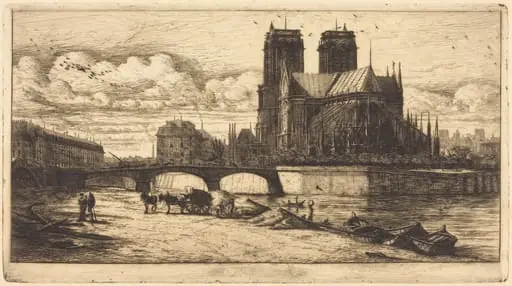 L'abside de Notre-Dame de Paris (The Apse of the Cathedral of Notre Dame, Paris)