Artwork
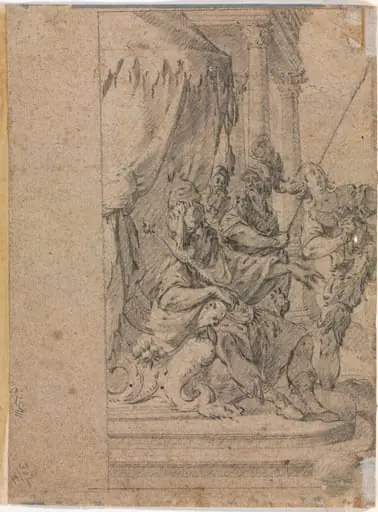
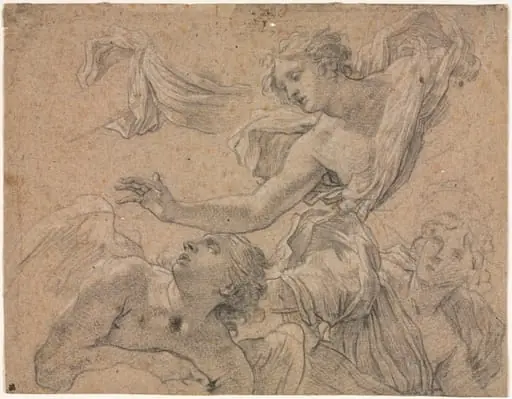
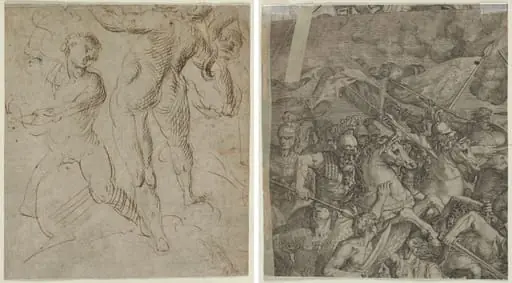
Studies of Angels (recto); Panthea before Cyrus? (verso)
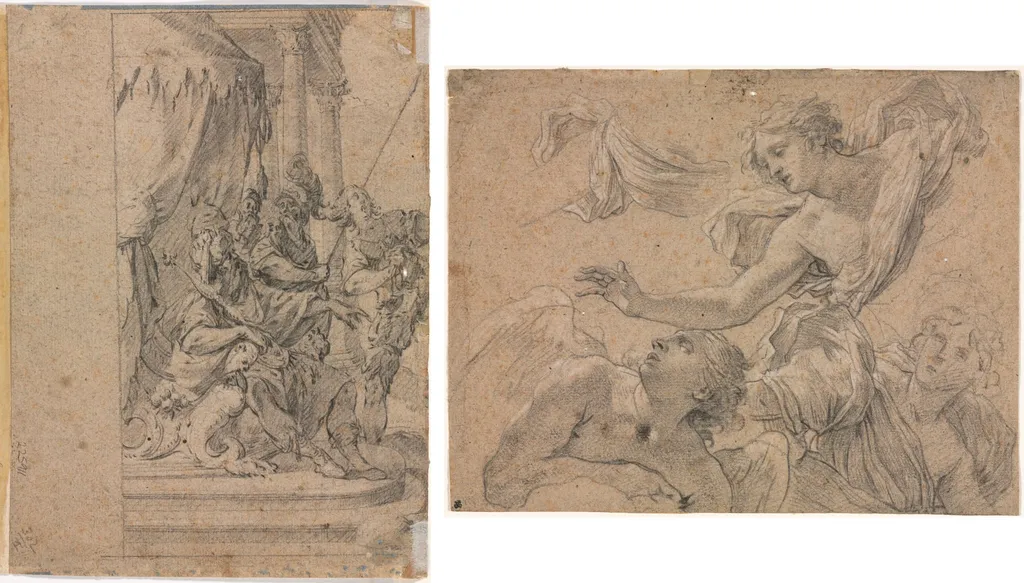
Studies of Angels (recto); Panthea before Cyrus? (verso) is a drawing by the Baroque artist Michel Dorigny. It dates from 1658 and is held in the collection of the Cleveland Museum of Art.
About this work
You see a drawing of angels and possibly a scene with a woman.
The drawing has a light and airy feel, with lines that suggest movement. It's interesting that this work was once thought to be by another artist, Simon Vouet, because of the similar style.
Check out the work of artist Michel Dorigny (French, 1617–1665) for more like this.
Overview
Created in black chalk, the sheet reflects Dorigny’s distinctive draftsmanship, once mistaken for that of his father-in-law and mentor, Simon Vouet.
This double-sided drawing by Michel Dorigny features angels on the recto and a possible figure of Panthea before Cyrus on the verso. Created in black chalk, the sheet reflects Dorigny’s distinctive draftsmanship, once mistaken for that of his father-in-law and mentor, Simon Vouet. The work exemplifies mid-17th-century French academic drawing, combining fluid line work with precise hatching to suggest volume and motion.
Subject & Meaning
The recto depicts a group of airborne angels, their drapery billowing as if caught in an unseen wind, suggesting a celestial or liturgical context. Though no known painting corresponds to this study, the composition implies preparation for a religious scene, possibly an ascension or heavenly vision. The verso, less defined, may represent a historical or biblical figure, though its narrative remains uncertain.
Technique & Style
Dorigny employed black chalk with controlled, parallel hatching to model form and suggest light. The contours are firm yet graceful, and the drapery flows with an ethereal lightness, distinguishing his hand from Vouet’s denser, more sculptural approach. The rhythmic lines convey movement without heavy shading, reflecting a refined, airborne aesthetic characteristic of his mature style.
History & Provenance
The drawing was long attributed to Simon Vouet due to stylistic similarities and their close professional relationship. Later analysis of line quality and handling identified Dorigny as the artist, based on comparisons with his other chalk studies. Its survival as a single sheet, unattached to a larger composition, suggests it was valued as a study in its own right.
Context
Working in Paris during the 1630s–1660s, Dorigny operated within the circle of Vouet’s workshop, where preparatory drawings were essential for large-scale religious and mythological commissions. While few of his finished paintings survive, his drawings reveal a sustained engagement with movement, drapery, and spatial harmony—qualities prized in French academic training of the period.
Legacy
Dorigny’s drawings, including this one, illustrate the transition from Vouet’s Baroque intensity to a more delicate, linear sensibility in French drawing. Though overshadowed in his time, his technique influenced later draftsmen who favored clarity and grace over dramatic weight. This sheet remains a key example of how preparatory studies preserved the evolving aesthetics of 17th-century French art.
Artist & collection
Artist
A French painter and engraver from the mid-1600s, he turned biblical and mythological scenes into dramatic, candlelit dramas.

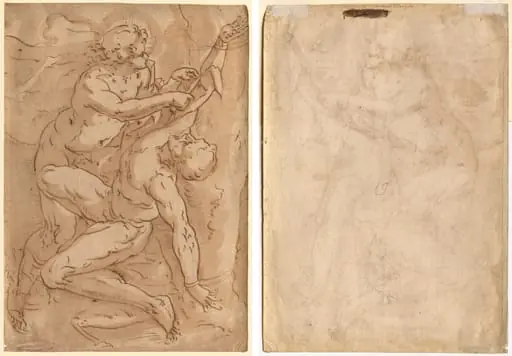 Apollo Flaying Marsyas (recto); Two Sketches of a Mother and Child (verso)
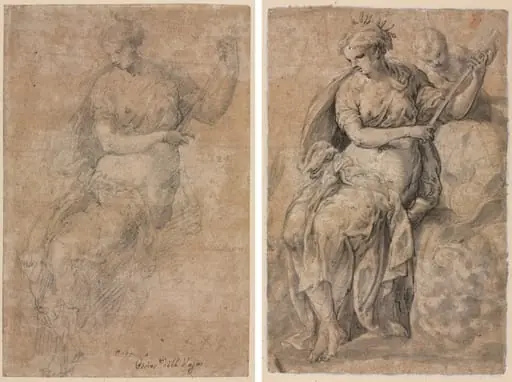 Allegorical Figure (recto and verso)
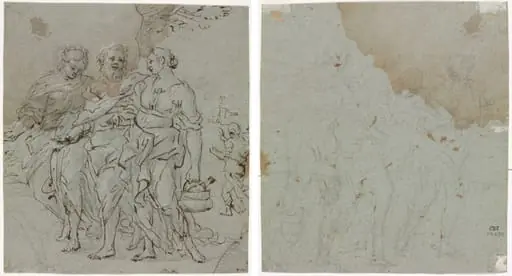 Lot and His Daughters (recto); Sketch for Lot and His Daughters (verso)
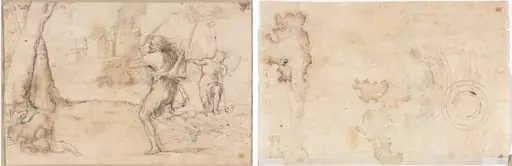 Romulus and Remus Found by Faustulus (recto) Concentric Circles (verso)
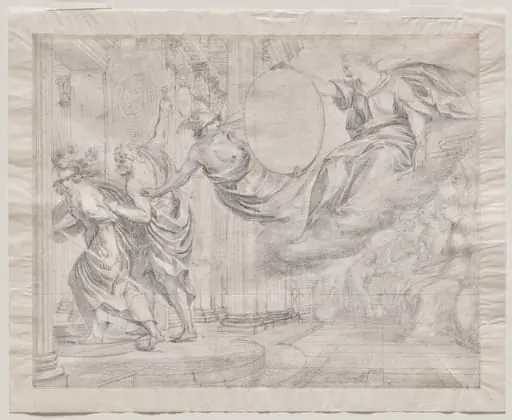 Allegory in Honor of Claude de Mesmes, Count d'Avaux (Allegorie en l'honneur de Claude de Mesmes, comte d'Avaux)
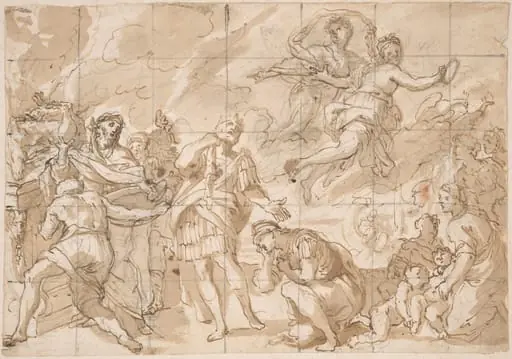 The Sacrifice of Iphigenia
 Laocoön (recto); Battle of the Milvian Bridge (fragment) (verso)