Artwork
Uzziah, Jotham and Ahaz
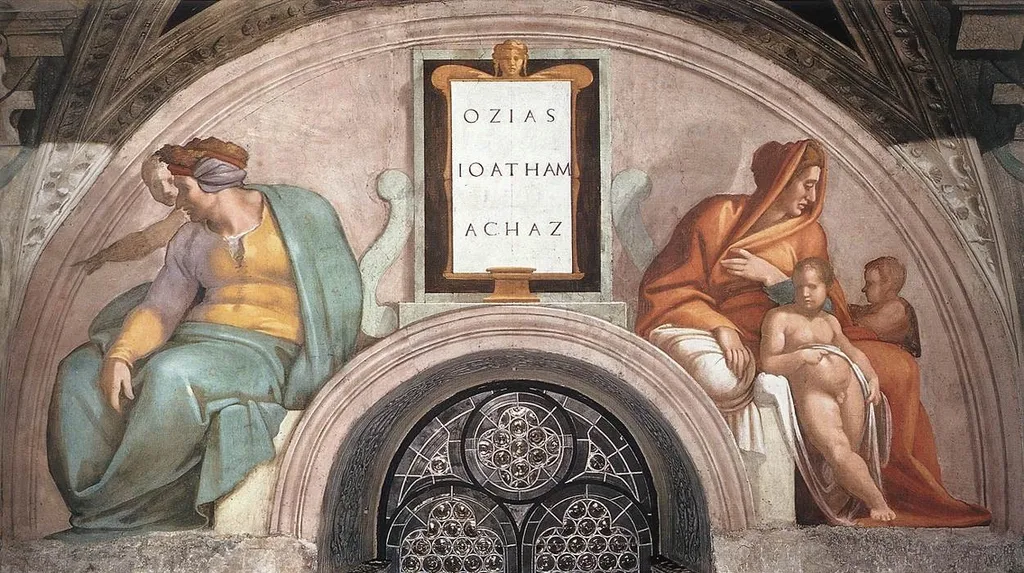
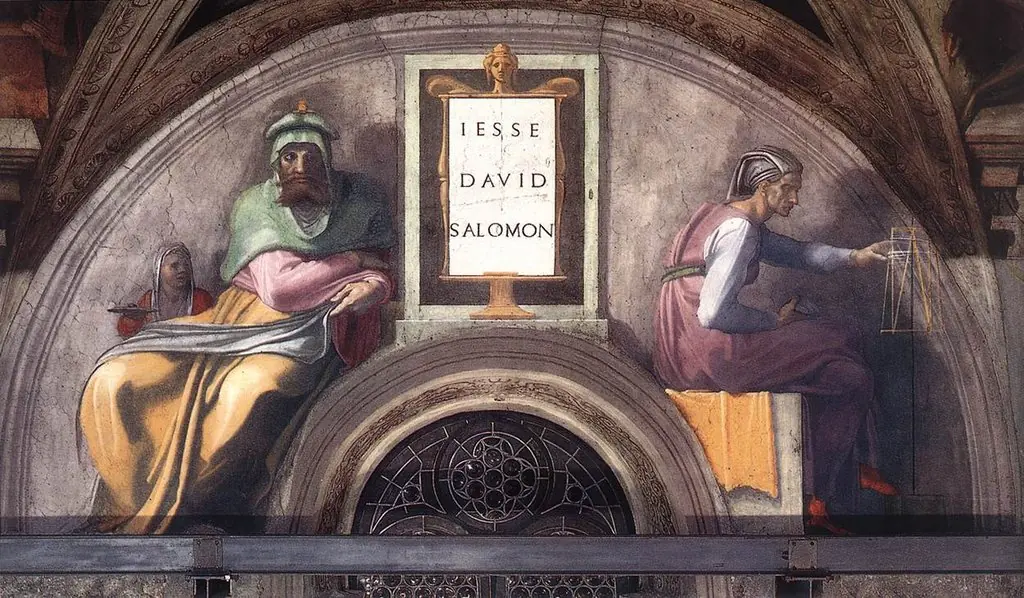
Uzziah, Jotham and Ahaz is a fresco painting by the High Renaissance artist Michelangelo. It dates from 1508 and is held in the collection of the Vatican Museums.
About this work
Overview
Uzziah, Jotham and Ahaz is a 1508 fresco painting by Michelangelo, located in the Vatican Museums. It depicts three biblical figures within an arched space.
Subject & Meaning
The fresco portrays three successive kings of Judah from the Old Testament: Uzziah, Jotham, and Ahaz. An inscription above them confirms their identities. The central figure, uniquely depicted as a woman with a naked infant, may symbolize a maternal or nurturing aspect, contrasting with the traditional masculine representation of kingship.
Technique & Style
Executed in the High Renaissance style, the work showcases Michelangelo's mastery of fresco technique. Characteristic elements include expressive figures, vibrant color palette (notably purple, orange, and blue against a light pink background), and dynamic composition within a defined architectural frame.
History & Provenance
Created in 1508 during Michelangelo's prolific period in Rome, the fresco was likely commissioned as part of a larger decorative project within the Vatican. It has remained in the Vatican Museums since its creation.
Context
This work reflects Michelangelo's broader practice of drawing inspiration from biblical narratives and classical aesthetics, contributing to the evolution of Western visual culture during the High Renaissance.
Artist & collection

Artist
Michelangelo di Lodovico Buonarroti Simoni (6 March 1475 – 18 February 1564), known mononymously as Michelangelo, was an Italian sculptor, painter, architect, and poet of the High Renaissance.

![Male Nude [recto], by Michelangelo](https://artifactworldgallery.com/img/michelangelo--male-nude-recto--8c3354d89884753a-w320.webp)
![Male Nude [verso], by Michelangelo](https://artifactworldgallery.com/img/michelangelo--male-nude-verso--d48a81b2ad2bdbb8-w320.webp)