Artwork
Selfridges, Oxford Street; Coronation of George VI
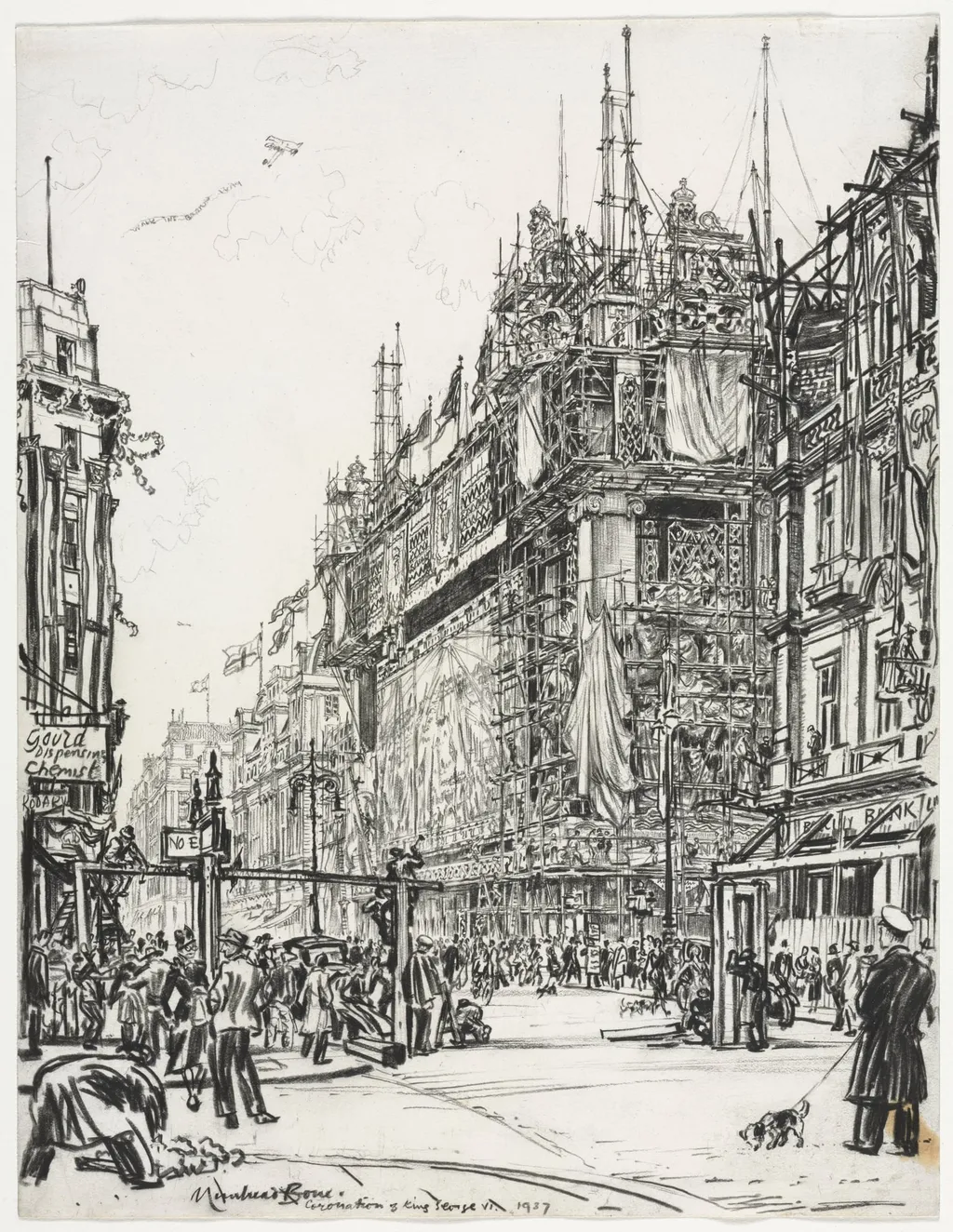
Selfridges, Oxford Street; Coronation of George VI is a drawing by Muirhead Bone. It dates from 1937 and is held in the collection of the Cleveland Museum of Art.
About this work
Next, check out Muirhead Bone (British, 1876–1953) to see how he captured everyday scenes with sharp lines.
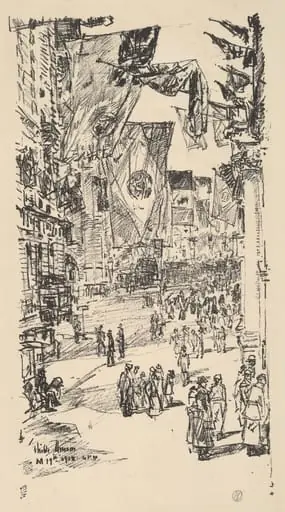
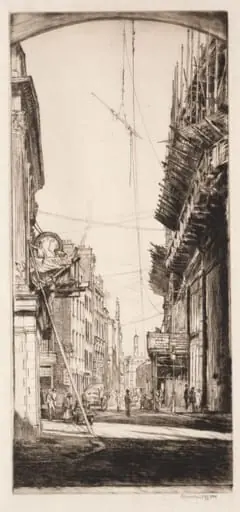
This sketch shows a busy city street lined with tall buildings. A giant, ornate wooden structure dominates the scene, covered in flags and scaffolding. People in hats and coats walk around, some stopping to look, while horses and carriages add to the crowd.
The artist focused on the details of the temporary structure, which looks like a grand stage or pavilion. It’s clearly built for a special event, with banners and decorations.
Next, check out Muirhead Bone (British, 1876–1953) to see how he captured everyday scenes with sharp lines.
Overview
Created in 1937, this drawing by Scottish artist Muirhead Bone captures a moment of public celebration on Oxford Street, where the commercial grandeur of Selfridges department store intersects with the ceremonial spectacle of King George VI’s coronation. Bone, known for his precise line work and interest in urban environments, rendered the scene with observational clarity, blending architecture and crowd dynamics into a single, layered composition.
Subject & Meaning
The drawing centers on a temporary wooden pavilion erected for the coronation, adorned with flags and scaffolding, standing prominently before Selfridges. The structure serves as both a focal point and a symbol of public pageantry, contrasting with the steady presence of the department store. Passersby, dressed in period attire, pause to observe, suggesting a moment of collective attention amid the routine of city life.
Technique & Style
Bone employed fine, controlled etching lines to define the intricate scaffolding, fabric banners, and architectural details of the building. His use of dense hatching and selective tonal variation conveys depth and movement without heavy shading. The composition is tightly framed, directing focus to the ceremonial structure while allowing the surrounding street activity to suggest scale and context through subtle detail.
History & Provenance
The work was produced during a period when Bone was actively documenting British civic life, following his earlier roles as a war artist. Created shortly after George VI’s accession, the drawing reflects public engagement with royal ceremonies in the interwar era. It likely originated as a preparatory study or independent record, preserved within institutional collections for its historical and artistic value.
Context
In 1937, London’s streets became stages for national ritual, as coronations drew crowds and temporary structures transformed commercial spaces. Selfridges, already a landmark of modern retail, was strategically positioned to participate in this spectacle. Bone’s depiction aligns with broader trends in British art that sought to record the intersection of tradition, commerce, and public spectacle in the modern city.
Legacy
Bone’s work contributes to a visual archive of early 20th-century British urban experience. His ability to merge architectural precision with human activity influenced later documentary artists. While not widely exhibited today, this drawing remains a quiet testament to how public events reshaped everyday urban landscapes, captured with restraint and attention to detail.
Artist & collection
Artist
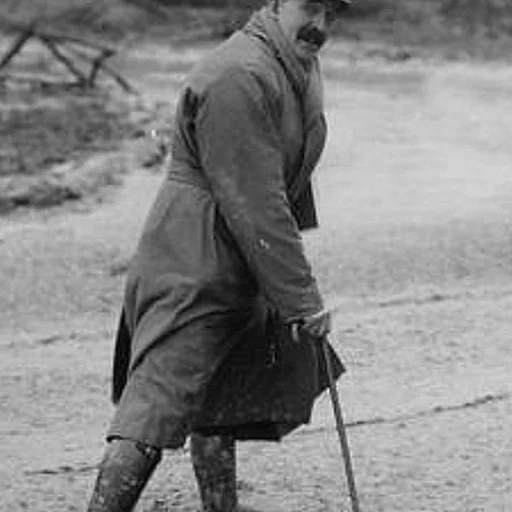
Sir Muirhead Bone (23 March 1876 – 21 October 1953) was a Scottish etcher and watercolourist who became known for his depiction of industrial and architectural subjects and his work as a war artist in both the First and Second World Wars.