Artwork
Sir Francis Drake
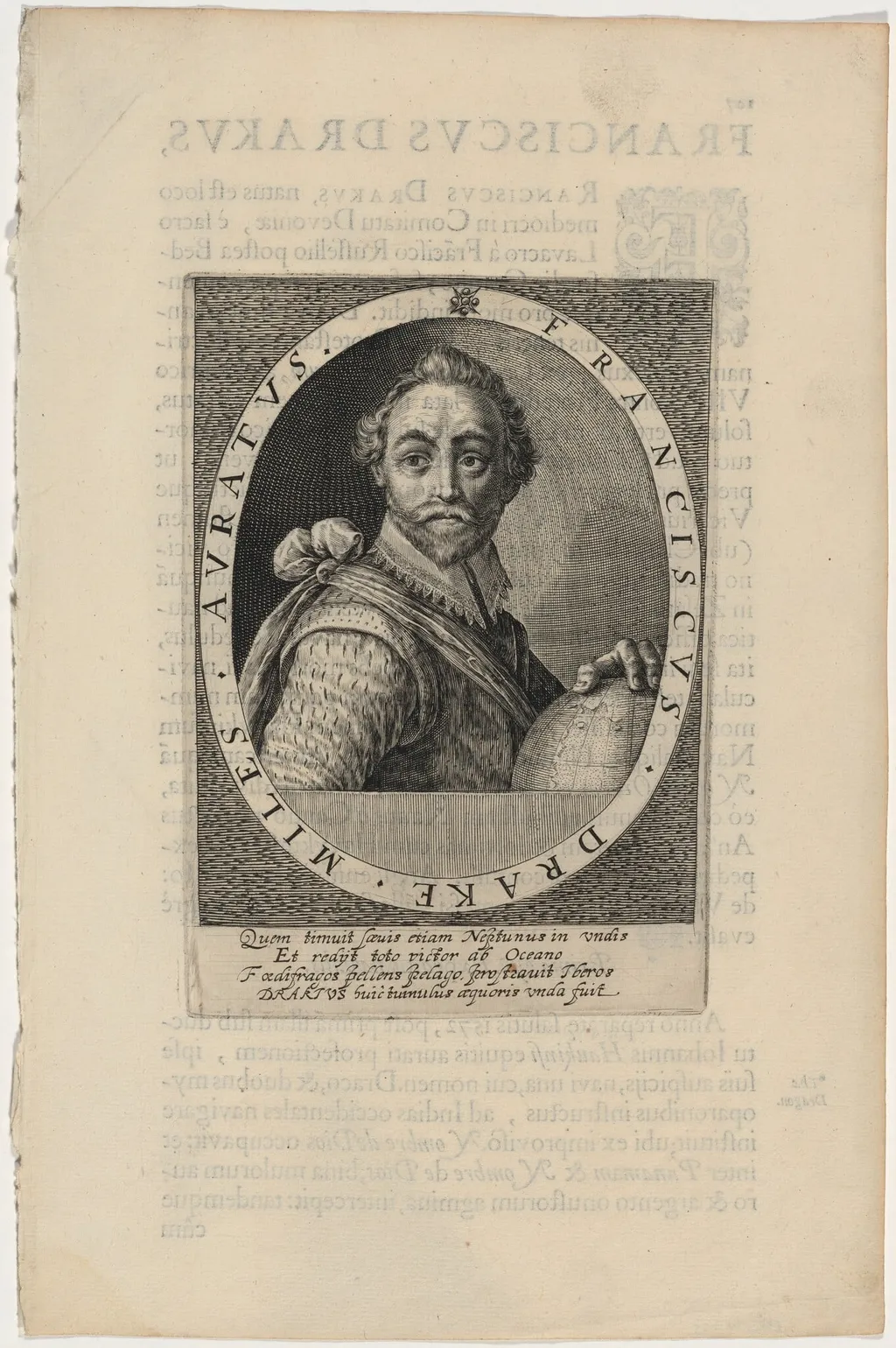
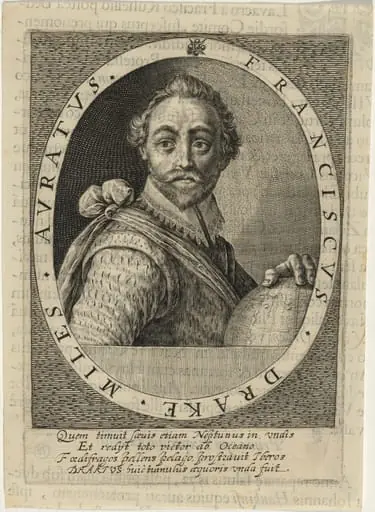
Sir Francis Drake is an ink print by the Baroque artist Willem de Passe. It dates from 1620 and is held in the collection of the National Gallery of Art.
About this work
Overview
The portrait is framed by inscriptions: his name in English above and Latin text below, likely a biographical or honorific verse.
This 1620 engraving by Willem de Passe depicts Sir Francis Drake in profile, rendered in fine black-and-white lines on paper. The image is contained within an oval border, formed by closely spaced incised marks typical of engraving technique. The portrait is framed by inscriptions: his name in English above and Latin text below, likely a biographical or honorific verse. The composition emphasizes formality and authority, characteristic of early 17th-century portraiture in print.
Subject & Meaning
Sir Francis Drake, the English navigator and privateer, is portrayed with solemnity and dignity. His thick beard, curled hair, and high ruff collar reflect the fashion of Elizabethan elites, while his steady gaze and clenched hand holding a rolled document suggest resolve and intellectual authority. The image functions as a commemorative portrait, reinforcing his status as a national figure following his circumnavigation and service to the Crown.
Technique & Style
The portrait was executed using metal engraving, a process in which fine lines are incised into a copper plate with a burin. De Passe employed meticulous cross-hatching and stippling to model facial features, capturing texture in the beard, the sheen of fur, and the crispness of the ruff. The background remains unadorned, directing focus to the face and attire. The oval frame is defined by a continuous line of tiny, repeated marks, a hallmark of de Passe’s precision.
History & Provenance
Created in 1620, the engraving was produced during the early Stuart period, when interest in Elizabethan heroes remained strong. Willem de Passe, a Dutch engraver active in England, specialized in portraiture for aristocratic and naval figures. This print likely circulated among collectors and institutions as a visual record of Drake’s legacy, possibly commissioned or licensed by his family or associates after his death in 1596.
Context
In the decades following Drake’s death, his exploits were mythologized in England as symbols of maritime prowess and Protestant defiance. Engravings like this one served to disseminate his image beyond elite circles, reinforcing national identity through visual culture. De Passe’s work was part of a broader European trend of producing portrait prints of notable figures, blending artistic skill with political commemoration.
Legacy
This engraving became one of the most widely reproduced images of Drake, shaping his visual identity for centuries. Its formal composition and detailed rendering influenced later depictions in textbooks and public monuments. Though not the only portrait of him, it remains a key reference for historians due to its proximity to his lifetime and the authority of its maker, who was known for accuracy in likenesses.
Artist & collection