Artwork
Sf. Teodor Tiron
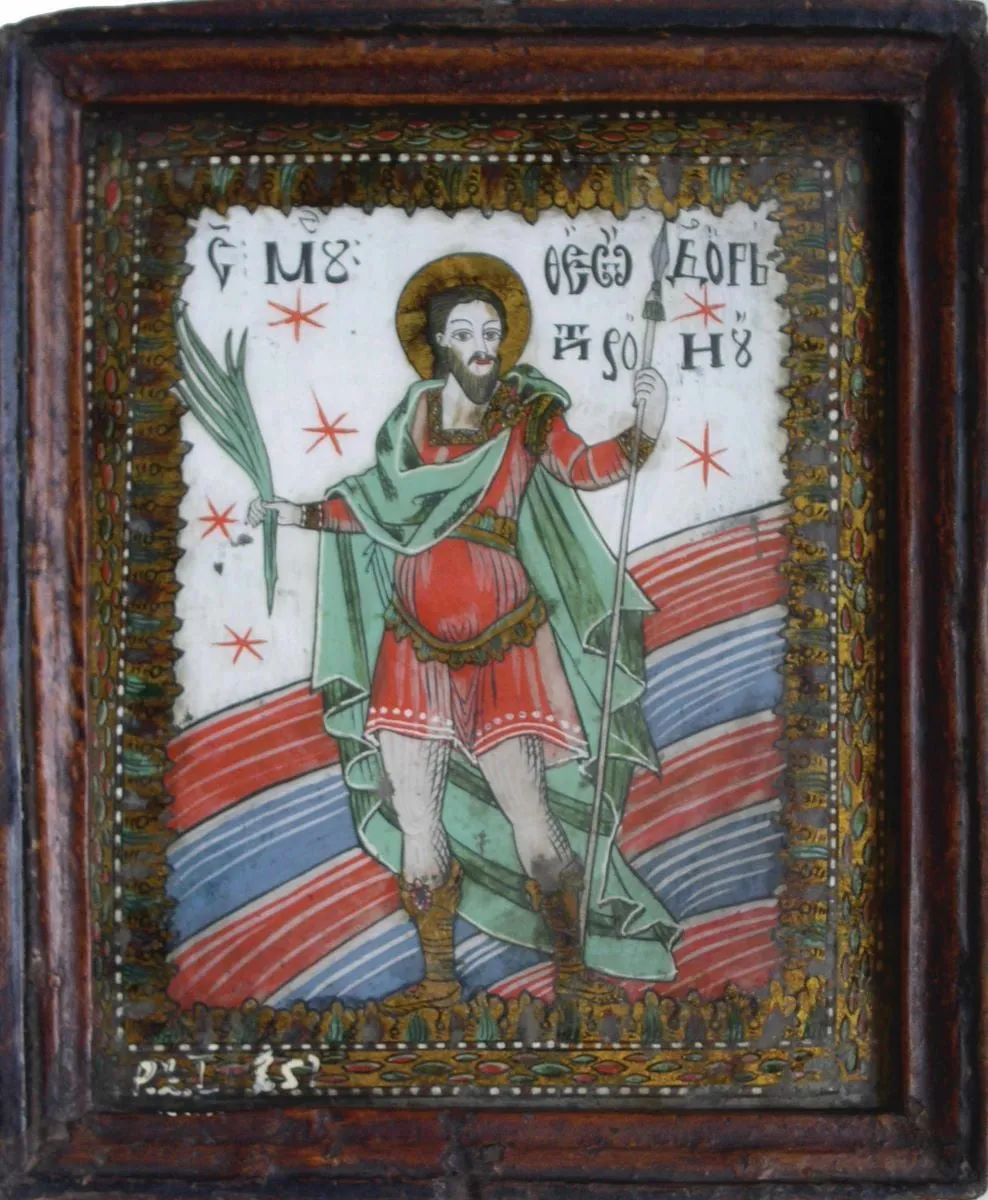
Sf. Teodor Tiron is a drawing by Petru din Topârcea. It is held in the collection of the Alba Iulia Orthodox Archdiocese. This religious panel portrays Saint Theodore Tiron, a soldier-saint venerated in Eastern Christian traditions.
About this work
Overview
Rendered on a flat, white ground with red star motifs, the figure stands rigidly frontal, framed by an ornamental border.
This religious panel portrays Saint Theodore Tiron, a soldier-saint venerated in Eastern Christian traditions. Rendered on a flat, white ground with red star motifs, the figure stands rigidly frontal, framed by an ornamental border. The composition follows Byzantine conventions, emphasizing symbolic presence over naturalism. The saint’s attire and attributes align with standard iconographic types used in liturgical contexts.
Subject & Meaning
Saint Theodore Tiron is depicted as a warrior-saint, holding a spear—symbolizing spiritual combat—and a palm branch, signifying martyrdom and victory over death. His red and green robes may reflect traditional color symbolism: red for blood shed in faith, green for eternal life. The halo confirms his sanctity. The image functions as a devotional object, intended to inspire reverence and invoke the saint’s intercession.
Technique & Style
The painting employs tempera or similar pigments on a rigid support, with flat planes of color and minimal shading. Details are rendered with precise, linear strokes, typical of late medieval icon painting. The decorative border and star motifs suggest regional craftsmanship, possibly influenced by Byzantine or local Romanian traditions. The lack of perspective and spatial depth reinforces its liturgical purpose over illusionistic realism.
History & Provenance
Attributed to Petru din Topârcea, a 15th-century painter active in Moldavia, this work likely originated in a monastic or church setting. Its survival suggests it was preserved within a religious community, possibly removed from an altar screen or wall. Documentation is sparse, but stylistic parallels place it within the broader corpus of Moldavian iconography from the late medieval period.
Context
Created during a time when Orthodox Christian communities in Eastern Europe relied heavily on icons for worship and teaching, this image reflects the enduring influence of Byzantine models. Regional variations, such as the star decoration and color choices, indicate local adaptation. Such panels were central to private and communal devotion, especially in areas where literacy was limited and visual symbols conveyed theological truths.
Legacy
Works like this one contribute to the understanding of Moldavian religious art’s continuity with Byzantine traditions while revealing local aesthetic choices. Though not widely known outside regional studies, Petru din Topârcea’s output helps trace the evolution of icon painting in the Danubian Principalities. The survival of such panels underscores the resilience of devotional practices through centuries of political change.
Artist & collection
Artist
This Romanian artist painted vivid religious scenes on wood—think bold colors against dark backgrounds, fine linework, and ornate frames.

 Arhanghelul Mihail
 Sf. Nicolae
 Maica Domnului cu Pruncul
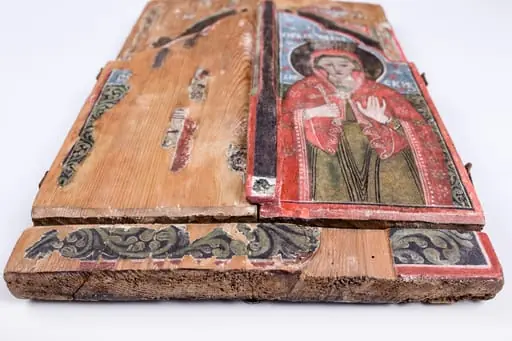 Tripticul de față are pe laterala din stângă o icoană, care o reprezintă pe Sfânta Mare Cuvioasă Parascheva din Epivat, Tracia, cu Sfintele Moaște la Iași. Are crucea în mâna dreaptă și o ramură de finic în mâna stângă. Este îmbrăcată în cămașă lungă albă - sacos, acoperit cu veșmânt roșu vermillon, cu interiorul căptușit cu verde și griuri. Maforiomul este închis la gât cu o broșă - fibulă. Peste maforionul roșu, sfânta cuvioasă are coroniță și aureolă. Fondul icoanei este cerul albastru de un ton cobalt, cu stele roșii. Icoana este foarte frumos realizată artistic și estetic, finețea nuanțelor cromatice și expresivitatea sfintei cuvioase remarcându-se într-un mod deosebit. Inscripția din româno-chrilică se traduce Sf Parascheva. Cromatica este armonioasă: roșu, albastru, verde, gri, negru, alb.
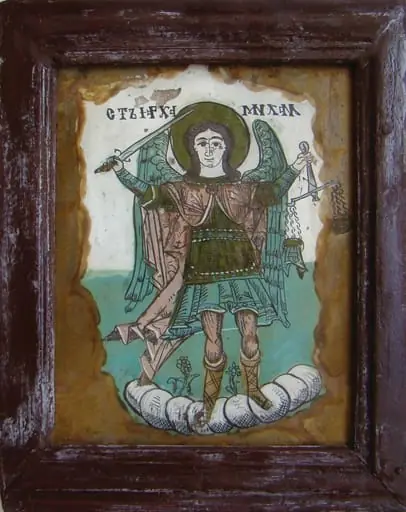
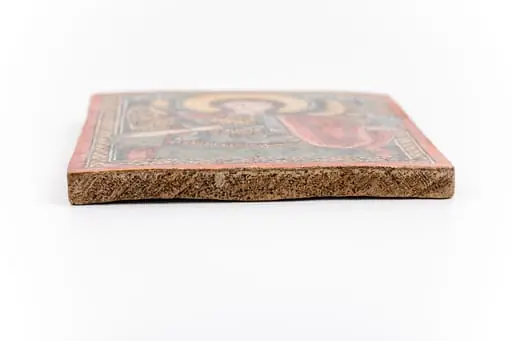 Sfântul Arhanghel Mihail este unul dintre mai-marii voievozi ai oștilor cerești. Sfântul Arhanghel Mihail este numit slujitorul Legii. Este îmbrăcat în haine de oștean militar, cavaler, cu cămașă verde, vestă de zale, cu solzi aurii, cu tunică și mantie roșie-vermillon. Ține în mâna dreaptă spada de război ridicată, fiind un sfânt luptător și apărător al Creștinismului și în mâna stângă Potirul pictat cu nuanțe de negru-gri-alb, pentru a arăta argintul. Are aureolă și aripi ocru-galbene. Fondul icoanei este negru. Icoana are un chenar decorativ geometrizant, bogat ornamentat, format dintr-un lanț împletit de romburi ondulatorii, pictate cu roșu și galben alternativ. Rama pictată din aceeași bucată de lemn a icoanei este roșie-cărămizie. Trăsăturile feței sunt foarte fin realizate, cu minuțiozitatea detaliului. Cromatica armonioasă este alcătuită din: roșu-vermillon, cărămiziu, ocru-galben, verde, gri,brun-roșcat, alb, bej, negru, acajou. Inscripția din româno-chirilică se traduce Sfântul Arhanghel Mihail.
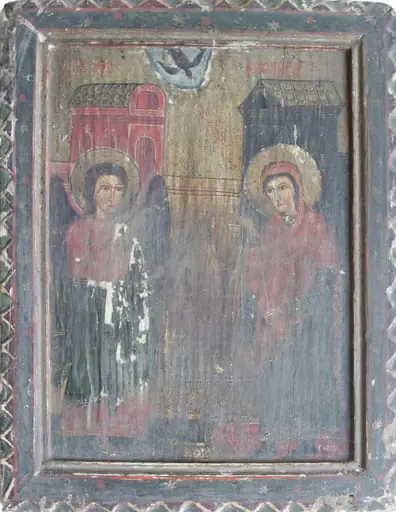 Buna Vestire
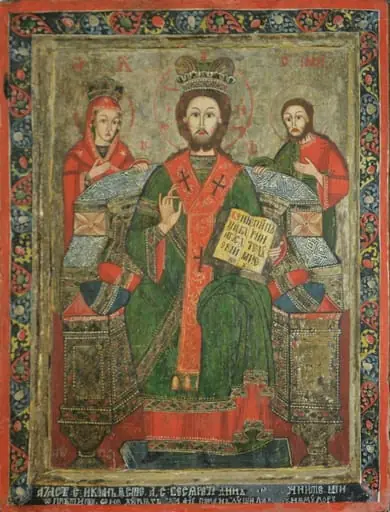 Deisis
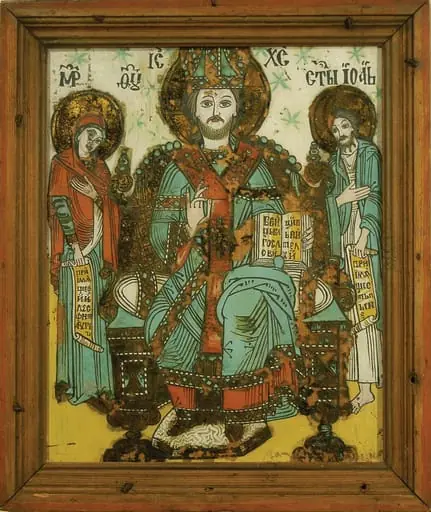 Deisis
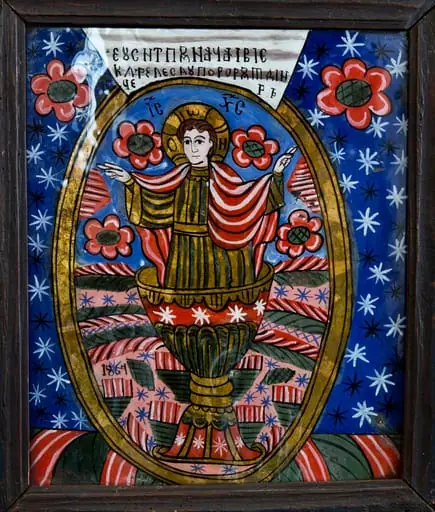 Emanuel în potir
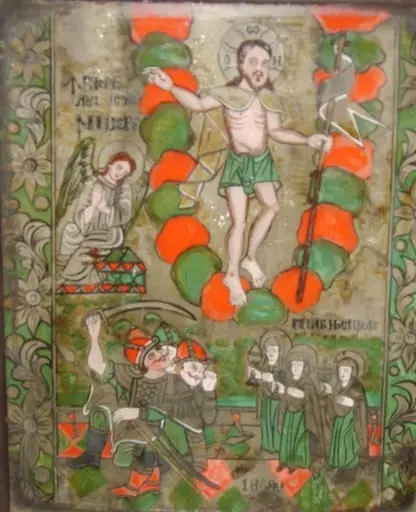 Învierea lui Iisus
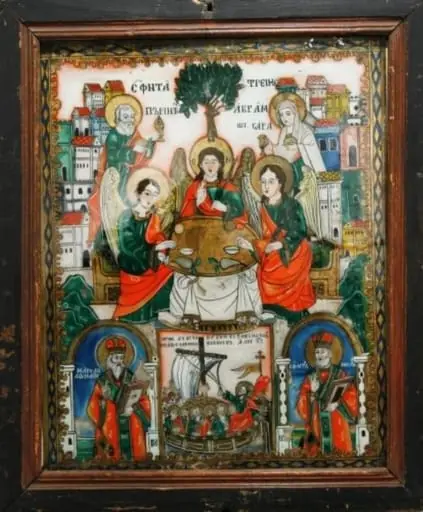 Sfânta Treime (Sfânta Troiță, Filoxenia, Cina de la Mamvri)
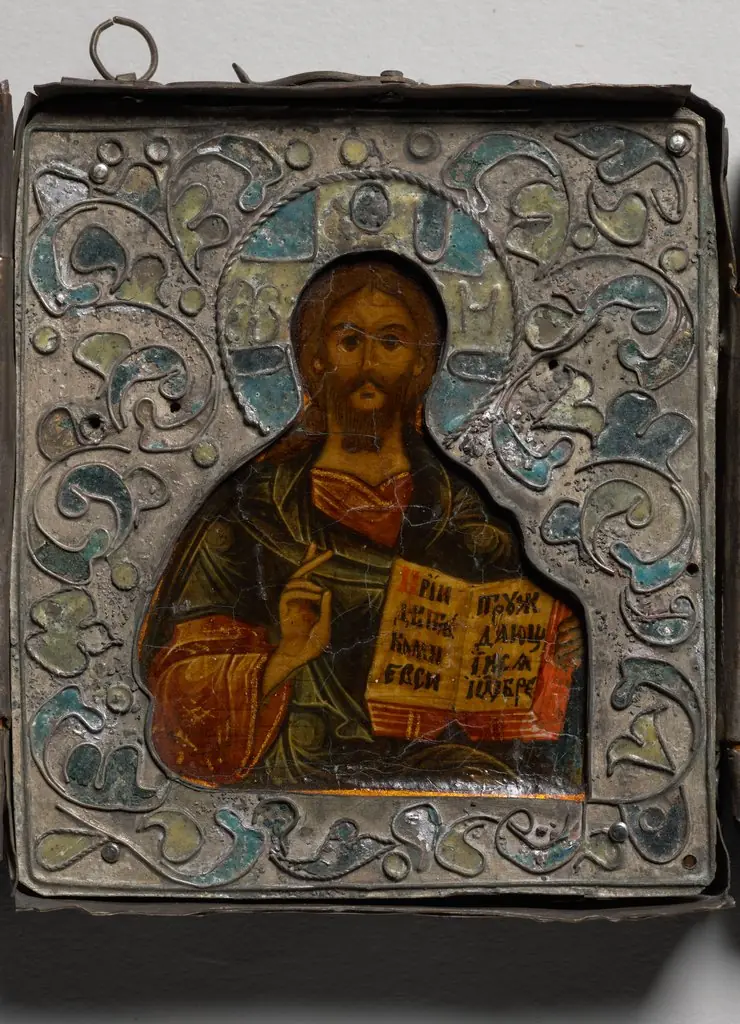 Christ
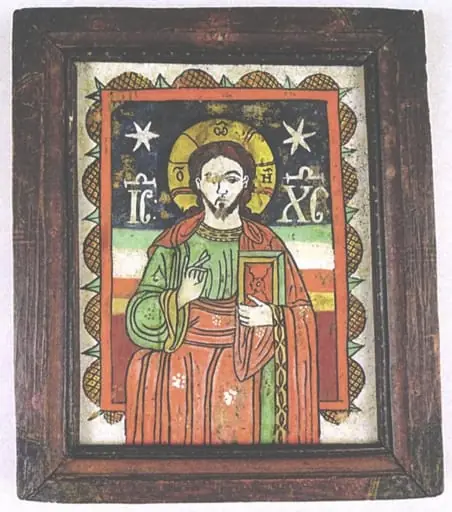 Iisus Hristos binecuvântând
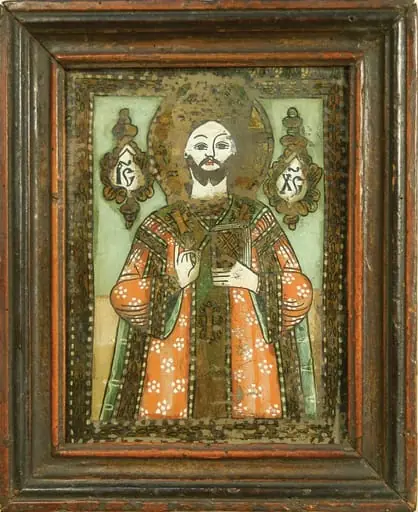 Iisus Hristos Mare Arhiereu și Învățător
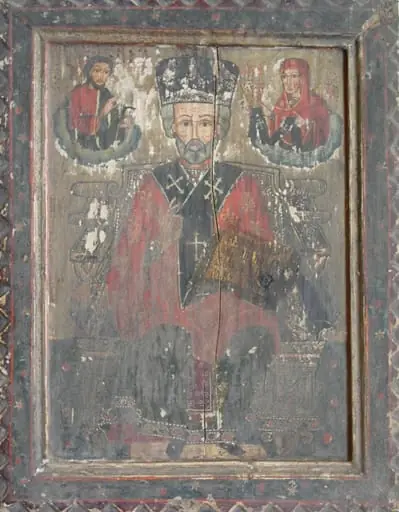
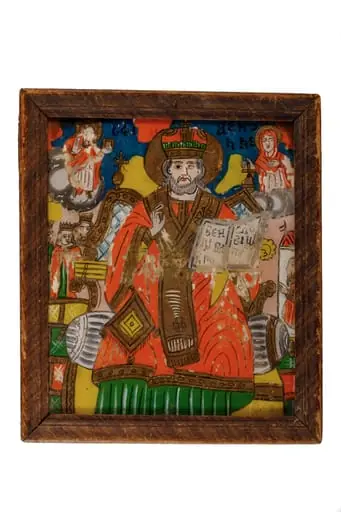 Icoană pictată pe sticlă reprezentând pe Sf. Nicolae. Sfântul este prezentat pe tron, față, bărbat tânăr, plete, barbă scurtă, cu dreapta binecuvântând, iar în stânga ține Evanghelia. Sus este încadrat de Iisus și Maria care îi oferă Evanghelia și omoforul. Stânga, la nivelul brațului, trei personaje în picioare și în dreapta o clădire și o mână (?) întinsă. Omoforul auriu cu cruci se evidențiază pe haina roșie cu linii ce marchează anatomia corpului. Icoana este înrămată.
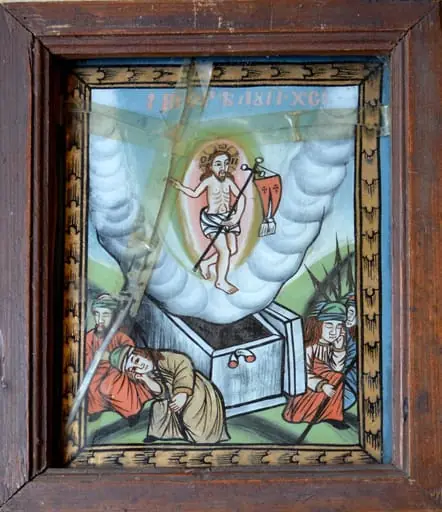 Învierea Domnului
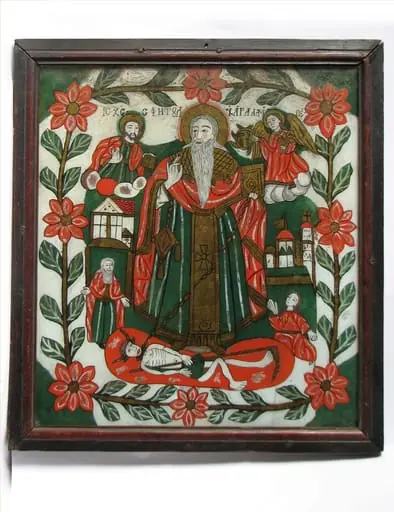 Sfântul Mare Mucenic Haralambie
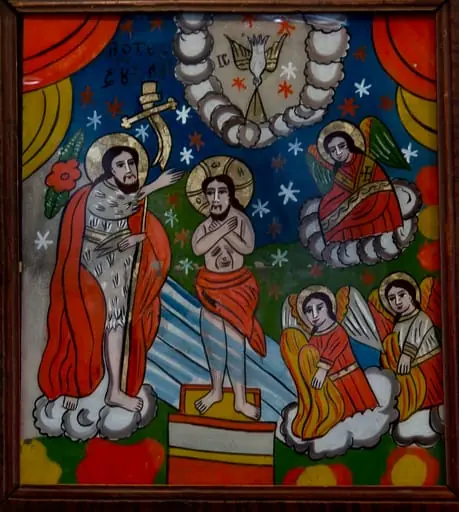 Botzezul lui IS HS
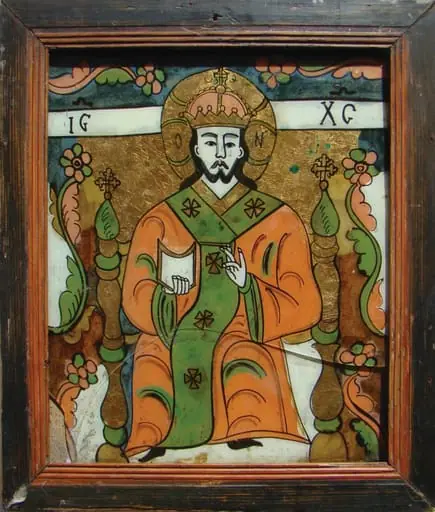 Iisus Hristos Mare Arhiereu și Învățător, tronând
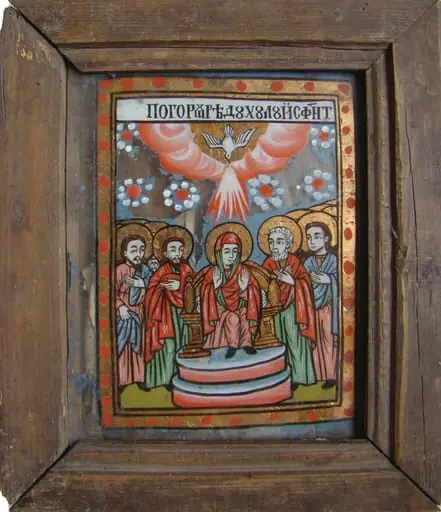 Pogorârea Sf. Duh