Artwork
Cape Ann Willows
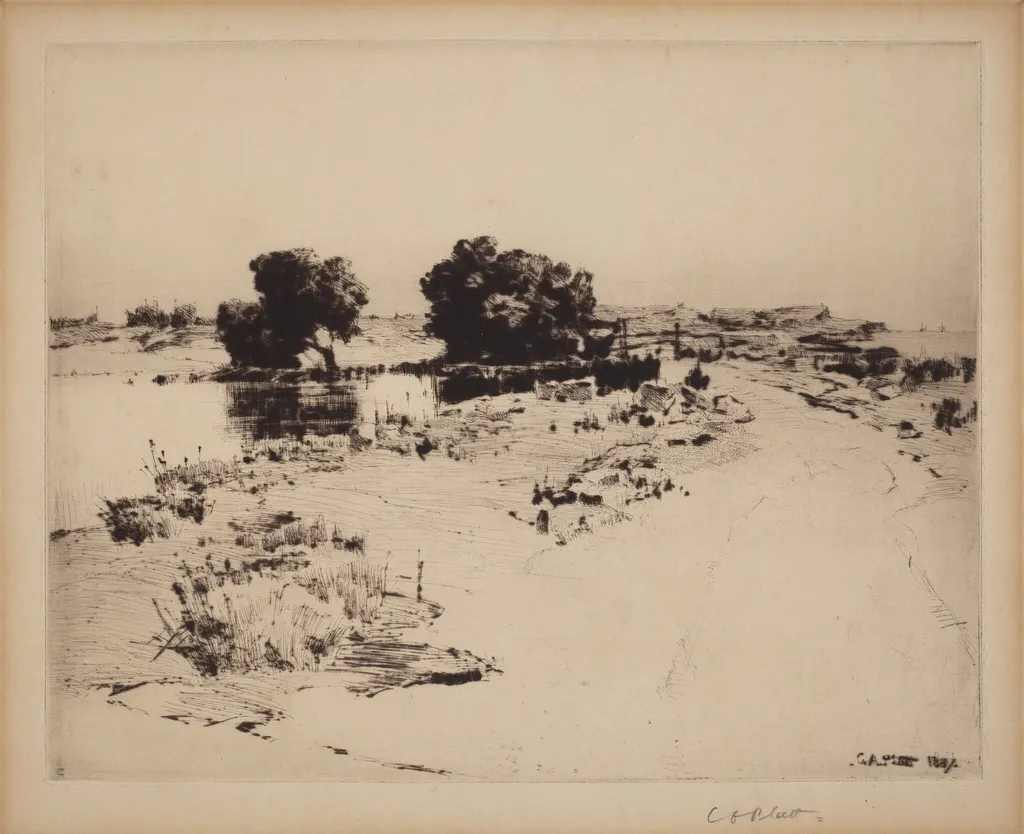
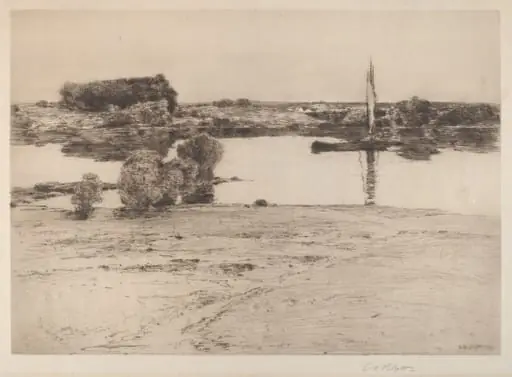
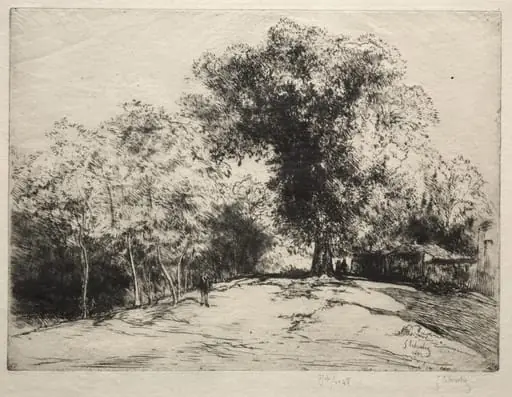
Cape Ann Willows is an ink print by the Impressionist artist Charles A. Platt. It dates from 1887 and is held in the collection of the National Gallery of Art.
About this work
Overview
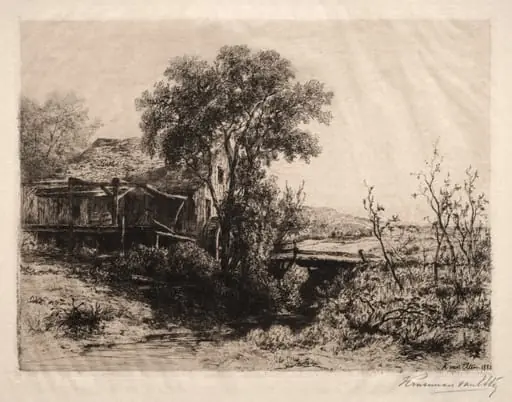
Cape Ann Willows is a black-and-white drypoint print made by Charles A. Platt in 1887. It captures a quiet coastal scene in Massachusetts, featuring willow trees and grasses in the foreground with a stretch of water beyond. The work is rendered entirely in tonal gradations of gray, using the fine, incised lines characteristic of drypoint to suggest texture and atmosphere without color.
Subject & Meaning
The print depicts a tranquil stretch of shoreline near Cape Ann, emphasizing the interplay between land and water. Willows bend over the edge of the water, their forms softened by the medium’s subtle grain. The composition conveys stillness and observation rather than narrative, inviting attention to the quiet rhythms of nature rather than dramatic event or symbolism.
Technique & Style
His handling of tone relies on density and line variation rather than hatching, creating a muted, atmospheric effect.
Platt employed drypoint, a printmaking method involving scratching lines directly into a metal plate. The resulting burr holds ink, producing rich, velvety blacks and soft grays. His handling of tone relies on density and line variation rather than hatching, creating a muted, atmospheric effect. The technique aligns with late 19th-century interest in direct, tactile mark-making over polished finish.
History & Provenance
Created during Platt’s early career, Cape Ann Willows reflects his time spent in New England, where he studied landscape and architecture. The print was likely made as part of a personal exploration of regional scenery, not for commercial sale. It remains among his lesser-known graphic works, preserved in institutional collections focused on American printmaking of the period.
Context
In the 1880s, American artists increasingly turned to intimate natural scenes, influenced by European Realism and early Impressionism. Platt, trained in architecture, approached landscape with structural sensitivity. His drypoints, like this one, reflect a broader trend among artists seeking to capture light and form through direct, unembellished observation, distinct from academic painting conventions.
Legacy
Though Platt is better known for his architectural designs, Cape Ann Willows stands as a quiet example of his graphic sensitivity. The print contributes to the understated tradition of American etching and drypoint, valued for its restraint and technical precision. It remains a reference point for scholars examining the intersection of drawing, printmaking, and landscape in post-Civil War American art.
Artist & collection