Artwork
Biserica Stavropoleos
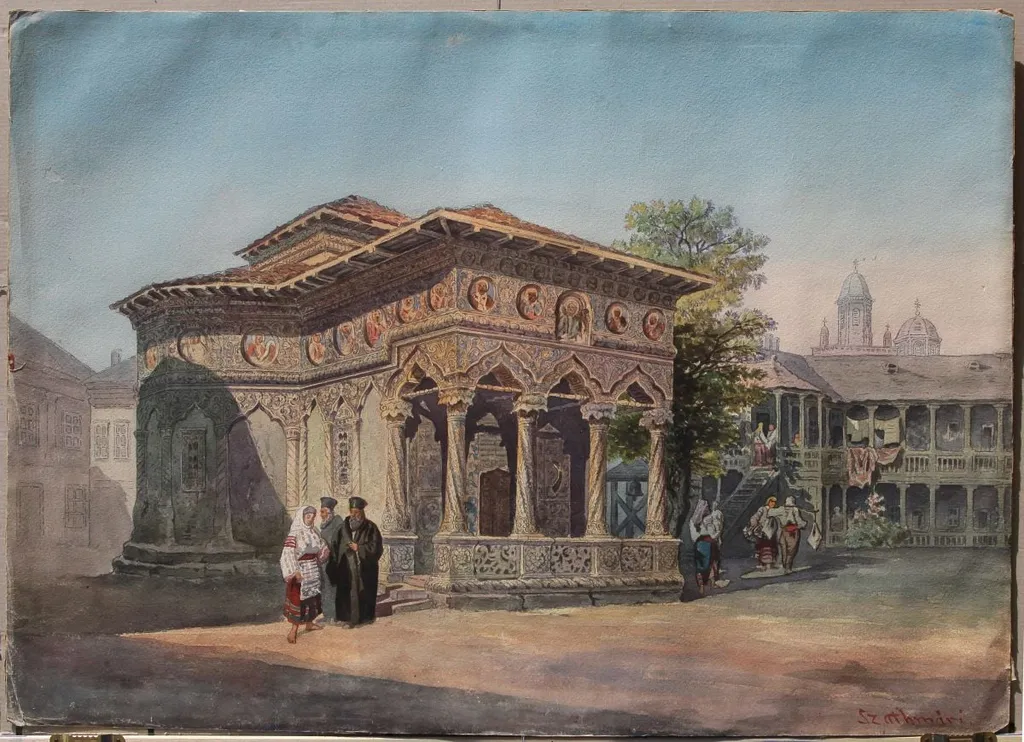
Biserica Stavropoleos is an unspecified painting by Carol Popp de Szathmary. It dates from 1859 and is held in the collection of the Museum of Art Cluj-Napoca.
About this work
Overview
Painted around 1859 by Carol Popp de Szathmary, this work depicts the Stavropoleos Monastery in Bucharest. Rendered in oil on canvas, the piece captures the building in a quiet, early morning light. It is part of the collection at the Museum of Ethnography, where it serves as a visual record of 19th-century Romanian religious architecture and urban life.
Subject & Meaning
The painting centers on the Stavropoleos Church, a small but ornate Eastern Orthodox monastery. Figures near the entrance—a woman in a white dress with red trim and two men in dark attire—suggest daily devotional activity. The stillness of the street and distant dome imply a contemplative atmosphere, reflecting the church’s role as a spiritual anchor within the city’s fabric.
Technique & Style
Szathmary employed subtle chiaroscuro to model the church’s arched doorway and tiled roof, enhancing volume through soft transitions of light and shadow.
Szathmary employed subtle chiaroscuro to model the church’s arched doorway and tiled roof, enhancing volume through soft transitions of light and shadow. Colors are muted yet deliberate: warm terracottas contrast with cool grays in the surrounding buildings. Delicate brushwork renders the carved stone details and decorative wall patterns with precision, avoiding theatricality in favor of quiet observation.
History & Provenance
Created during a period of cultural revival in Wallachia, the painting was likely made as part of a broader effort to document architectural heritage. It entered the Museum of Ethnography’s collection in the late 19th or early 20th century, where it has remained as a key example of Romanian topographical art from the mid-1800s.
Context
In the 1850s, Romanian artists began turning to local subjects as national identity took shape. The Stavropoleos Church, founded in the 18th century, was one of Bucharest’s few remaining Ottoman-era religious structures. Szathmary’s depiction aligns with a growing interest in preserving vernacular architecture amid modernization.
Legacy
The painting remains a reference for scholars studying 19th-century Romanian urban landscapes. Its restrained aesthetic influenced later documentary artists who sought to record heritage sites before they vanished. Though not widely exhibited, it endures as a quiet testament to the architectural and social rhythms of its time.
Artist & collection

Artist
Carol Szathmari was a Romanian painter, lithographer, and photographer of Transylvanian Hungarian origin, who was based in Bucharest from the age of 18 until his death.
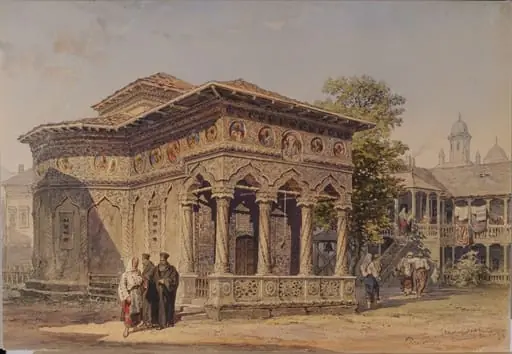 Biserica Stavropoleos
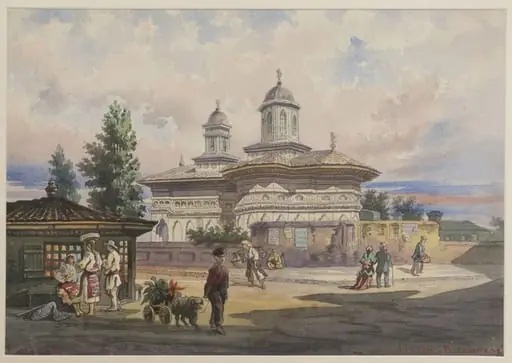 Biserica Batiștei
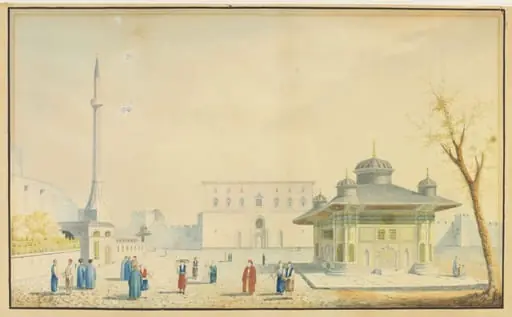 The Bab-i Hümayün or Imperial Gate of Topkapi Sarayi, with the Fountain of Sultan Ahmet III
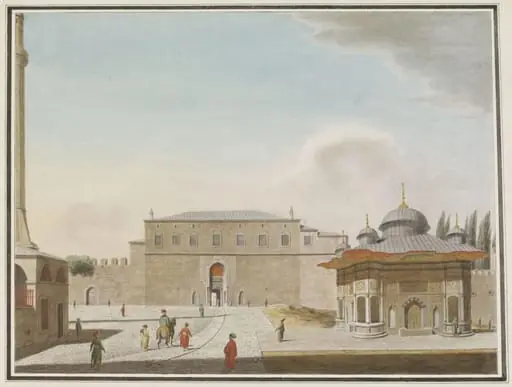 Bab-i-Hümayün (Imperial Gate) to Topkapi Sarayi, with the Fountain of Sultan Ahmet III
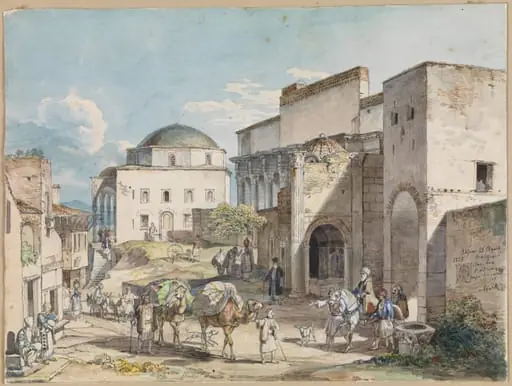 Gadeparti i Athen. Med Hadji Hazekis' palads og Tzistarakis Moskeen
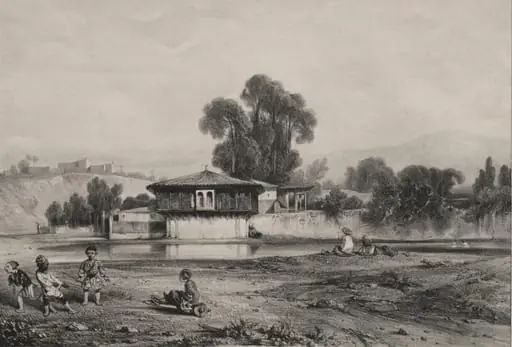 Pavilion at the Edge of a River
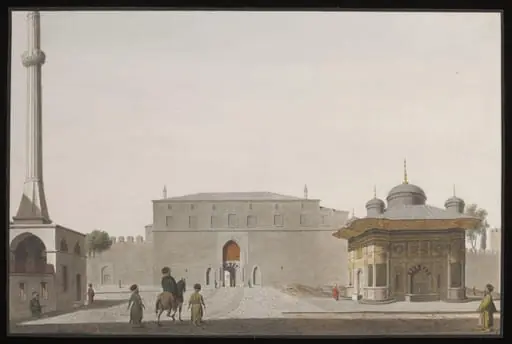 Bab-i-Hümayün (Imperial Gate) to Topkapi Sarayi, with the Fountain of Sultan Ahmet III
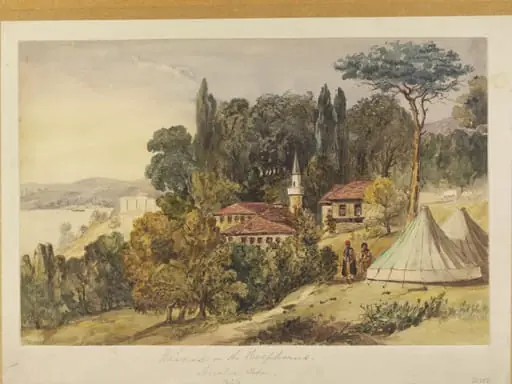 Beicos on the Bosphorus. Asiatic Side
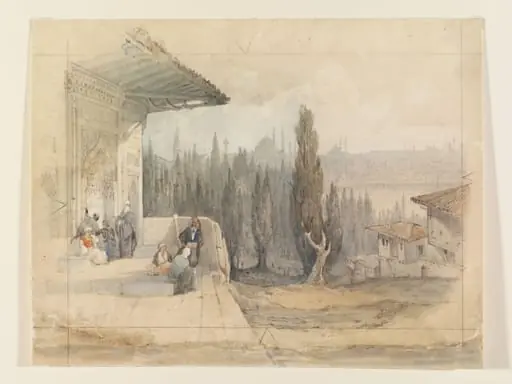 Pera
Pera![Kirkclisia [Kirklareli] 40 leagues from Constantinople, by Luigi Mayer](https://artifactworldgallery.com/img/luigi-mayer--kirkclisia-kirklareli-40-leagues-from-constantinople--fb21c76d0b35aeb7-w320.webp) Kirkclisia [Kirklareli] 40 leagues from Constantinople
Kirkclisia [Kirklareli] 40 leagues from Constantinople Scene at a Fountain outside a cemetery, probably Smyrna