Artwork
Maica Domnului îndurerată
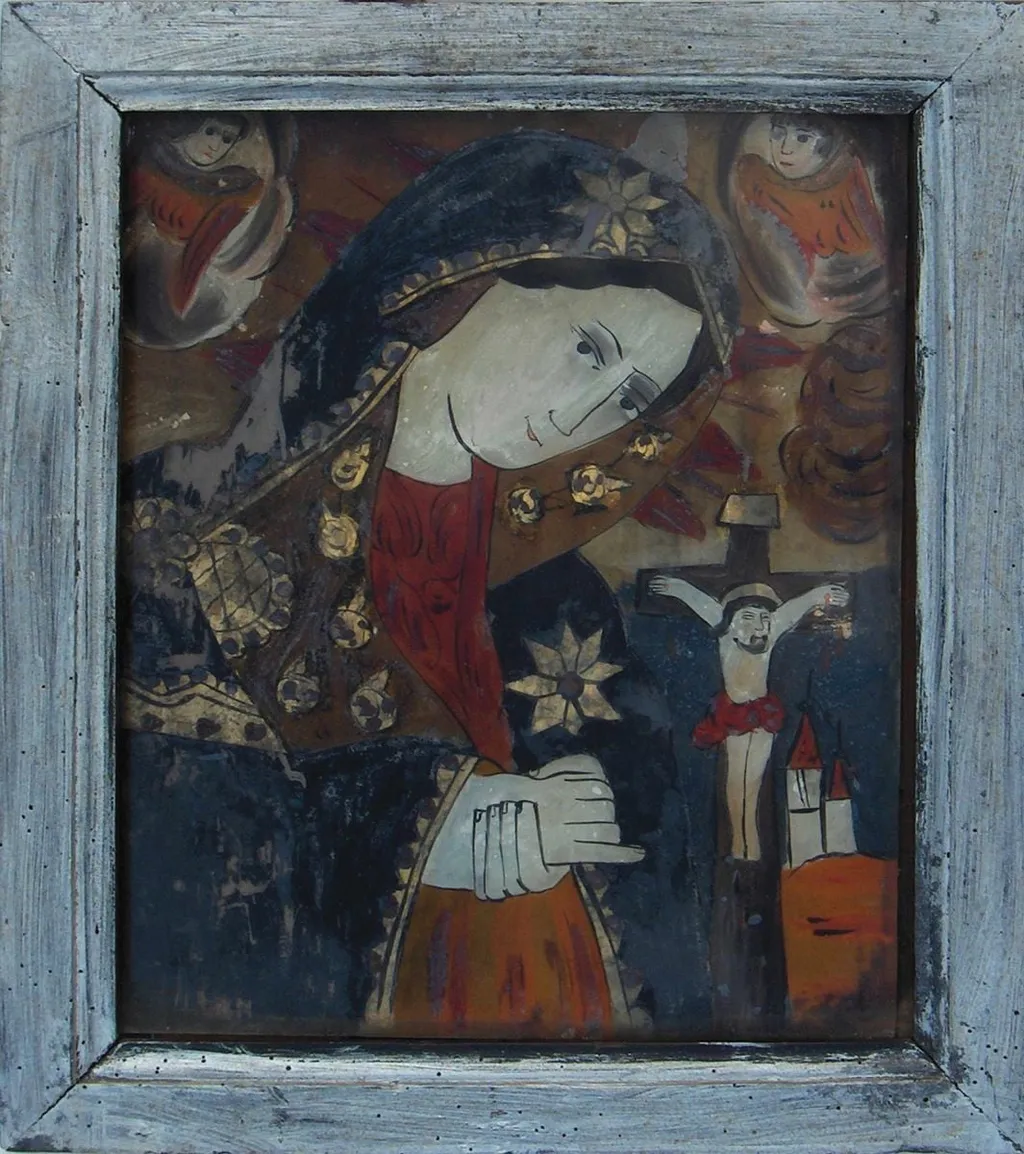
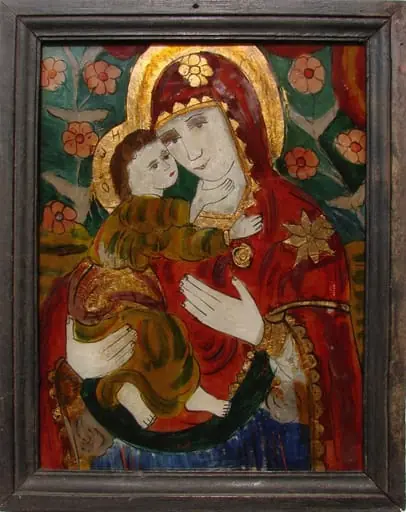
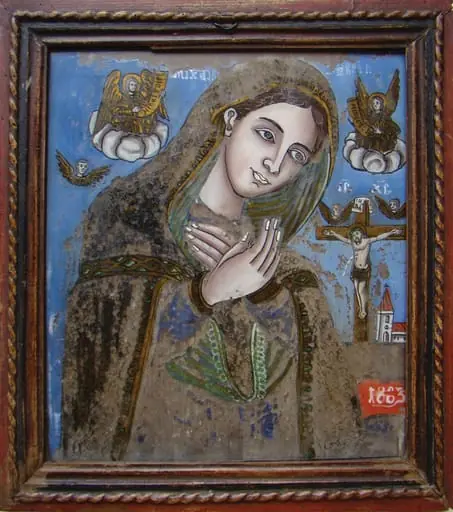
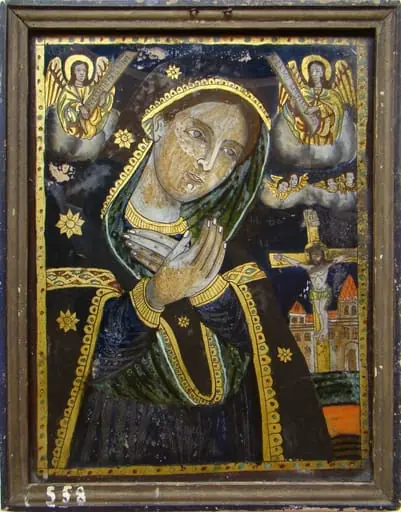
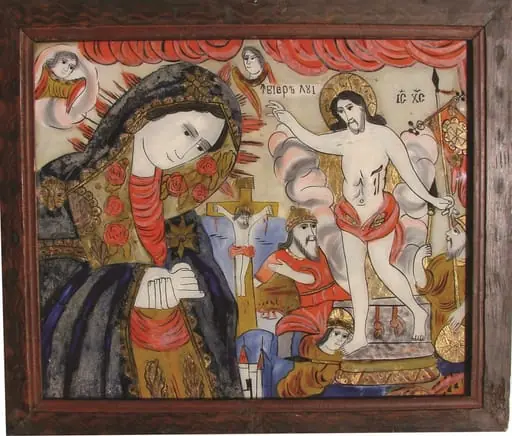
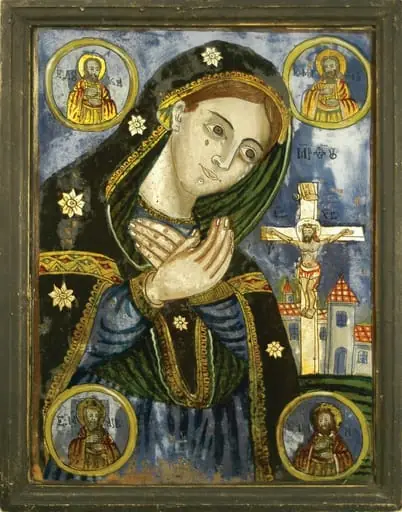
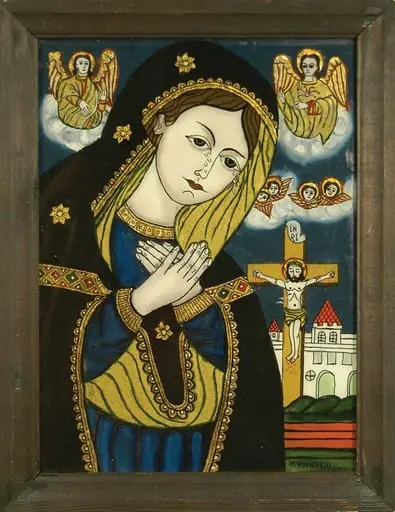
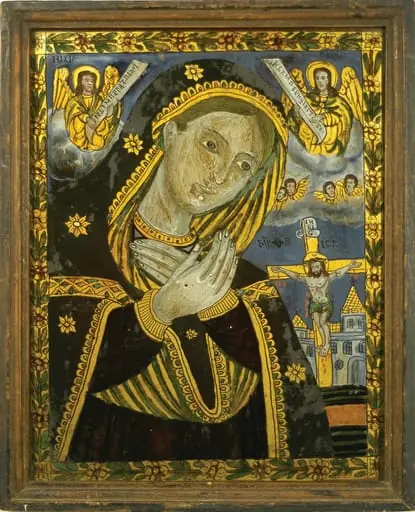
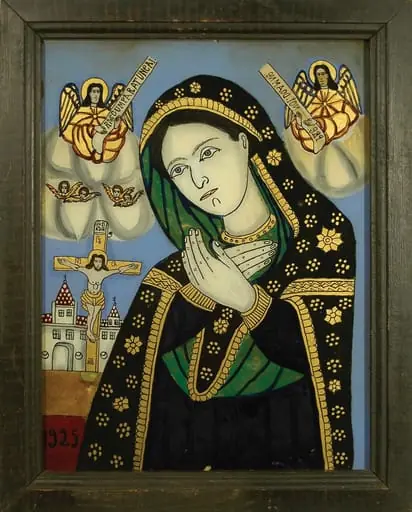
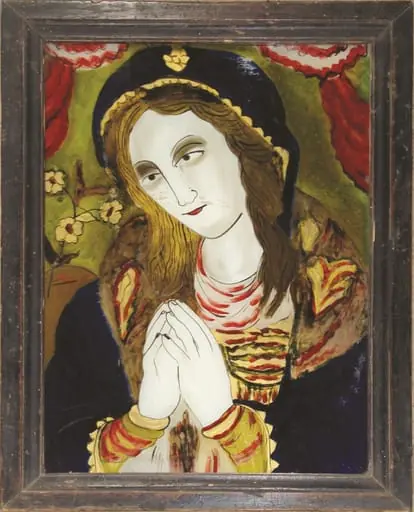
Maica Domnului îndurerată is an unspecified painting by the Byzantine icon painting artist Petru Prodan. It is held in the collection of the Alba Iulia Unification National Museum. This devotional image depicts the Virgin Mary in mourning, holding a staff while gazing downward.
About this work
Overview
This devotional image depicts the Virgin Mary in mourning, holding a staff while gazing downward. Behind her, a rigid figure on a cross suggests the crucified Christ. The composition is sparse, with minimal spatial depth and flat, muted colors. Gold stars and deep blue tones frame the scene, while two faint faces hover above Mary’s head, hinting at spiritual presence.
Subject & Meaning
The scene illustrates the Virgin Mary’s sorrow following Christ’s crucifixion, a common theme in Eastern Christian iconography. The staff may symbolize her role as intercessor or the Tree of Life. The floating faces likely represent divine witnesses or angels, reinforcing the sacred nature of her grief. The imagery emphasizes contemplation over narrative drama.
Technique & Style
Painted with simplified forms and minimal shading, the figures appear stylized rather than naturalistic. Mary’s face is rendered in quick, linear strokes; Christ’s body is angular and flat, resembling a cut-out silhouette. The background uses unmodulated color fields with gold accents, typical of folk or provincial religious art where symbolic clarity outweighs illusionistic depth.
History & Provenance
The work appears to originate from a regional tradition in Eastern Europe, possibly 18th or 19th century, where liturgical images were produced by local artisans rather than academically trained painters. Its faded pigments and crude execution suggest it was made for domestic or village church use, not for urban ecclesiastical settings.
Context
Such images were common in rural Orthodox communities, serving as focal points for private prayer. They often blended canonical themes with local artistic conventions, prioritizing spiritual resonance over technical refinement. The inclusion of celestial figures above Mary reflects beliefs in the communion of saints and divine observation during moments of sacred sorrow.
Legacy
This piece exemplifies how religious devotion in marginalized regions sustained visual traditions outside mainstream artistic currents. Its simplicity and emotional directness influenced later folk art revivals and continue to inform studies of non-elite religious expression in Eastern Europe, offering insight into how faith was visually communicated beyond institutional norms.
Artist & collection
Artist
Petru Prodan painted religious scenes in the icon tradition. His works include *Sf. Nicolae* and *Prohodul lui Iisus*, showing saints and biblical figures in gold-leaf settings. The figures are stiff and frontal,…
Museum
Alba Iulia Unification National Museum
Continue through works from the same source collection.