Artwork
Tradescantia virginica
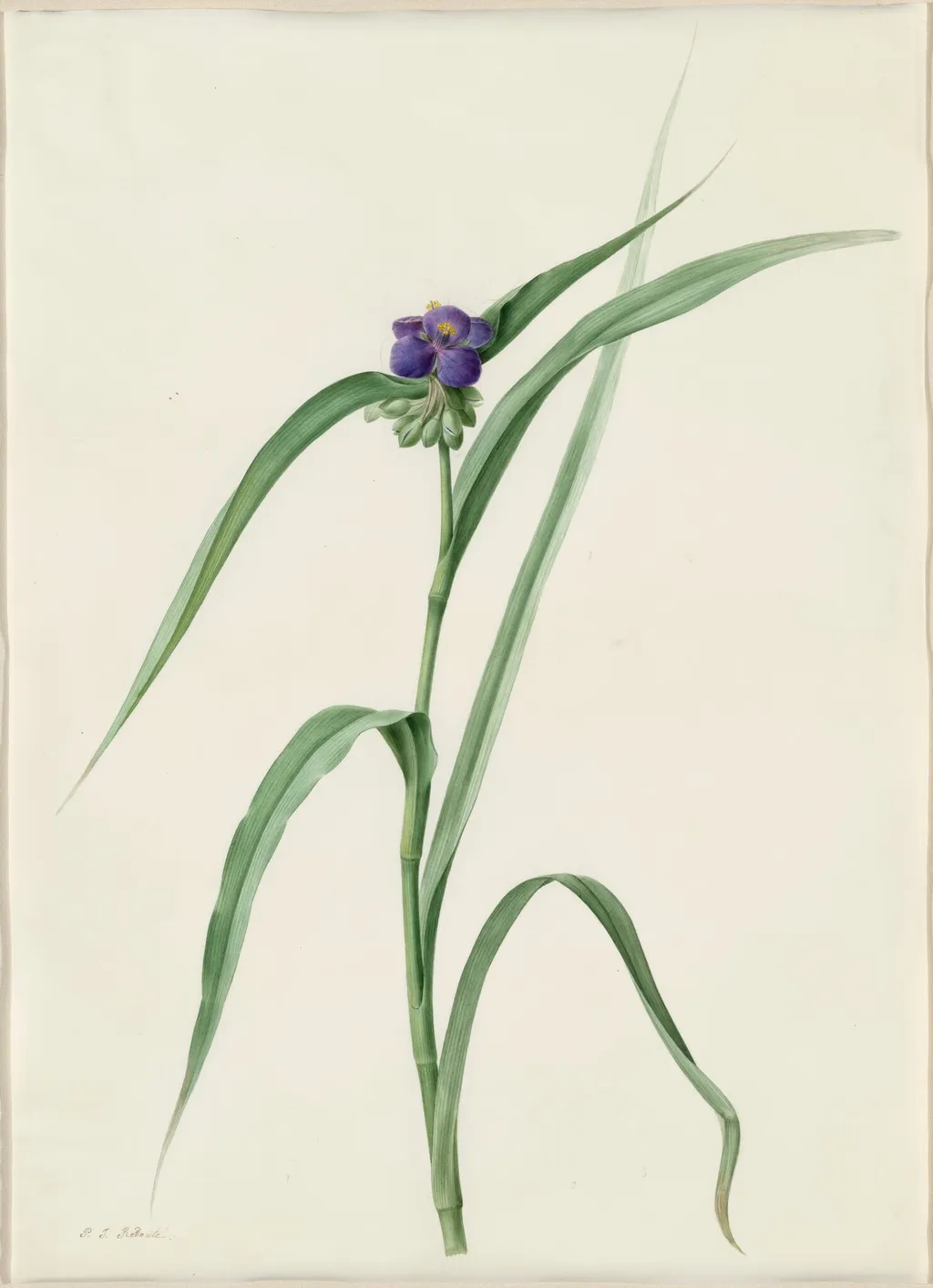
Tradescantia virginica is a watercolor drawing by the Romanticist artist Pierre Joseph Redouté. It dates from 1809 and is held in the collection of the National Gallery of Art.
About this work
Overview
The work is one of many precise botanical studies he produced during his career in France.
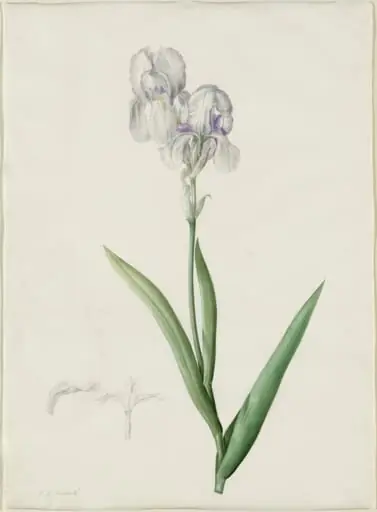
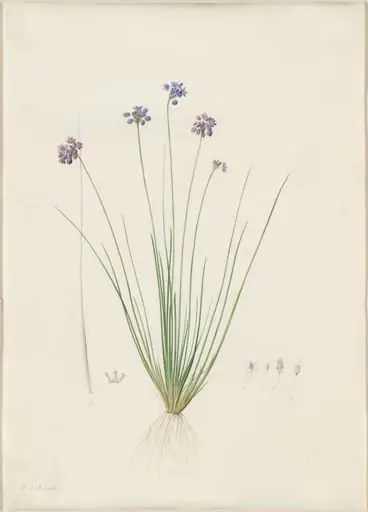
Pierre-Joseph Redouté created this watercolor and graphite drawing on vellum in 1809, depicting the Virginia spiderwort, a native North American flowering plant. The work is one of many precise botanical studies he produced during his career in France. Rendered on a thin, translucent support, the image emphasizes clarity and scientific accuracy over decorative flourish, reflecting the conventions of late 18th- and early 19th-century botanical illustration.
Subject & Meaning
The subject, Tradescantia virginica, is shown in full bloom with a single purple flower featuring six petals and a central cluster of yellow stamens. The plant grows from a slender, gently arched stem, flanked by long, narrow leaves with softly undulating edges. Rendered without context or habitat, the focus is entirely on the plant’s morphology, serving as a visual record for scientific study rather than symbolic or aesthetic expression.
Technique & Style
Redouté employed fine graphite lines to define structure, then layered translucent watercolor to suggest form and subtle tonal variation. The vellum surface enhances the delicacy of the pigments, allowing light to pass through and giving the leaves a luminous quality. Shading is minimal yet precise, particularly in the foliage, creating a sense of volume without heavy modeling. The absence of a background isolates the specimen, reinforcing its role as a scientific document.
History & Provenance
Created during Redouté’s tenure as a court artist in France, the drawing belongs to a larger body of work produced under royal patronage and later published in illustrated botanical volumes. Though originally made for scientific use, many of his drawings were reproduced as stipple engravings for wider dissemination. This particular piece entered the collection of the National Gallery of Art in Washington, D.C., where it remains as part of a significant archive of botanical art.
Context
Redouté worked during a period of intense botanical exploration and classification, when European naturalists sought to document global flora. His illustrations supported the work of institutions like the Jardin des Plantes and aligned with Enlightenment ideals of empirical observation. Despite political upheavals—including the French Revolution—he retained his position through successive regimes, underscoring the value placed on his technical skill and objectivity.
Legacy
Redouté’s drawings, including this one, became foundational references for botanical science and horticulture. His method of combining precise draftsmanship with delicate color application influenced generations of botanical illustrators. Though his works were widely reproduced, the original watercolors retain their significance as artifacts of scientific observation, valued for their fidelity and restraint.
Artist & collection

Artist
Pierre-Joseph Redouté (French pronunciation: , 10 July 1759 – 19 June 1840), was a painter and botanist from the Austrian Netherlands, known for his watercolours of roses, lilies and other flowers at the Château de…