Artwork
Discura longicauda (Racket-Tail)
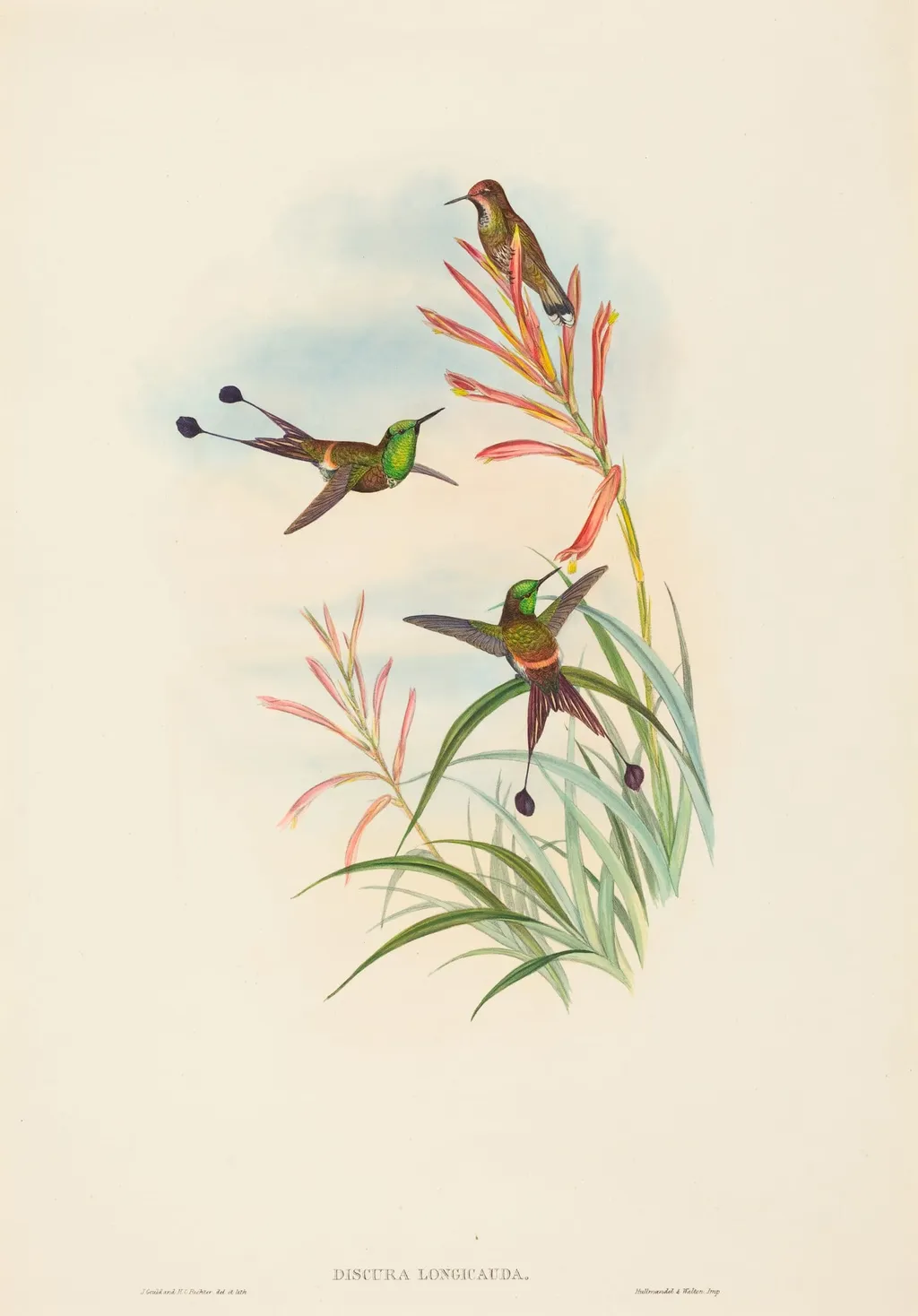
Discura longicauda (Racket-Tail) is an ink print by the Romanticist artist H.C. Richter. It dates from 1842 and is held in the collection of the National Gallery of Art. Created in 1842 by H.
About this work
Overview
The print captures the birds with meticulous detail, emphasizing their vivid green plumage and distinctive elongated tail feathers.
Created in 1842 by H.C. Richter, this hand-colored lithograph depicts three Racket-Tail hummingbirds, scientifically known as Discura longicauda. The print captures the birds with meticulous detail, emphasizing their vivid green plumage and distinctive elongated tail feathers. Rendered in a soft, light background, the composition directs attention to the birds’ forms and behavior, reflecting the era’s interest in natural history illustration.
Subject & Meaning
The three birds—two perched on a flowering branch, one suspended in flight—illustrate the species’ agility and feeding habits. The name Discura longicauda, meaning 'long-tailed,' directly references the unique racket-shaped tail feathers that define the bird. The image serves not as romanticized nature art, but as a precise visual record, aligning with 19th-century scientific efforts to document avian species through accurate depiction.
Technique & Style
Richter employed lithography, a printmaking method using stone surfaces to transfer ink, then added color by hand to achieve lifelike hues. The technique allowed fine lines and subtle gradations, essential for rendering the birds’ iridescent feathers and delicate floral details. The background remains muted, enhancing the clarity of the subjects and reinforcing the image’s scientific intent over aesthetic flourish.
History & Provenance
This print was produced during a period of heightened interest in natural history, when illustrated volumes were used to catalog newly observed species. Richter, known for his collaborations with zoologists, contributed to publications aimed at both scholars and the educated public. The work likely appeared in a scientific journal or monograph, though its exact original publication remains unconfirmed in available records.
Context
In the early 1840s, European naturalists were actively documenting global biodiversity, often relying on artists to translate specimens into visual form. Without photography, lithography offered a reliable means of reproduction. Richter’s work reflects this transitional moment in science, where art served as a critical tool for observation, classification, and dissemination of biological knowledge.
Legacy
Though the scientific name Discura longicauda is no longer in use—modern taxonomy has reclassified the species—the print endures as an example of 19th-century naturalist illustration. It preserves a visual record of how species were perceived and rendered before photographic documentation, offering insight into the intersection of art, science, and colonial-era exploration.
Artist & collection


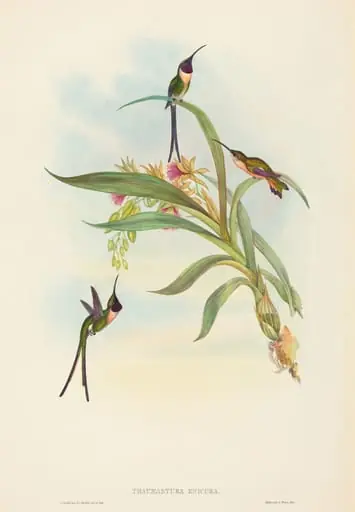 Tharmastura enicura (Slender Shear-Tail)
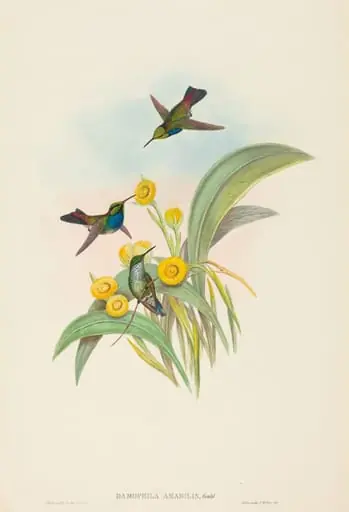 Damophila amabilis (Blue-breasted Hummingbird)
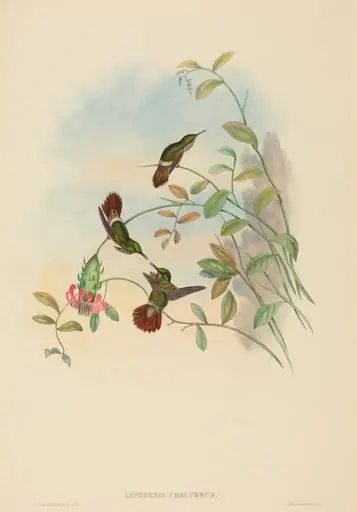 Lophornis chalybeus (Festive Coquette)
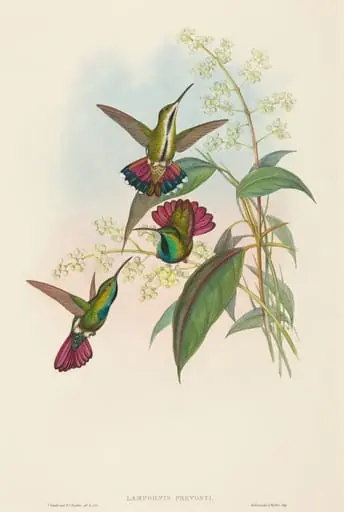 Lampornis prevosti
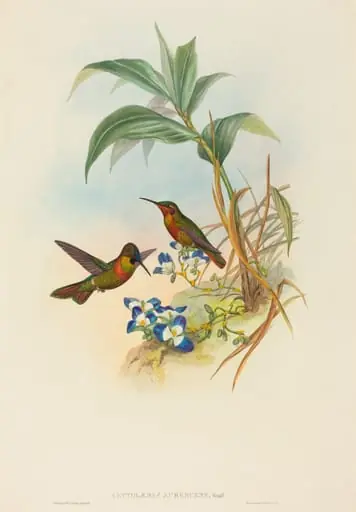 Clytolaema aurescens (Banded Ruby or Gould's Ruby)
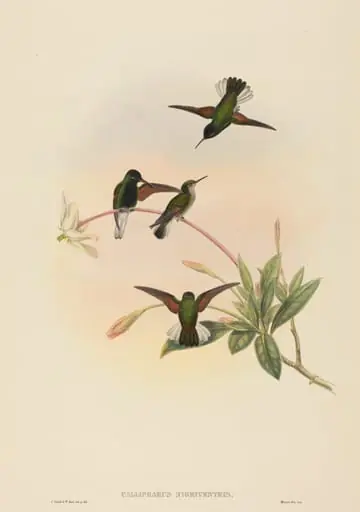 Callipharus nigriventris (Black-bellied Hummingbird)
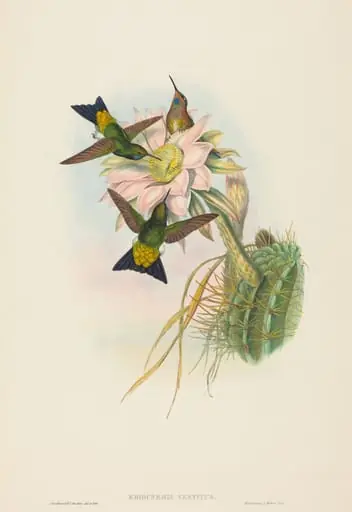 Eriocnemis vestitus (Glowing Puff-Leg)
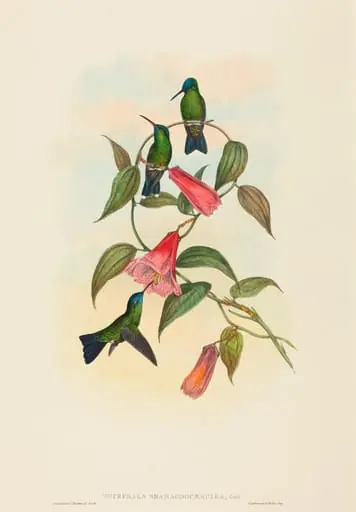 Eucephala smaragdocaerulea (Gould's Wood Nymph)
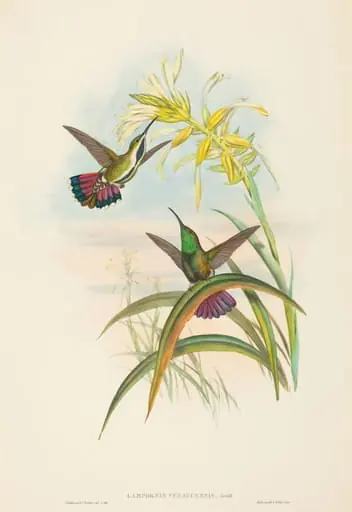 Lampornis veraguensis (Veraguan Mango)