Artwork
Emperor Maximilian II
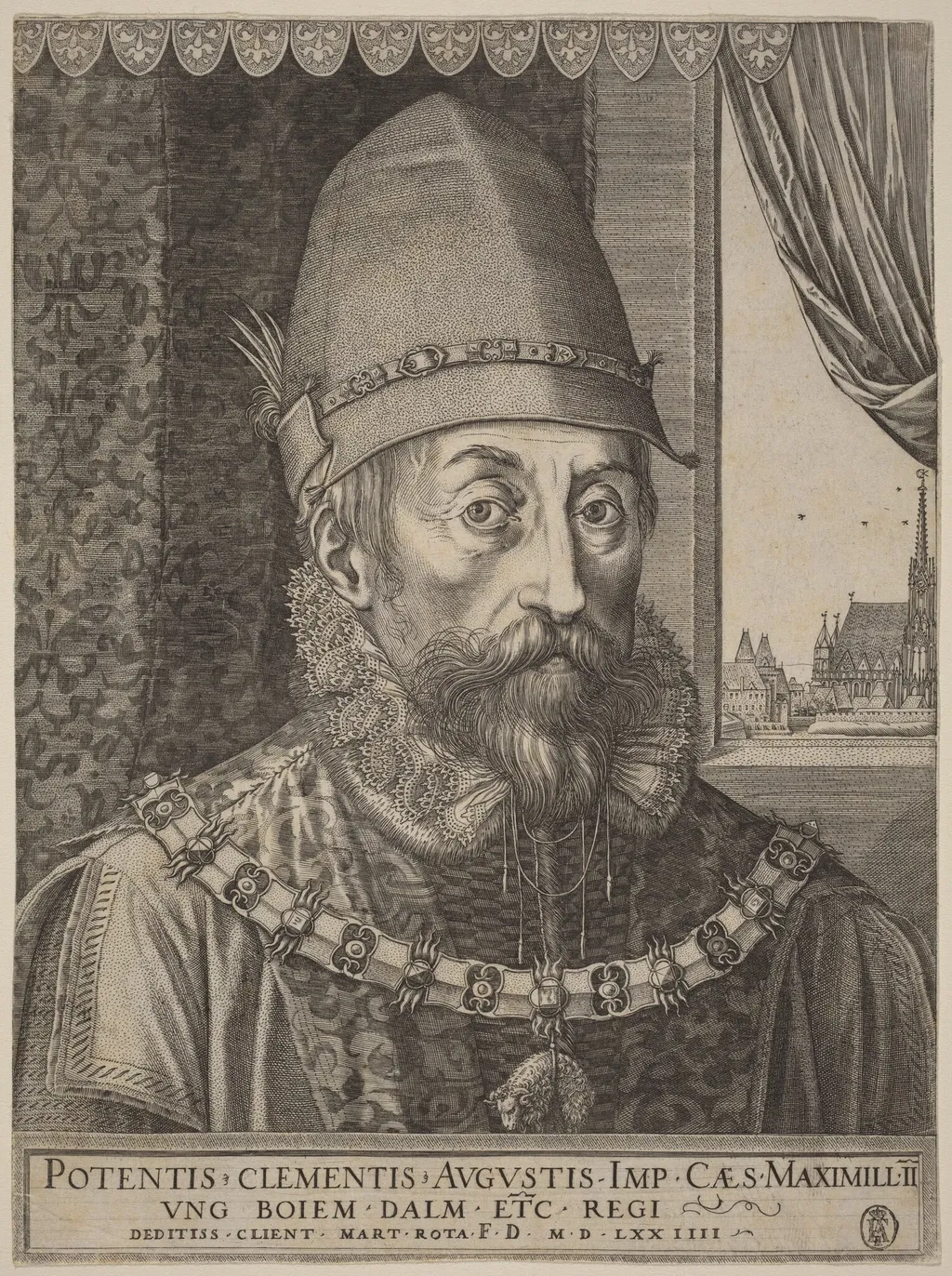
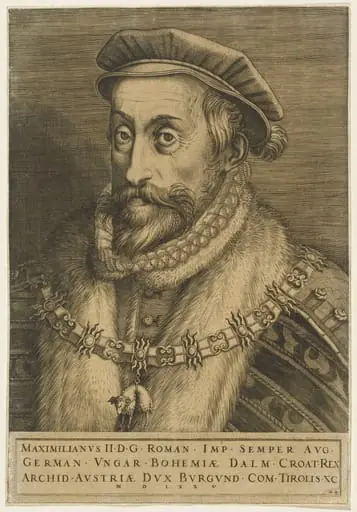
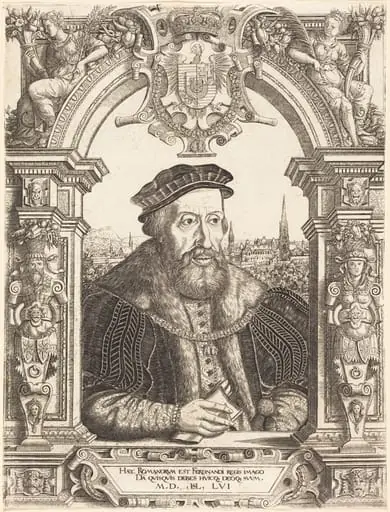
Emperor Maximilian II is an ink print by the Renaissance artist Martino Rota. It dates from 1574 and is held in the collection of the National Gallery of Art.
About this work
Overview
Martino Rota’s 1574 engraving presents a full‑length portrait of Holy Roman Emperor Maximilian II, who ruled from 1564 until his death in 1576. Rendered in black‑and‑white line work, the image shows the monarch in regal attire, set against a modest architectural backdrop that suggests a town or castle.
Subject & Meaning
The portrait follows contemporary conventions for royal representation, foregrounding the emperor’s authority through symbols such as a heavy chain, an elaborate robe, and a distinctive hat. The inclusion of a distant landscape reinforces his dominion over a broad realm.
Technique & Style
Rota employed fine incised lines to model light and shadow, creating texture in the beard, fabric, and background. The engraving’s linear precision reflects the Northern European print tradition of the mid‑16th century, where detail was achieved through meticulous hatching and cross‑hatching.
History & Provenance
Born circa 1520 in Šibenik, Dalmatia, Rota worked in major artistic centers including Venice, Rome, and Vienna, gaining a reputation for portrait engravings. This particular work was produced during his Viennese period, when he was active in the imperial court’s visual culture.
Context
The portrait aligns with the broader trend of disseminating imperial imagery through prints, a practice that allowed rulers to project their image across the Holy Roman Empire. Such engravings served both decorative and political functions, reinforcing the emperor’s legitimacy among a literate elite.
Artist & collection
Artist
Martino Rota, also Martin Rota and Martin Rota Kolunić (c. 1520–1583) was an artist, now mainly known for his printmaking, from Dalmatia. Martino Rota was born in about the year 1520 in Šibenik (Sebenico), Dalmatia.…