Artwork
Last Judgment
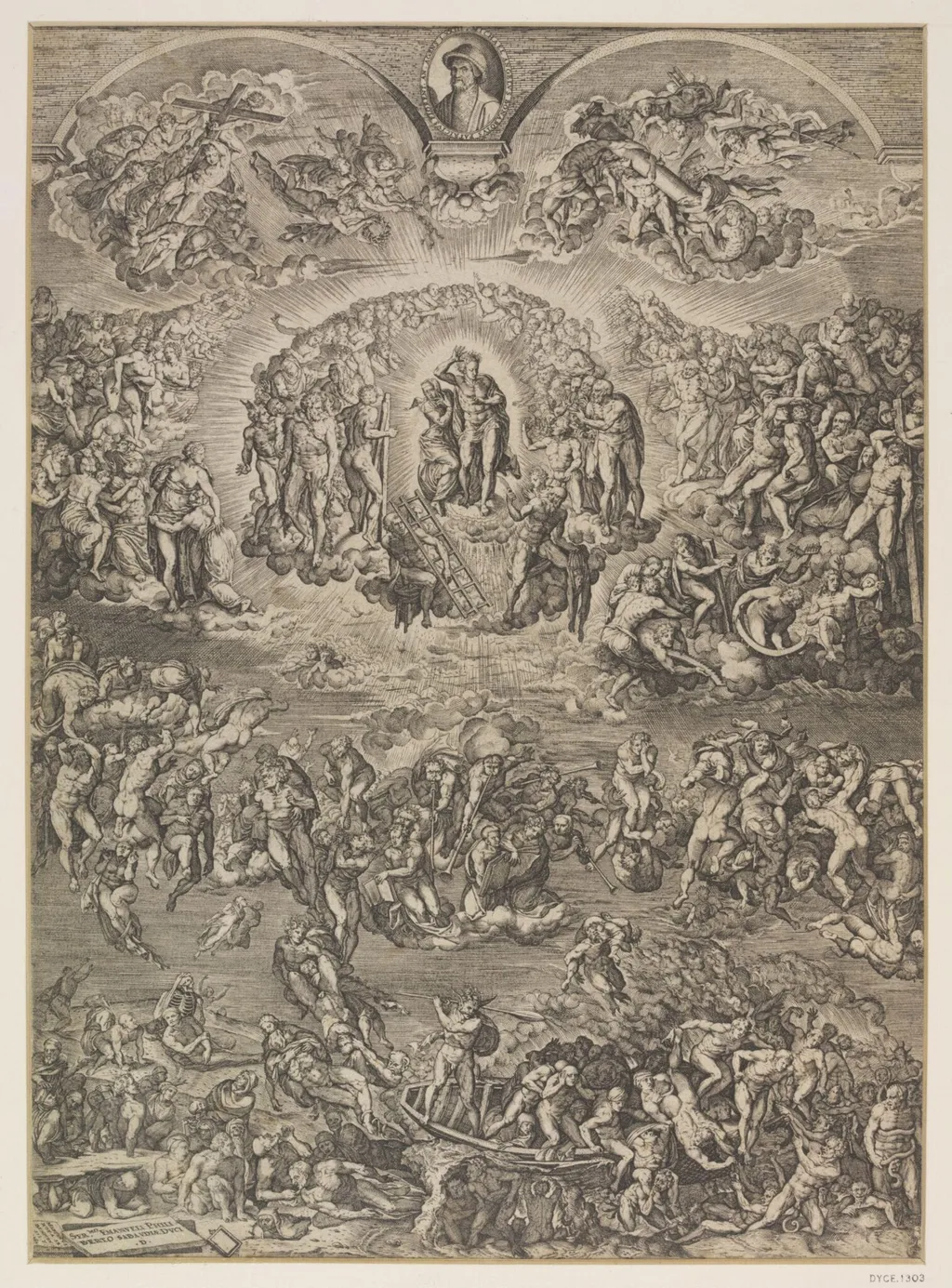
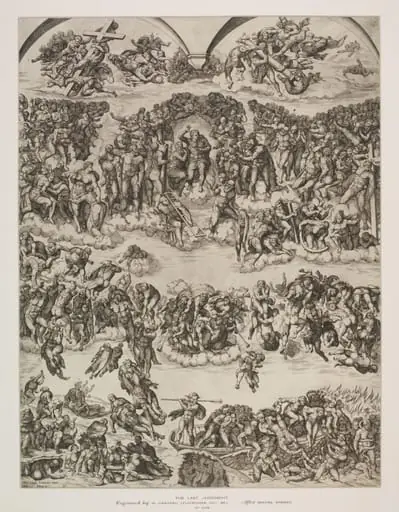
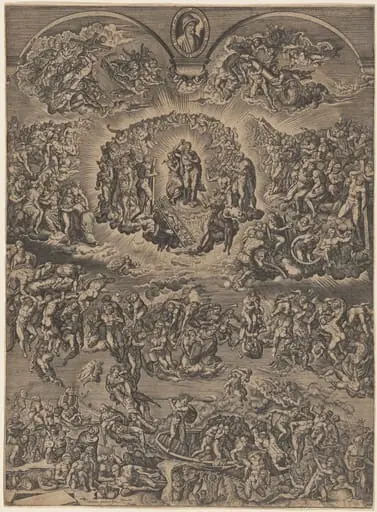
Last Judgment is a print by the Renaissance artist Martino Rota. It dates from 1569 and is held in the collection of the Victoria and Albert Museum.
About this work
Overview
The composition follows earlier printed versions by Leonardo Gaultier, reflecting the demand for accessible renditions of Michelangelo’s monumental work.
Martino Rota’s 1569 engraving is a detailed black-and-white reproduction of Michelangelo’s fresco in the Sistine Chapel. Created as a printed work on paper, it includes two inscribed plaques noting the date and dedicating the image to Emmanuel Philibert, Duke of Savoy. The composition follows earlier printed versions by Leonardo Gaultier, reflecting the demand for accessible renditions of Michelangelo’s monumental work.
Subject & Meaning
The scene depicts the final judgment of souls, with Christ at the center, holding a cross as the divine arbiter. Surrounding figures are caught in moments of ascent or descent—some lifted by angels, others pulled down by demons. The arrangement conveys moral consequence, with emotional reactions ranging from terror to reverence, emphasizing the inescapable nature of divine judgment.
Technique & Style
Rota employed fine, precise lines to render the dense, interwoven bodies in chiaroscuro. Sharp contrasts between light and shadow heighten the sense of motion and volume, giving the crowded composition a dynamic tension. The absence of color focuses attention on form and gesture, while the intricate detailing of drapery and anatomy reflects the engraver’s skill in translating fresco into print.
History & Provenance
The print was made shortly after Michelangelo’s fresco was completed and during a period of heightened interest in reproducing his works. Rota, an established engraver in Rome, had access to the original and likely worked from direct observation or preparatory drawings. The dedication to the Duke of Savoy suggests a patronage context, aligning the image with aristocratic taste and religious authority.
Context
In the mid-16th century, prints served as key vehicles for disseminating religious imagery across Europe, especially after the Council of Trent emphasized visual instruction in faith. Rota’s engraving responded to this demand, making a controversial and complex fresco available to collectors and clergy beyond the Vatican, while also reinforcing its theological message through widespread circulation.
Legacy
Rota’s engraving became one of the most widely circulated versions of Michelangelo’s Last Judgment, influencing later interpretations and preserving the composition’s impact before photographic reproduction. It stands as an example of how print technology extended the reach of High Renaissance art, shaping public perception of sacred imagery for generations.
Artist & collection
Artist
Martino Rota, also Martin Rota and Martin Rota Kolunić (c. 1520–1583) was an artist, now mainly known for his printmaking, from Dalmatia. Martino Rota was born in about the year 1520 in Šibenik (Sebenico), Dalmatia.…