Artwork
Timur distributes gifts from his grandson, the Prince of Multan, from a Zafar-nama (Book of Victories)
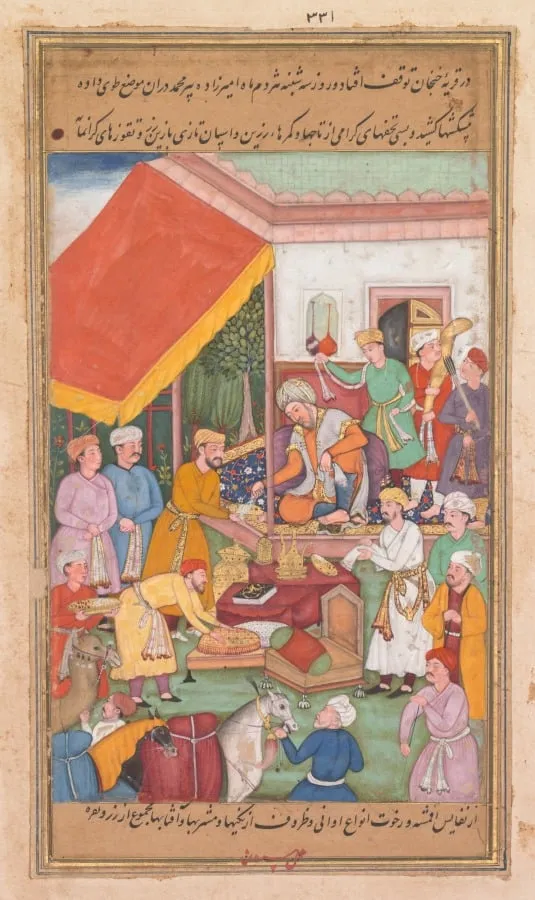
Timur distributes gifts from his grandson, the Prince of Multan, from a Zafar-nama (Book of Victories) is an unspecified painting by the Mughal Painting artist Shravana. It dates from 1599 and is held in the collection of the Cleveland Museum of Art. The painting depicts the Turkic ruler Timur seated beneath a red awning, distributing gifts to his retinue.
About this work
Overview
A richly patterned blue carpet with a gold border lies beneath him, while horses, camels and piles of treasure are arranged on the surface.
The painting depicts the Turkic ruler Timur seated beneath a red awning, distributing gifts to his retinue. A richly patterned blue carpet with a gold border lies beneath him, while horses, camels and piles of treasure are arranged on the surface. The scene is set in a region ruled by Timur’s grandson, the Prince of Multan, who has sent the offerings for Timur to re‑gift according to the merit of his followers.
Subject & Meaning
Timur, the 14th‑century conqueror who is the most celebrated paternal ancestor of Mughal emperor Akbar, is shown performing a ceremonial act of generosity. By redistributing the presents received from his grandson, the ruler affirms his authority and the hierarchical bonds within his court, emphasizing the reciprocal obligations that underpinned elite patronage in the period.
Technique & Style
Executed in the Mughal court tradition, the work features a vivid red canopy and a blue carpet adorned with a floral vine motif that became fashionable in the early 1500s. Fine brushwork renders the textures of silk, gold thread and animal hide, while the composition balances the central figure with the surrounding gifts, reflecting the detailed naturalism characteristic of Akbar’s atelier.
History & Provenance
Although Timur died in 1405, the painting was created nearly two centuries later for the court of Emperor Akbar, who claimed descent from the conqueror. The artist, employed by Akbar’s workshop, produced the image to celebrate the imperial lineage and to reinforce the legitimacy of the Mughal dynasty through visual association with its celebrated forebear.
Context
The work belongs to the broader Mughal tradition of historiographic painting, where past rulers were rendered in contemporary courtly settings. By placing Timur in a richly furnished environment, the painting aligns the 14th‑century figure with the opulence and cultural sophistication of 16th‑century Mughal India, illustrating how historical memory was adapted to serve present political narratives.
Artist & collection

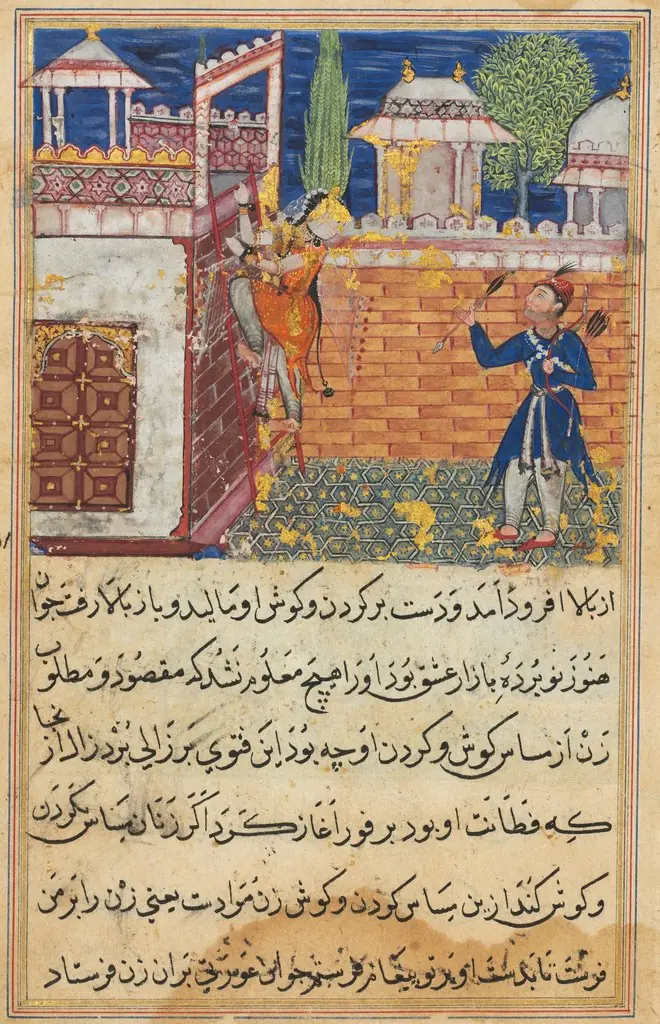 The deceitful wife returns to her terrace after caressing her lover, from a Tuti-nama (Tales of a Parrot): Eighth Night
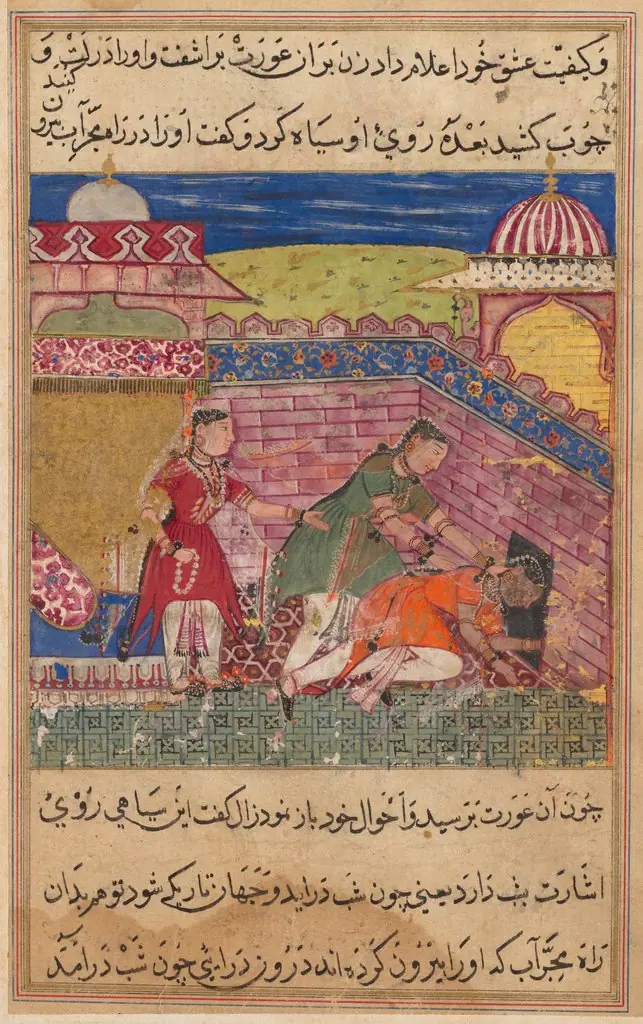 The deceitful wife ejects the procuress after blackening her face, from a Tuti-nama (Tales of a Parrot): Eighth Night
 The deceitful wife ejects the procuress after blackening her face, from a Tuti-nama (Tales of a Parrot): Eighth Night
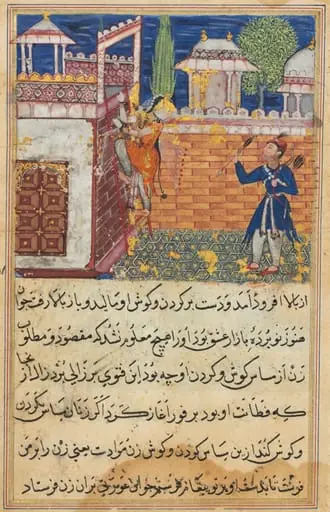 The deceitful wife returns to her terrace after caressing her lover, from a Tuti-nama (Tales of a Parrot): Eighth Night
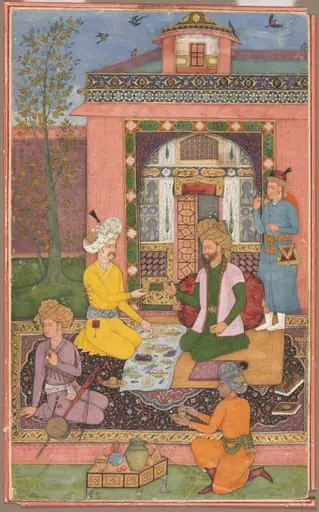 A Royal Picnic on a Terrace
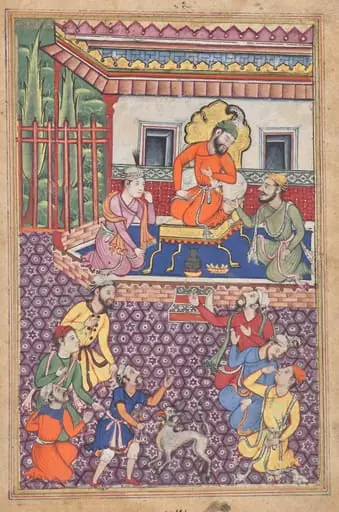 The court of the Raja of Ujjain, from a Tuti-nama (Tales of a Parrot): Forty-sixth Night
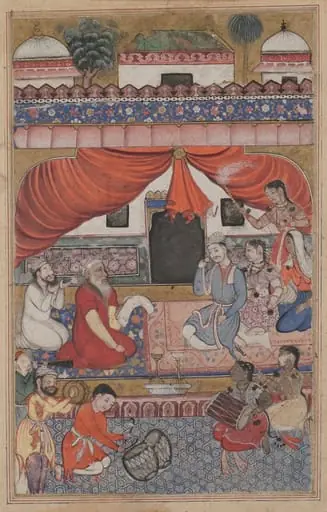 Preparation for the marriage of Mahmuda to the Young Vizier, from a Tuti-nama (Tales of a Parrot): Thirty-third Night
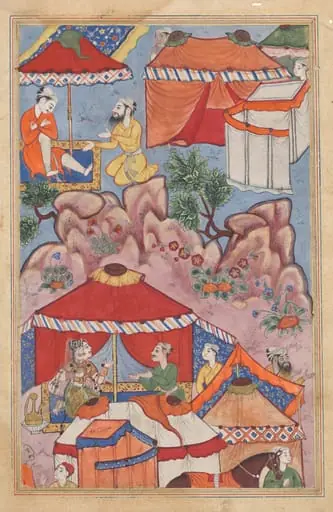 Bashir confides his love for Habbaza to an Arab friend, and sends him to her with a message, from a Tuti-nama (Tales of a Parrot): Twenty-fourth Night
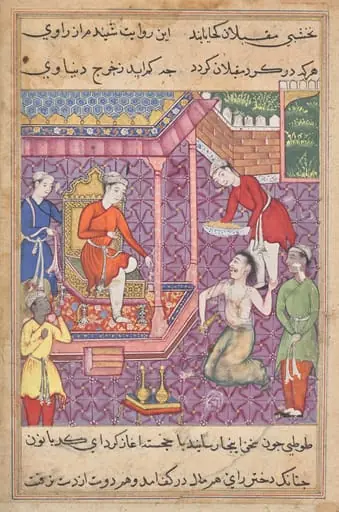 The magician disguised as a Brahman returns to claim his “daughter-in-law,” from a Tuti-nama (Tales of a Parrot): Thirty-fifth Night
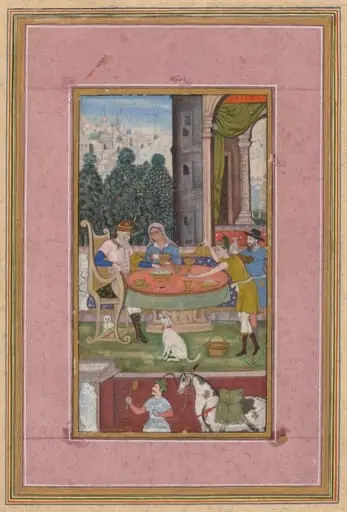 Dining Scene with European Elements
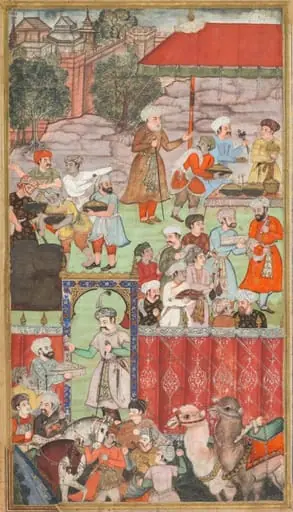 A feast for Babur hosted by his half-brother Jahangir Mirza in Ghazni in May 1505, from a Babur-nama (Memoirs of Babur)