Artwork
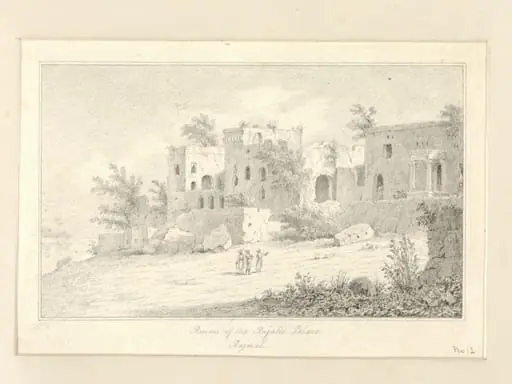
"Remains of the Old Fort of the Jumna, Allahabad".
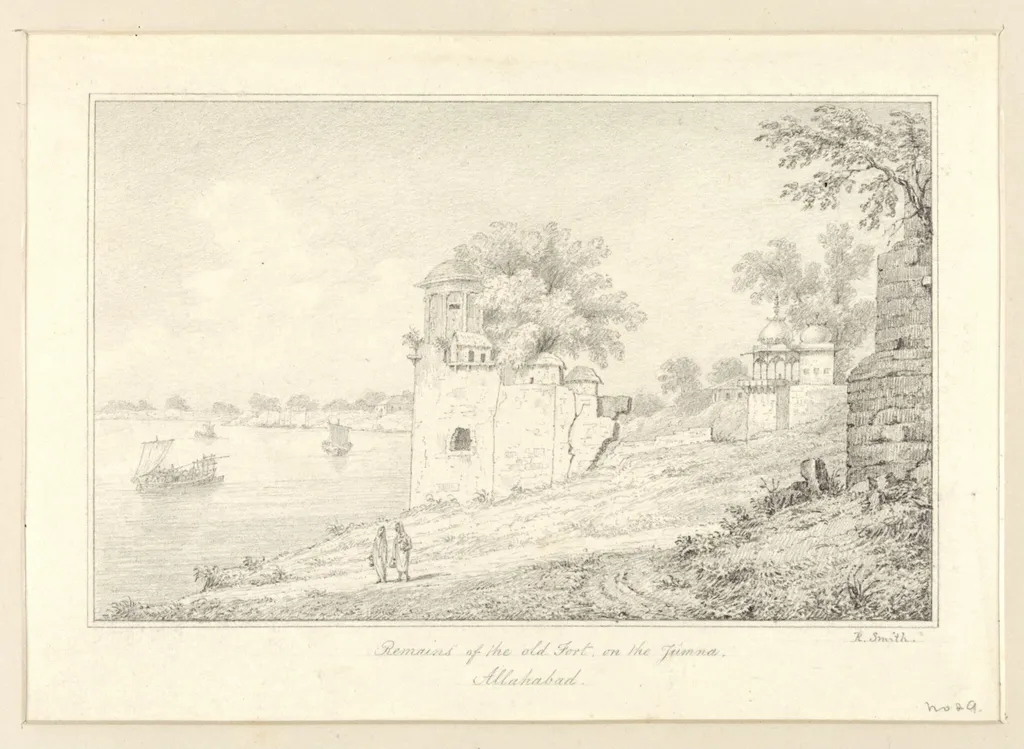
"Remains of the Old Fort of the Jumna, Allahabad". is a drawing by the Romanticist artist Robert Captain Smith. It dates from 1830 and is held in the collection of the Victoria and Albert Museum. The drawing records the dilapidated remains of a fort situated on the banks of the Jumna River at Allahabad.
About this work
Overview
The drawing records the dilapidated remains of a fort situated on the banks of the Jumna River at Allahabad. A solitary figure walks along the riverbank while two small boats drift nearby, and the surrounding vegetation frames the scene. The composition emphasizes the decay of the tower, arched windows and a nearby domed structure, conveying a quiet, weathered atmosphere.
Subject & Meaning
The work captures the passage of time upon a once‑defensive complex, highlighting how natural forces and neglect have reduced the fort to ruins. By placing human activity—a lone wanderer and modest river traffic—against the crumbling architecture, the artist suggests a contrast between enduring landscape and transient human presence, underscoring the site's historical layers.
Technique & Style
Executed in mounted pencil, the image relies on fine cross‑hatching to model light and shadow, creating depth in the stonework and water surface. The delicate line work renders texture on the tower’s weathered walls and the foliage, while the restrained palette of graphite tones reinforces the muted, antiquated mood of the scene.
History & Provenance
Created in 1830 by Captain Robert Smith during his travels along the Ganges, the drawing formed part of a larger set of sixty‑five illustrated sketches documenting sites visited between 1828 and 1833. Unpublished during Smith’s service, the collection was later acquired by W. M. Biden after Smith’s retirement and entered a public collection in 1915.
Context
The fort at Allahabad occupied a strategic position on the Jumna, a river that has long served as a conduit for trade and military movement. By the early nineteenth century the structure was already in decline, reflecting broader patterns of colonial interest in recording Indian architectural heritage before extensive modernization.
Artist & collection