Artwork
Venus dissuading Adonis from the chase
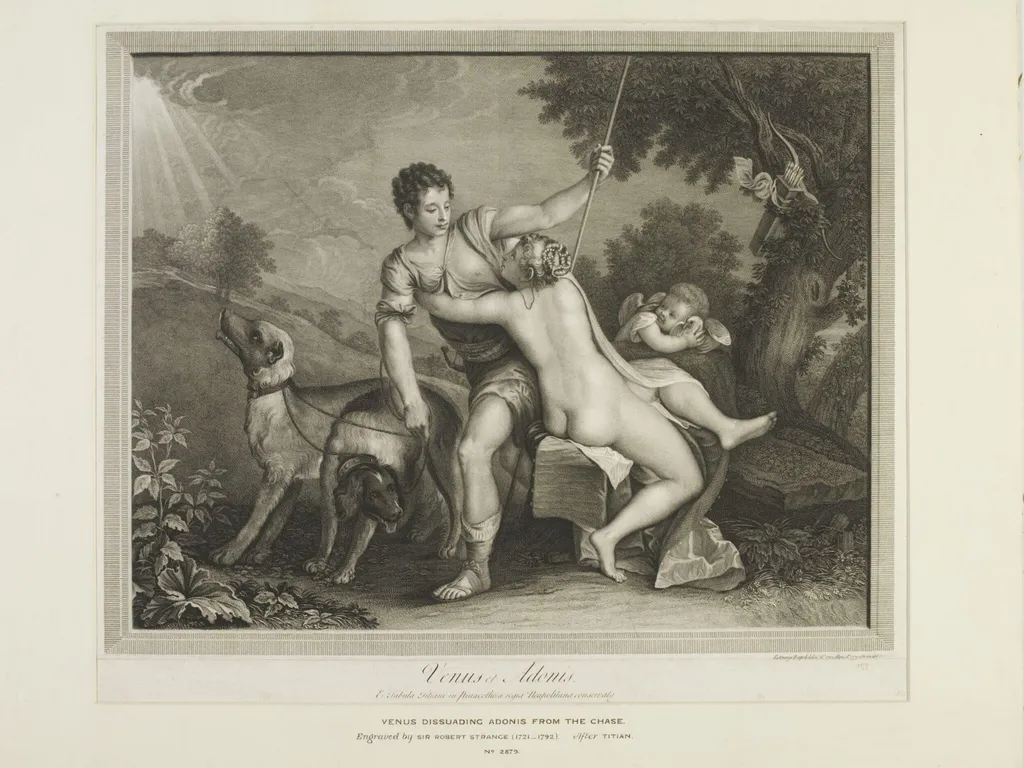
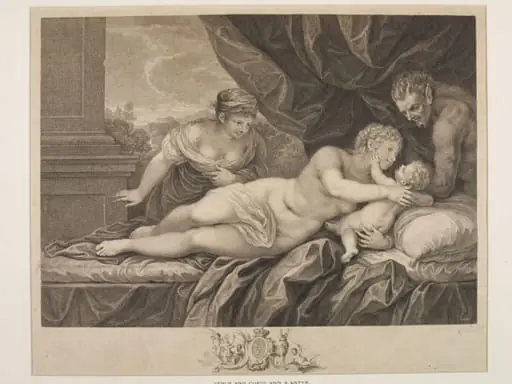
Venus dissuading Adonis from the chase is a print by Robert, Sir Strange. It dates from 1750 and is held in the collection of the Victoria and Albert Museum. This print by Sir Robert Strange captures a moment from classical mythology, adapted from Titian’s earlier painting.
About this work
Overview
Strange’s version preserves the narrative tension between Venus and Adonis while refining the composition for the medium of printmaking.
This print by Sir Robert Strange captures a moment from classical mythology, adapted from Titian’s earlier painting. Executed in ink on paper, it translates the emotional intensity of the original into the tonal contrasts and fine lines characteristic of 18th-century engraving. Strange’s version preserves the narrative tension between Venus and Adonis while refining the composition for the medium of printmaking.
Subject & Meaning
The scene illustrates Venus, goddess of love, attempting to prevent Adonis, a mortal hunter, from pursuing a dangerous boar. Her grip on his arm and the bow she holds suggest both affection and urgency, while his resistance conveys his determination. The dog, attentive to Venus, reinforces her emotional presence. The moment reflects themes of desire, mortality, and the futility of resisting fate.
Technique & Style
Strange employed fine-line engraving to render texture and movement, using delicate hatching to suggest fabric folds and musculature. The contrast between the soft contours of Venus’s robe and the sharp definition of Adonis’s body heightens the drama. Light falls diagonally from above, casting subtle shadows that deepen the spatial depth and emotional gravity of the scene.
History & Provenance
Created in the mid-18th century, the print derives from Titian’s lost painting, known through copies and descriptions. Strange, a Scottish engraver and former soldier, gained recognition for his reproductive prints after studying in Rome. This work was part of a series of engravings he produced after Old Master paintings, intended for collectors and connoisseurs in Britain and Europe.
Context
During the 18th century, reproductive prints were vital for disseminating images of classical themes among the educated elite. Strange’s work aligned with a broader interest in antiquity and the Italian Renaissance. His adaptation of Titian’s composition reflects contemporary tastes for mythological narratives that combined emotional depth with formal elegance.
Legacy
Strange’s engraving contributed to the continued circulation of Titian’s imagery beyond oil painting, making the myth accessible to a wider audience. Though not widely exhibited today, it remains a significant example of British printmaking’s role in preserving and interpreting Renaissance art during the Enlightenment.
Artist & collection