Artwork
A Classical Temple
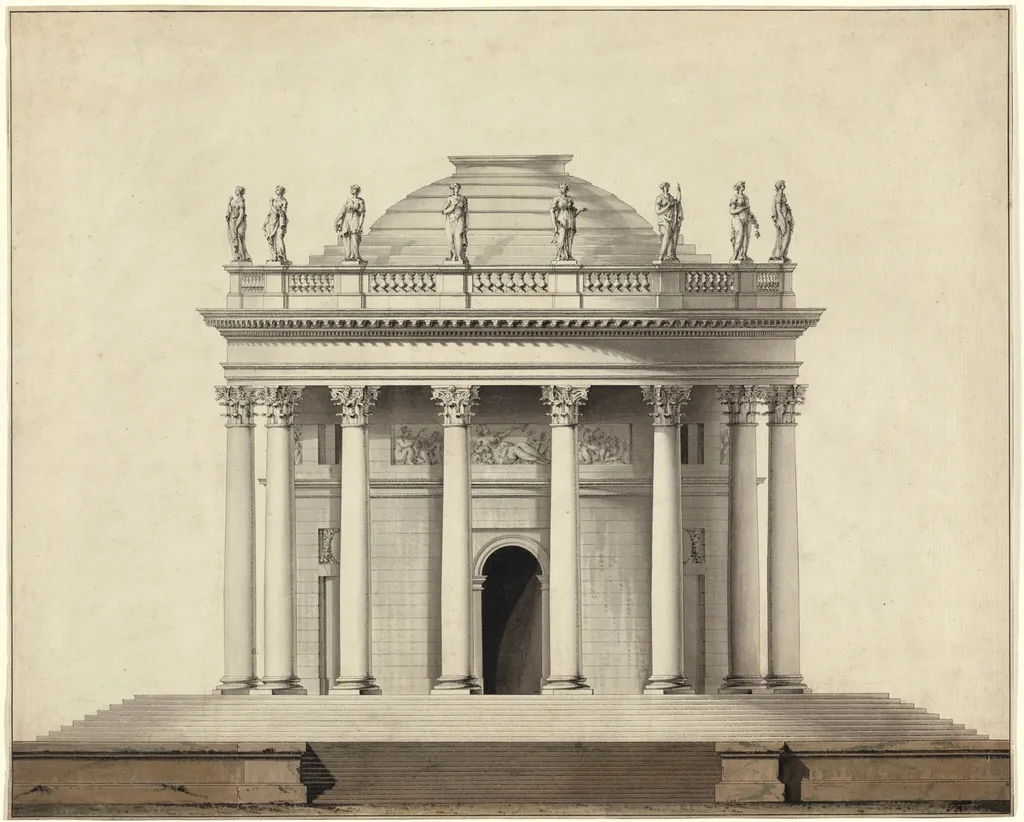
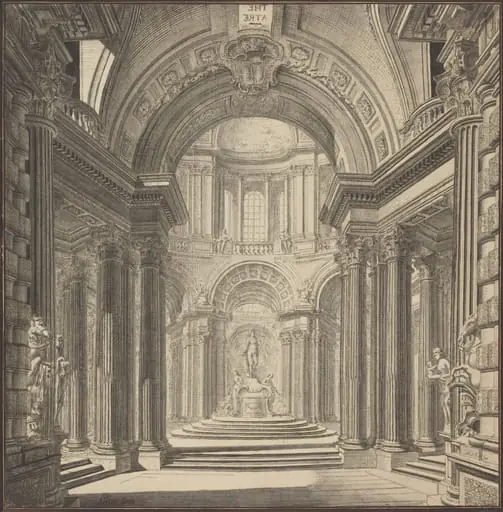
A Classical Temple is an ink drawing by the Romanticist artist Louis Gustave Taraval. It dates from 1780 and is held in the collection of the National Gallery of Art. Louis‑Gustave Taraval’s drawing, dated around 1780, presents a meticulously rendered classical temple.
About this work
Overview
Louis‑Gustave Taraval’s drawing, dated around 1780, presents a meticulously rendered classical temple. Executed with pen and black ink complemented by gray, brown, and green washes on laid paper, the work captures the architectural form in a balanced, disciplined composition.
Subject & Meaning
The image centers on a temple crowned by a domed roof and supported by six substantial columns. A broad, shallow staircase leads to a prominent arched entrance, while the roofline is populated with sculptural figures and the walls bear symmetrical decorative reliefs, suggesting an idealized vision of antiquity.
Technique & Style
Taraval combines precise linear drawing with subtle tonal washes, using variations of gray, brown, and green to model volume and suggest atmospheric depth. The interplay of light and shadow enhances the three‑dimensionality of the structure, while the careful rendering of architectural details reflects the neoclassical interest in order and harmony.
History & Provenance
Created in the late eighteenth century, the drawing belongs to a period when French artists frequently studied classical motifs for academic training. Though specific ownership records are scarce, the work is attributed to Taraval, a French painter and draughtsman active in the years surrounding the French Revolution.
Context
The drawing aligns with the neoclassical movement’s revival of ancient Roman and Greek architecture, a trend that permeated French art and architecture after the mid‑1700s. Such studies were often used as preparatory material for larger compositions or architectural projects.
Legacy
As an example of Taraval’s draftsmanship, the piece illustrates the period’s emphasis on architectural accuracy and decorative restraint. It continues to serve as a reference for scholars examining the diffusion of classical ideals in French visual culture before the turn of the nineteenth century.
Artist & collection


 Architectural Study
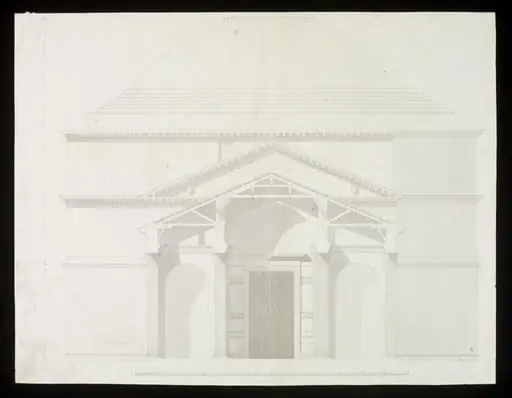 Longitudinal section through Pantheon portico
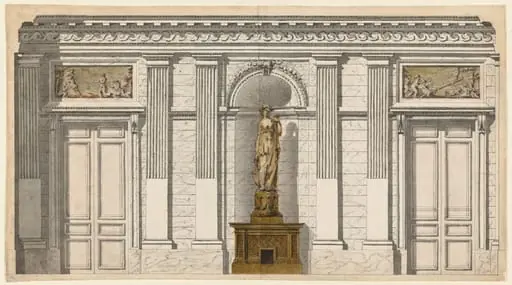 Design for a Wall with Two Doors and a Sculpture
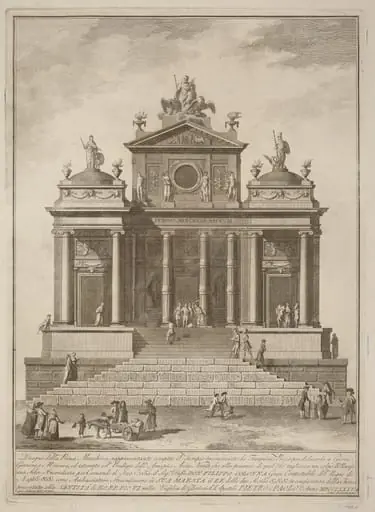 The Prima Macchina for the Chinea of 1785: The Temple of Jupiter Begun by Tarquinius Priscus with the Marvel of Accius Naevius
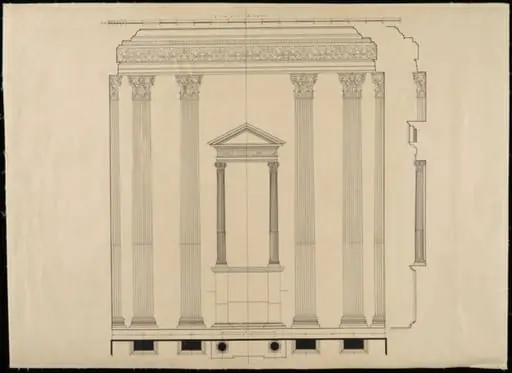 Elevation of wall showing niche.
 Design for a Baldaquin
 The Prima Macchina for the Chinea of 1746: The Temple of Minerva
 Elevation of wall showing mantelpiece.
 Design for an Antique Gallery
 Interior of a Temple