Artwork
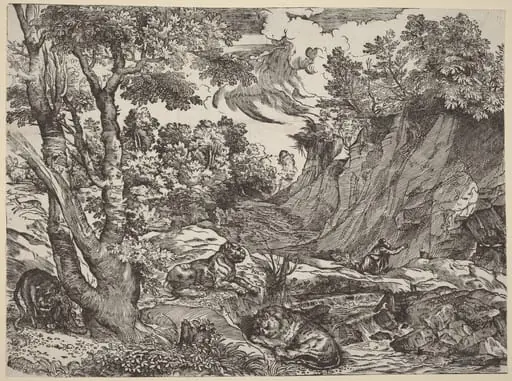
Saint Jerome in Penitence
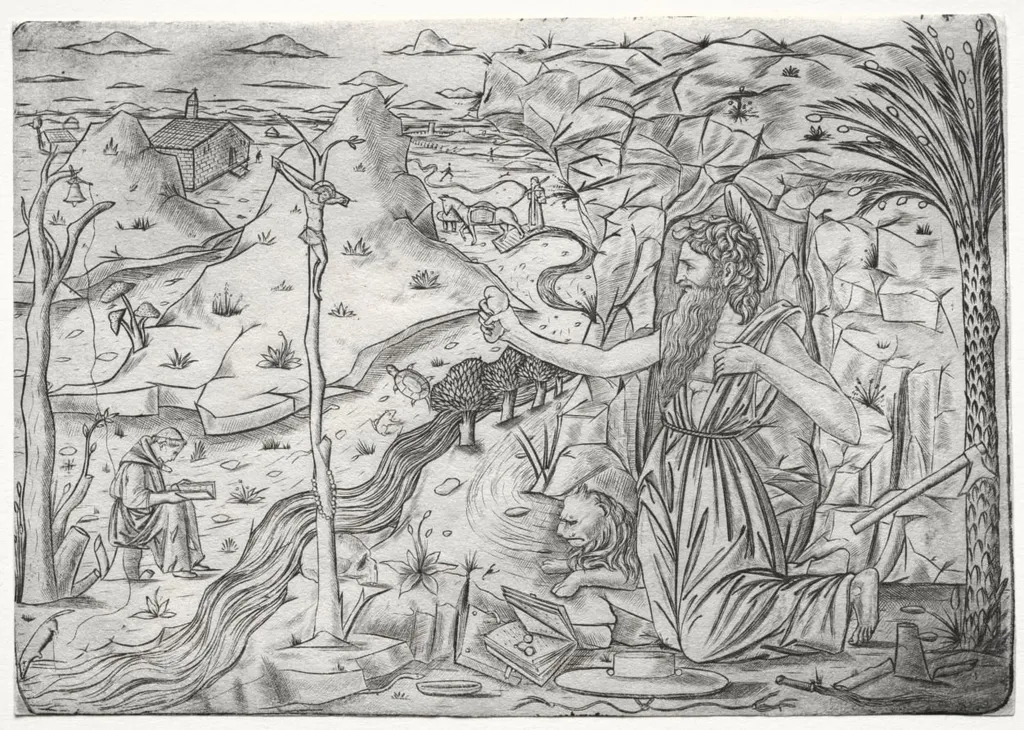
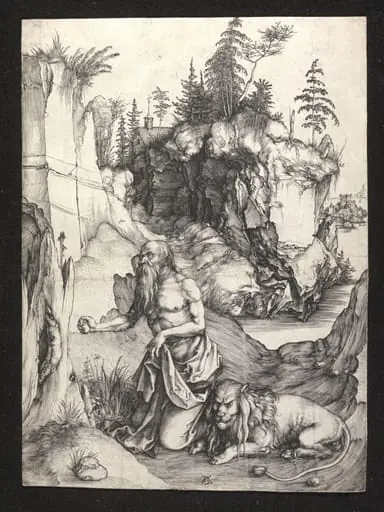
Saint Jerome in Penitence is a print by the Renaissance artist Unknown. It dates from 1490 and is held in the collection of the Cleveland Museum of Art.
About this work
The lion became his friend after he helped it, and the hat and book remind us he later translated the Bible.
A man kneels in a rocky desert, beating his chest with a stone while praying toward a small wooden cross. A lion sits nearby, and a cardinal’s hat rests on the ground beside an open book.
This painting shows Saint Jerome, who lived alone in the wilderness to suffer for his faith. The lion became his friend after he helped it, and the hat and book remind us he later translated the Bible. The skull at the cross is a quiet sign of death.
Look up paintings from Italy, Florence or northern Italy, 15th century to see more like this.
Overview
The print depicts Saint Jerome kneeling on a barren, rocky terrain, his hand pressing a stone against his chest as he prays toward a modest wooden cross. A lion rests close by, while a cardinal’s hat lies on the ground beside an open book. A solitary figure at the left edge suggests a wandering mendicant.
Subject & Meaning
Jerome is shown in the ascetic tradition of retreating to the desert near Antioch, where he pursued spiritual purification through bodily hardship. The stone‑beating gesture symbolizes penitence, while the cross and skull allude to Christ’s crucifixion and mortality. The lion recalls the legend of Jerome rescuing the animal from a thorn, and the hat and book reference his later role as the translator of the Latin Vulgate.
Technique & Style
Executed as a print, the work relies on stark contrasts of line and texture to convey the harshness of the landscape and the solemnity of the saint’s devotion. Fine hatching renders the lion’s fur and the craggy ground, while broader strokes define the cross and the surrounding foliage, creating a balanced composition that emphasizes both narrative detail and symbolic elements.
Context
The image belongs to a broader tradition of 15th‑century Italian devotional prints that visualized saints in isolated, contemplative settings. Such works were intended for private meditation, reinforcing the virtues of self‑denial and scholarly dedication embodied by Jerome, a figure revered for both his ascetic life and his scholarly contributions to the Church.
Artist & collection

 Domestic Scene
 Giacomo and Cardinal Marco, investing Andrea, Abbot of San Zeno, with his Benefice
 The Nymph of Fontainebleau
 Portrait of a Woman
 Madonna and Child with Saints in the Enclosed Garden
 Venus and Minerva
 Family Group of Four on Sofa
 Wall painting from Room H of the Villa of P. Fannius Synistor at Boscoreale