Artwork
The merchant hears of his wife’s unfaithfulness (above); the unfaithful wife performs penance by plucking her hair (below), from a Tuti-nama (Tales of a Parrot): First Night
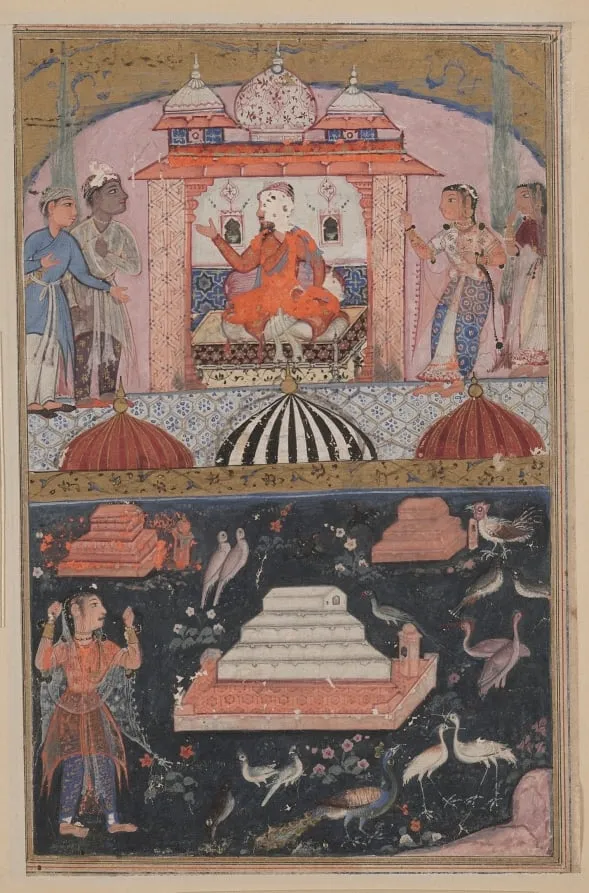
The merchant hears of his wife’s unfaithfulness (above); the unfaithful wife performs penance by plucking her hair (below), from a Tuti-nama (Tales of a Parrot): First Night is an unspecified painting by the Mughal Painting artist Unknown. It dates from 1560 and is held in the collection of the Cleveland Museum of Art. This painting is one of many illustrations from the Tuti-nama, a manuscript commissioned by the Mughal emperor Akbar.
About this work
You see two stacked scenes: a man in a red robe listening to servants whisper, and below, a woman pulling out her hair while birds watch.
You see two stacked scenes: a man in a red robe listening to servants whisper, and below, a woman pulling out her hair while birds watch.
The painting comes from a book of parrot tales told to Emperor Akbar. The parrot here is the real storyteller—it spies on the wife, reports her affair, and later makes sure she’s forgiven. The tiny birds in the lower scene act like a Greek chorus, judging her every move.
Look up Mughal India, court of Akbar (reigned 1556–1605) to see more of these vivid, storybook pages.
Overview
This painting is one of many illustrations from the Tuti-nama, a manuscript commissioned by the Mughal emperor Akbar. It depicts two narrative scenes stacked vertically: the upper register shows a merchant learning of his wife’s infidelity through servants’ whispers, while the lower shows her performing a ritual of penance. The parrot, central to the tale, observes both moments, acting as witness and moral arbiter. The work exemplifies the Mughal court’s interest in illustrated storytelling as a tool of moral instruction.
Subject & Meaning
The narrative centers on betrayal and redemption, framed through the parrot’s surveillance. The merchant’s distress, conveyed by the huddled servants, contrasts with the wife’s solitary act of self-punishment—plucking her hair as a sign of remorse. The surrounding birds function as silent judges, reinforcing societal scrutiny. The parrot’s dual role as informant and reconciler underscores the tale’s theme: truth, though painful, leads to restoration. The story serves as both moral fable and commentary on fidelity within domestic life.
Technique & Style
Executed in opaque watercolor and gold on paper, the painting features fine brushwork and intricate detail characteristic of Mughal miniature traditions. Figures are rendered with delicate lines, and the composition uses spatial division to separate the two narrative layers without disrupting visual flow. Color is used symbolically—red for the merchant’s authority, muted tones for the wife’s penance. The birds are rendered with naturalistic precision, enhancing their role as observers in the moral drama.
History & Provenance
Created around 1560 in the imperial atelier of Akbar, this painting belonged to a larger illustrated manuscript of the Tuti-nama, a Persian collection of tales adapted into Persian and then translated into Persian with Indian influences. The manuscript was produced over several years by a team of artists under royal patronage. It later entered European collections in the 18th century, where individual folios were dispersed. This folio remains among the best-preserved examples of early Mughal book illustration.
Context
The Tuti-nama was part of Akbar’s broader project to synthesize Persian, Indian, and Islamic literary traditions. Illustrated manuscripts like this one were not merely decorative but served as instruments of courtly culture and ethical education. The parrot’s role as narrator reflects a broader Indo-Persian literary motif of animals as moral guides. The painting’s structure—two scenes in one frame—mirrors the oral storytelling practices familiar to the court, blending visual and narrative economy.
Legacy
This folio exemplifies the Mughal innovation in integrating narrative complexity with visual precision, influencing later imperial manuscripts. Its emphasis on psychological nuance and moral consequence set a precedent for storytelling in Indian painting. Though the Tuti-nama was eventually superseded by other literary cycles, its stylistic and thematic elements persisted in courtly art. Today, it remains a key reference for understanding how Mughal rulers used art to shape cultural values and reinforce social norms.
Artist & collection

 Domestic Scene
 Giacomo and Cardinal Marco, investing Andrea, Abbot of San Zeno, with his Benefice
 The Nymph of Fontainebleau
 Portrait of a Woman
 Madonna and Child with Saints in the Enclosed Garden
 Venus and Minerva
 Family Group of Four on Sofa
 Wall painting from Room H of the Villa of P. Fannius Synistor at Boscoreale
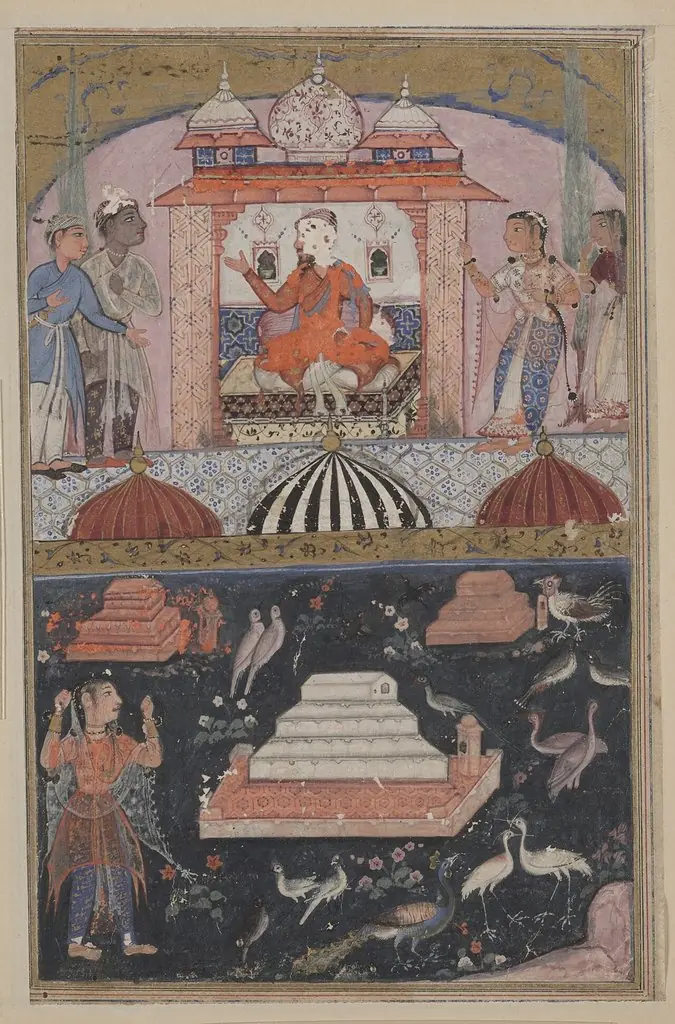 The merchant hears of his wife’s unfaithfulness (above); the unfaithful wife performs penance by plucking her hair (below), from a Tuti-nama (Tales of a Parrot): First Night
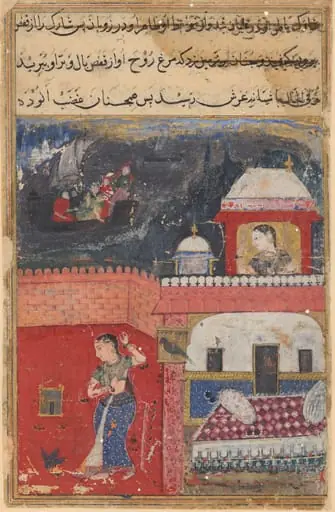 Khujasta kills the pet mynah who advises her not to be unfaithful to Maymun, her husband, from a Tuti-nama (Tales of the Parrot): First Night
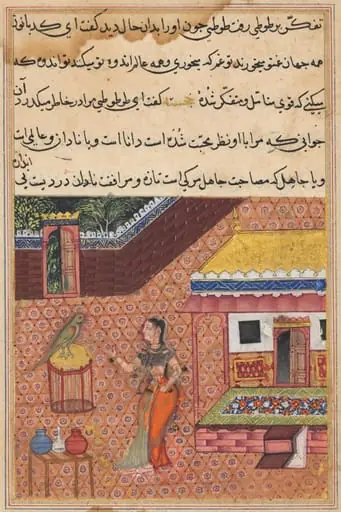 The parrot addresses Khujasta at the beginning of the thirty-fourth night, from a Tuti-nama (Tales of a Parrot)
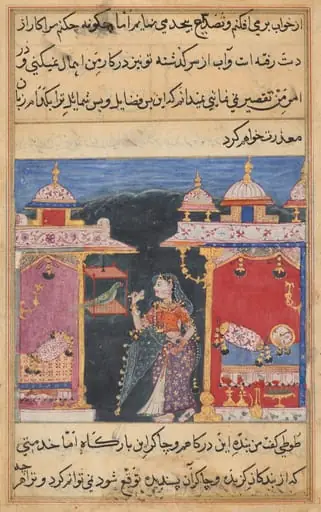 The Parrot Addresses Khujasta at the Beginning of the Seventh Night, from a Tuti-nama (Tales of a Parrot)
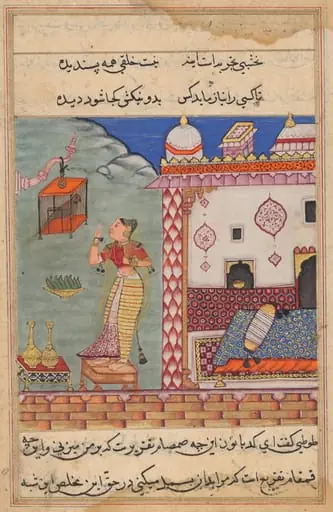 The Parrot Addresses Khujasta at the Beginning of the Twenty-seventh Night, form a Tuti-nama (Tales of a Parrot)
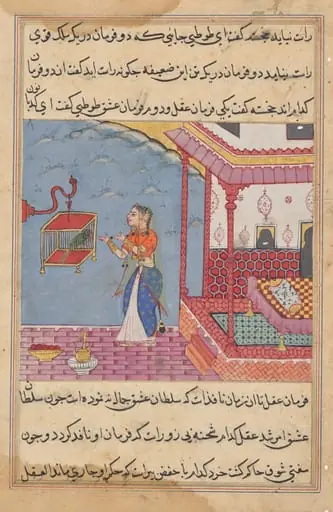 The Parrot Addresses Khujasta at the Beginning of the Twenty-Fourth Night, from a Tuti-nama (Tales of a Parrot)
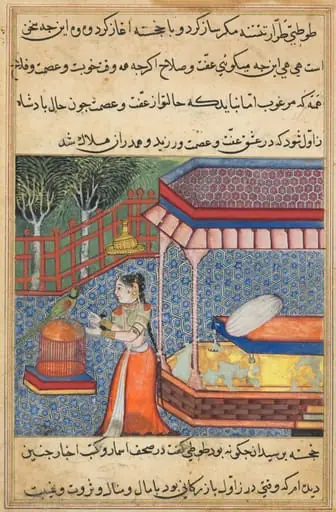 The parrot addresses Khujasta at the beginning of the thirty-sixth night, from a Tuti-nama (Tales of a Parrot)