Artwork
The Raja of Ujjain, who is traveling in the guise of a yogi, meets two brothers who ask him to equitably partition their father’s possession, from a Tuti-nama (Tales of a Parrot): Forty-sixth Night
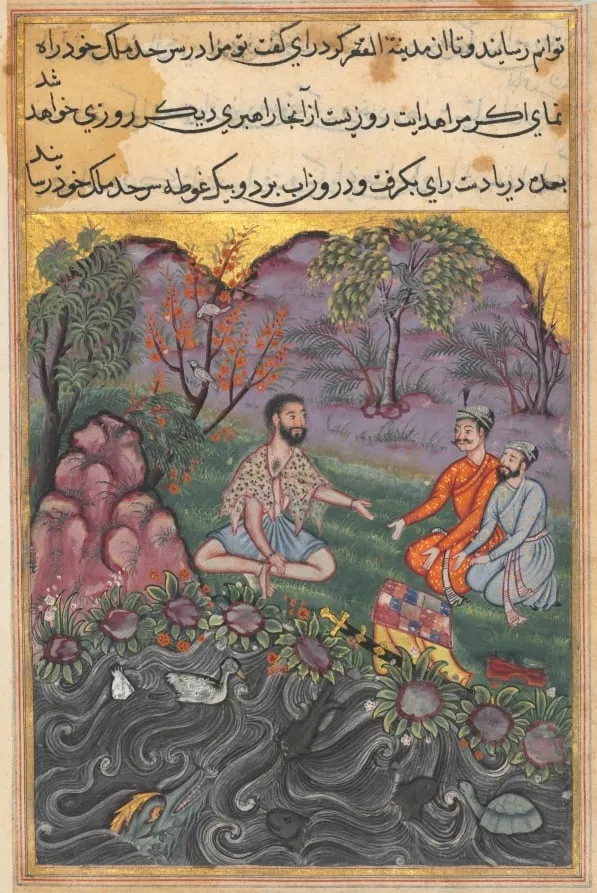
The Raja of Ujjain, who is traveling in the guise of a yogi, meets two brothers who ask him to equitably partition their father’s possession, from a Tuti-nama (Tales of a Parrot): Forty-sixth Night is an unspecified painting by the Mughal Painting artist Unknown. It dates from 1560 and is held in the collection of the Cleveland Museum of Art.
About this work
The bright colors and fine details show how skilled Mughal artists were at blending storytelling with art.
A man in a leopard-print cape sits by a pool with two brothers. Four magic items—a cloak, blanket, shoes, and sword—lie between them. The man is a king in disguise, tricking the brothers out of their inheritance.
This painting comes from a book of parrot tales made for Emperor Akbar’s court. The stories were meant to entertain and teach lessons. The bright colors and fine details show how skilled Mughal artists were at blending storytelling with art.
To see more works like this, look up Mughal India, court of Akbar (reigned 1556–1605).
Overview
This Mughal painting illustrates a scene from the Tuti-nama (Tales of a Parrot), depicting the Raja of Ujjain, disguised as a yogi, interacting with two brothers beside a pool.
Subject & Meaning
The Raja, recognizable by his leopard-print cape, pretends to mediate the division of the brothers' inherited possessions—a cloak, blanket, shoes, and sword—while actually intending to deceive them out of their inheritance.
Technique & Style
Characterized by bright colors and meticulous detail, the painting exemplifies the artistic skill of Mughal court artists during this period, blending narrative with visual elegance.
History & Provenance
Created for Emperor Akbar's court (reigned 1556–1605), this work is part of a Tuti-nama manuscript designed to entertain and impart moral lessons to the imperial audience.
Artist & collection

 Domestic Scene
 Giacomo and Cardinal Marco, investing Andrea, Abbot of San Zeno, with his Benefice
 The Nymph of Fontainebleau
 Portrait of a Woman
 Madonna and Child with Saints in the Enclosed Garden
 Venus and Minerva
 Family Group of Four on Sofa
 Wall painting from Room H of the Villa of P. Fannius Synistor at Boscoreale
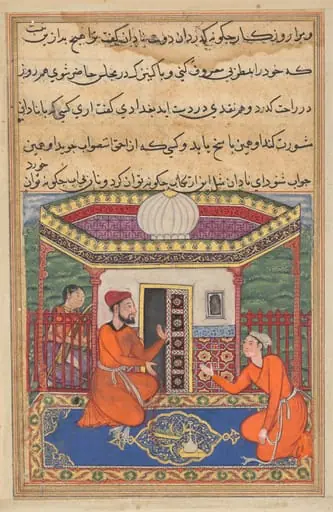 The young man of Baghdad solicits advice from a friend as his slave girl, who is adept at music, awaits, from a Tuti-nama (Tales of a Parrot): Forty-eighth Night
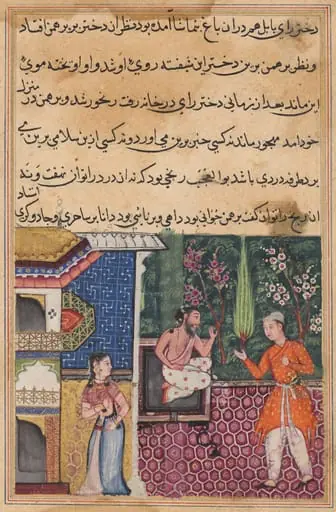 The Brahman gives an account of his falling in love with the king of Babylon’s daughter to his friend, the magician, from a Tuti-nama (Tales of a Parrot): Thirty-fifth Night
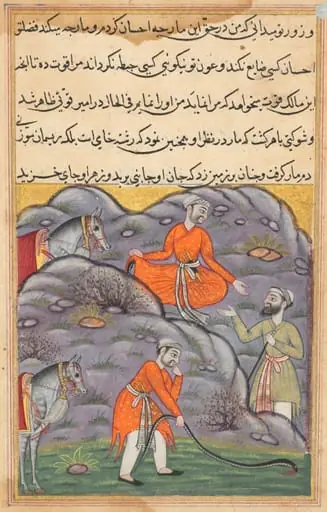 The emir slays the snake after giving it shelter, from a Tuti-nama (Tales of a Parrot): Forty-fifth Night
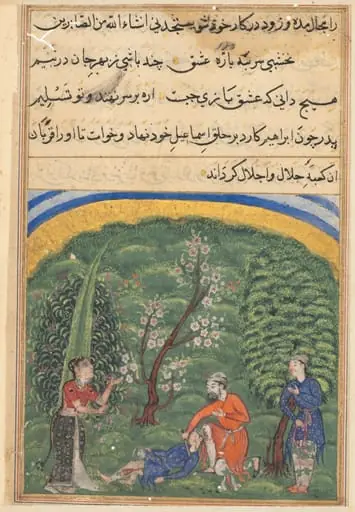 The sentinel in the employ of the Shah of Tabaristan prepares to sacrifice his son to the ghost of the Shah’s soul, from a Tuti-nama (Tales of a Parrot): Second Night
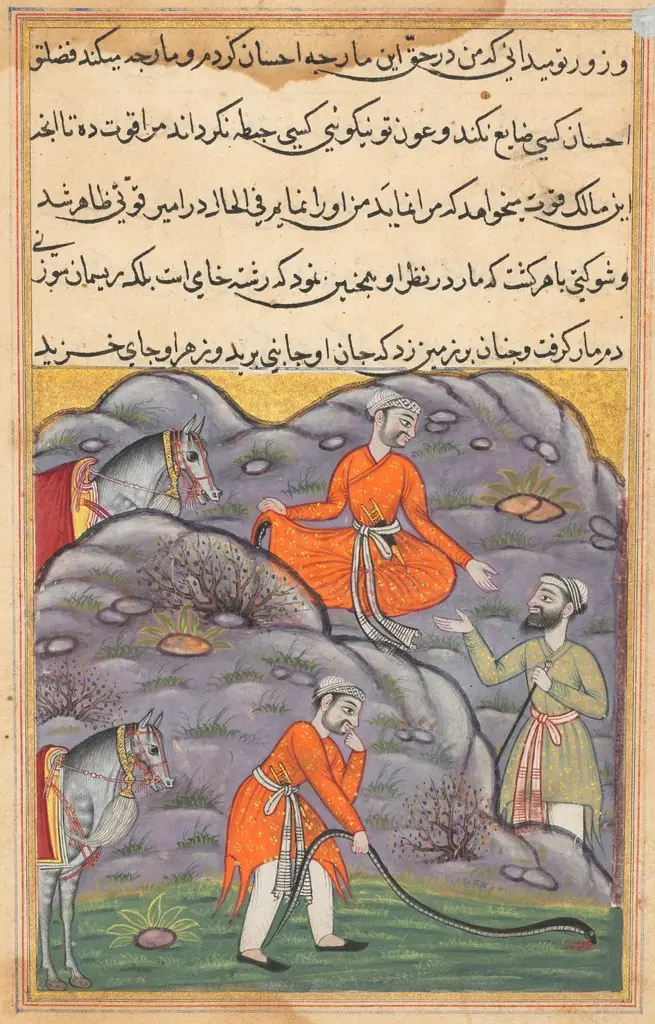 The Emir slays the snake after giving it shelter, from a Tuti-nama (Tales of a Parrot): Forty-fifth Night
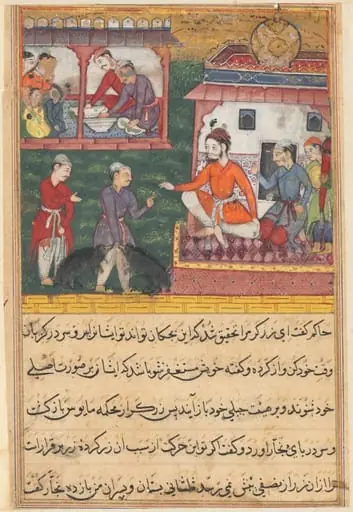 The goldsmith judged; the bear cubs trained by the carpenter as though they were his sons, from a Tuti-nama (Tales of a Parrot): Third Night
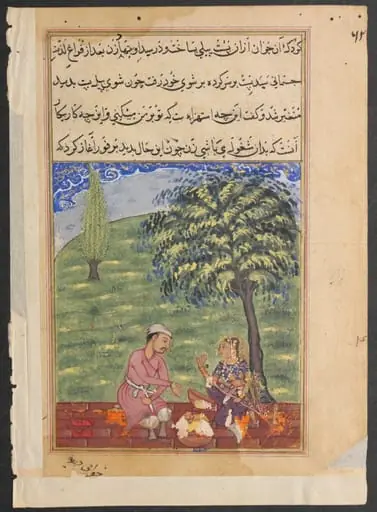 The unfaithful wife explaining away the presence of the dough elephant, from a Tuti-nama (Tales of a Parrot): Eighth Night