Artwork
The young man of Baghdad solicits advice from a friend as his slave girl, who is adept at music, awaits, from a Tuti-nama (Tales of a Parrot): Forty-eighth Night
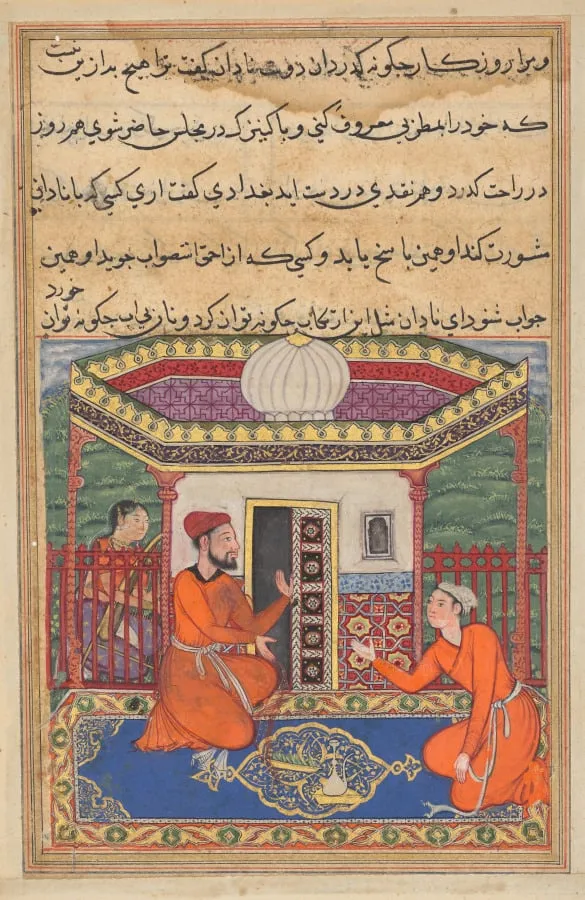
The young man of Baghdad solicits advice from a friend as his slave girl, who is adept at music, awaits, from a Tuti-nama (Tales of a Parrot): Forty-eighth Night is an unspecified painting by the Mughal Painting artist Unknown. It dates from 1560 and is held in the collection of the Cleveland Museum of Art.
About this work
The stories were meant to entertain and teach lessons—here, a man who wasted his money now faces a tough choice.
You see a young man in a turban talking to a friend while a woman with a harp waits behind them. The room is small, with patterned carpets and soft light.
This painting comes from a book of parrot tales told in Mughal India. The stories were meant to entertain and teach lessons—here, a man who wasted his money now faces a tough choice. The artist used bright colors and fine details to show the fabrics and expressions.
To see more art like this, look up *mughal india, court of akbar (reigned 1556–1605)*.
Overview
This painting is one of forty-eight illustrations from a Mughal manuscript of the Tuti-nama, a collection of frame tales centered on a talking parrot. Created during the reign of Akbar, it depicts a moment of moral tension within a story meant to instruct through narrative. The scene unfolds in a modest interior, rendered with delicate brushwork and vivid pigments, characteristic of the imperial atelier’s style.
Subject & Meaning
A young man, having exhausted his wealth, consults a companion on how to restore his fortune. The friend proposes he become a musician for noble patrons—a path the man finds dishonorable. In response, he resolves to sell the slave girl, who sits silently with her harp, embodying both his past indulgence and potential means of survival. The scene explores themes of dignity, loss, and the commodification of people under social decline.
Technique & Style
The artist employs fine, precise lines and layered washes to render textiles, facial expressions, and architectural details. Bright mineral pigments highlight the richness of garments and carpets, while soft, diffused lighting suggests an intimate interior. The composition isolates the figures against a plain background, focusing attention on their gestures and emotional distance, a hallmark of Mughal narrative painting.
History & Provenance
Commissioned under Emperor Akbar in the 1560s, the Tuti-nama manuscript was produced by a team of painters in the imperial atelier. This folio likely originated in the early phase of Mughal manuscript production, when Persian literary traditions were being adapted into an Indian context. The work remained in royal collections until dispersed in the 19th century, with individual folios entering private and institutional holdings.
Context
The Tuti-nama tales, originally composed in Persian, were translated and illustrated for Akbar’s court as tools of moral and political instruction. Each story, framed by the parrot’s nightly narratives, offered lessons on wisdom, restraint, and consequence. This scene reflects broader anxieties about social mobility and the erosion of aristocratic status in a changing imperial society.
Legacy
The illustration exemplifies the synthesis of Persian literary culture and Indian artistic practice that defined early Mughal painting. Its psychological nuance and attention to domestic detail influenced later courtly narratives. Though the manuscript was eventually disbound, its individual sheets continue to inform scholarly understanding of Mughal visual storytelling and its engagement with ethical dilemmas.
Artist & collection

 Domestic Scene
 Giacomo and Cardinal Marco, investing Andrea, Abbot of San Zeno, with his Benefice
 The Nymph of Fontainebleau
 Portrait of a Woman
 Madonna and Child with Saints in the Enclosed Garden
 Venus and Minerva
 Family Group of Four on Sofa
 Wall painting from Room H of the Villa of P. Fannius Synistor at Boscoreale
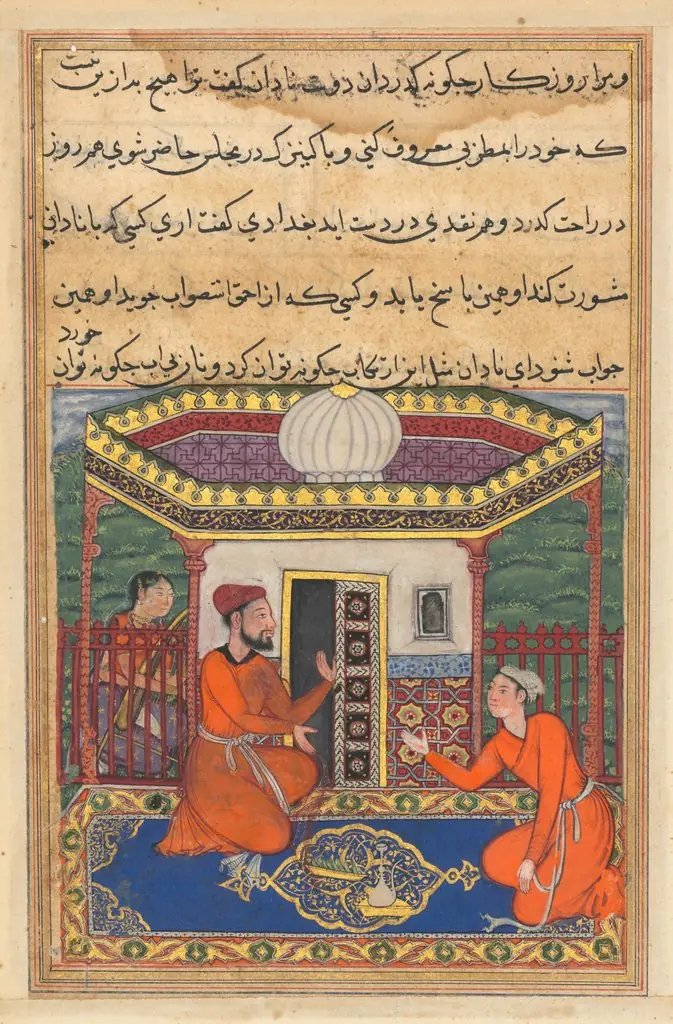 The young man of Baghdad solicits advice from a friend as his slave girl, who is adept at music, awaits, from a Tuti-nama (Tales of a Parrot): Forty-eighth Night
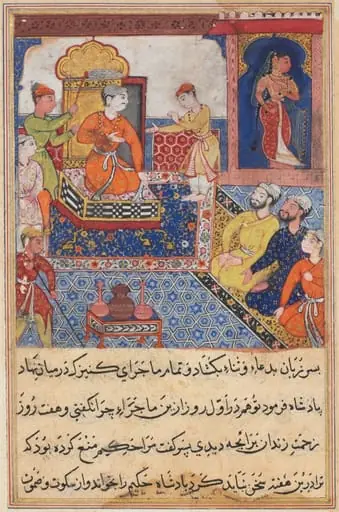 The young prince recounts his experiences to his father, the king, from a Tuti-nama (Tales of a Parrot): Eighth Night
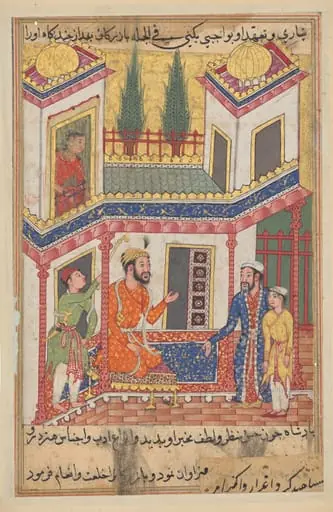 The merchant returns bringing a young slave who is really the son of the princess of Rum, now married to the king, from a Tuti-nama (Tales of a Parrot): Fiftieth Night
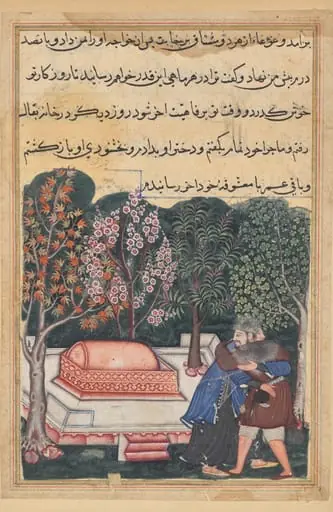 The young man of Baghdad reunited with his slave-girl, from a Tuti-nama (Tales of a Parrot): Forty-eighth Night
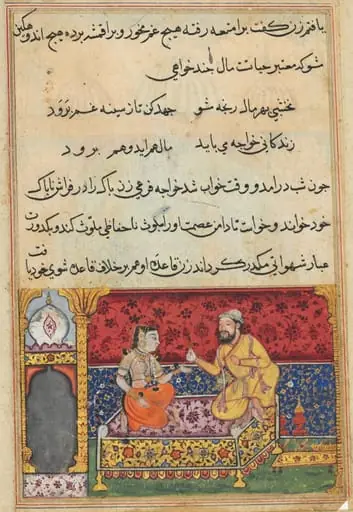 The young man changes himself to look like Mansur, and thus inveigles himself into the bed of Mansur’s wife, but is put off by her, from a Tuti-nama (Tales of a Parrot): Seventeenth Night
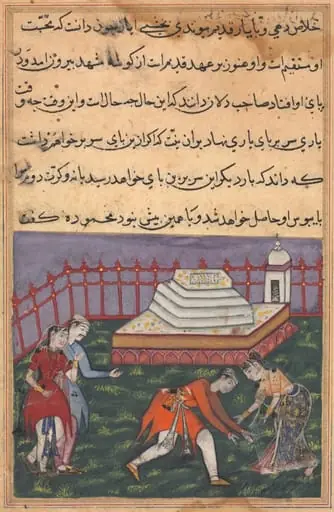 Hearing her declaration of love, Ayaz falls at the feet of Mahmuda at the holy shrine. The scene is witnessed by Salim, Ayaz’s friend, and a maid, from a Tuti-nama (Tales of a Parrot): Thirty-third Night
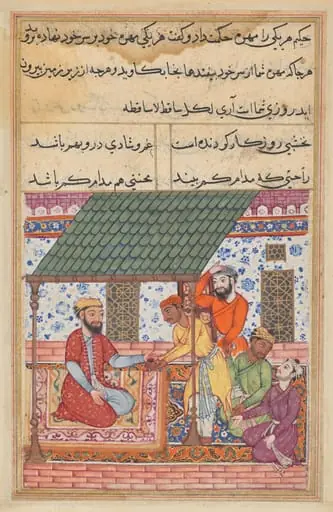 The four destitute friends go to a wise man who gives each one of them a magic shell to be placed on top of the turban, from a Tuti-nama (Tales of a Parrot): Forty-seventh Night
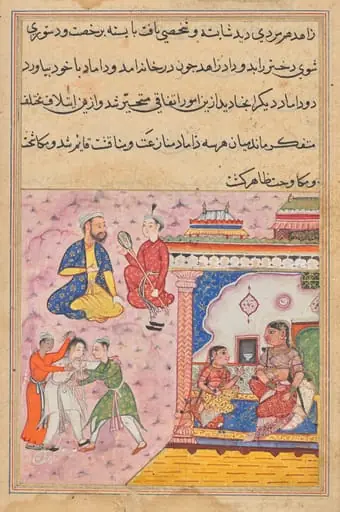 Three suitors fight amongst themselves for the hand of the devotee’s daughter, from a Tuti-nama (Tales of a Parrot): Twentieth Night
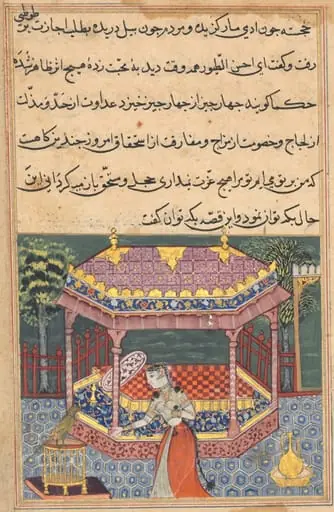 The parrot addresses Khujasta at the beginning of the thirty-seventh night, from a Tuti-nama (Tales of a Parrot)