Artwork
The suitors take the devotee’s daughter out of her tomb after breaking it open, when the physician discovers she is still alive, from a Tuti-nama (Tales of a Parrot): Twentieth Night
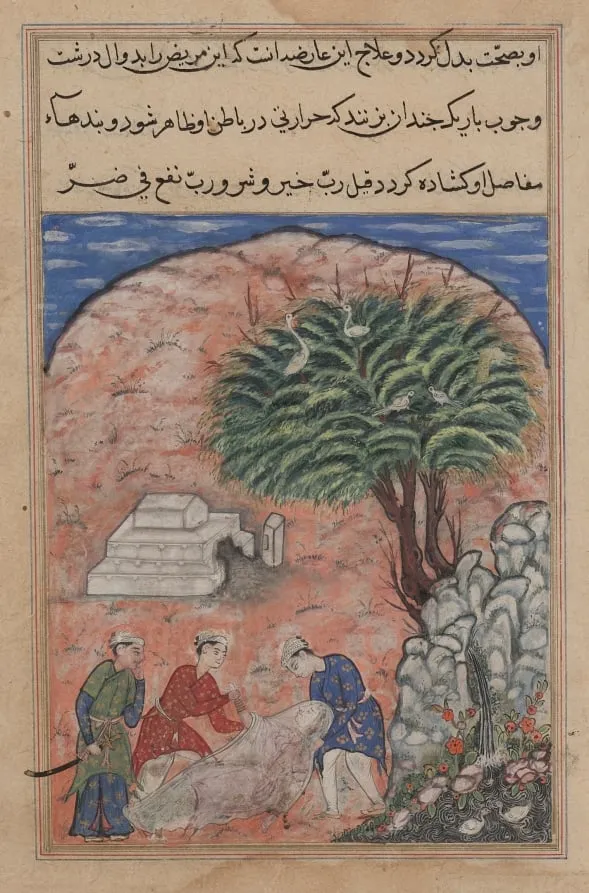
The suitors take the devotee’s daughter out of her tomb after breaking it open, when the physician discovers she is still alive, from a Tuti-nama (Tales of a Parrot): Twentieth Night is an unspecified painting by the Mughal Painting artist Unknown. It dates from 1560 and is held in the collection of the Cleveland Museum of Art. The painting captures a dramatic episode in which three men are lifting a woman from a shattered tomb.
About this work
The story is dark: the suitors thought she was dead, but the doctor finds she’s still alive.
Three men lift a woman from a broken tomb, her body limp in a thin white shroud. The tomb’s stone lid lies cracked on the ground behind them. A doctor kneels nearby, checking her pulse.
This scene comes from a *Tuti-nama*, a book of parrot tales told to Emperor Akbar. The story is dark: the suitors thought she was dead, but the doctor finds she’s still alive. The painting shows the moment of shock—hands frozen mid-air, faces half-hidden in shadow.
To see more stories like this, look up Mughal India, court of Akbar (reigned 1556–1605).
Overview
The painting captures a dramatic episode in which three men are lifting a woman from a shattered tomb. She lies limp, swathed in a sheer white shroud, while the stone lid of the burial chamber rests cracked nearby. A physician kneels at her side, checking for signs of life, as the suitors appear startled by the possibility that she may not be dead.
Subject & Meaning
The scene is drawn from the twentieth night of the *Tuti‑nama*, a collection of parrot tales presented to Emperor Akbar. In this particular narrative, the three suitors, believing the woman to be deceased, attempt to claim her as a bride, only to discover, through the doctor’s examination, that she is still breathing. The composition emphasizes the moment of shock and the moral ambiguity of their actions.
Technique & Style
Rendered in the refined Mughal court style, the work employs delicate brushwork to suggest the translucency of the burial shroud and the texture of the broken stone lid. Subtle chiaroscuro models the figures, casting their faces in partial shadow, while the muted palette foregrounds the drama without resorting to overt coloration. The composition balances narrative clarity with a restrained, almost documentary realism.
Context
Created during the reign of Akbar (1556–1605), the painting reflects the imperial patronage of illustrated manuscripts that blended Persian literary traditions with Indian courtly aesthetics. The *Tuti‑nama* itself was a didactic collection, using fantastical stories to convey moral lessons to the emperor and his entourage, illustrating the sophisticated cultural milieu of the Mughal court.
History & Provenance
The work originates from a manuscript of the *Tuti‑nama* produced for Akbar’s library, likely within the imperial atelier of the late 16th century. Surviving copies of the text and its illustrations have been dispersed among several collections; this particular painting is now held in a museum collection that acquired it through a mid‑20th‑century acquisition of Mughal manuscript material.
Artist & collection

 Domestic Scene
 Giacomo and Cardinal Marco, investing Andrea, Abbot of San Zeno, with his Benefice
 The Nymph of Fontainebleau
 Portrait of a Woman
 Madonna and Child with Saints in the Enclosed Garden
 Venus and Minerva
 Family Group of Four on Sofa
 Wall painting from Room H of the Villa of P. Fannius Synistor at Boscoreale
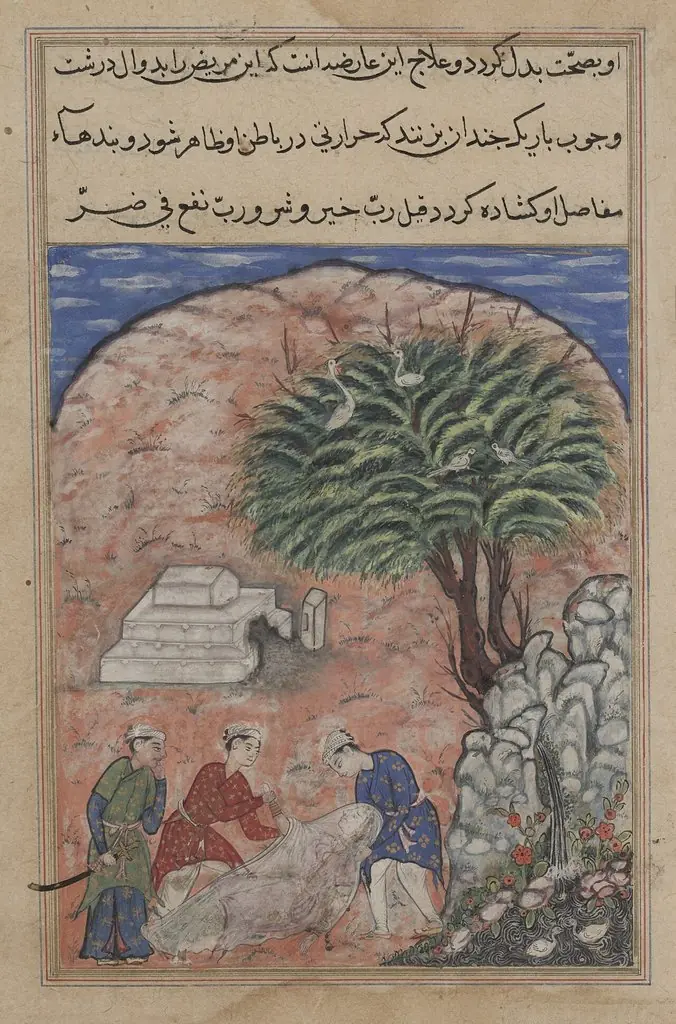 The suitors take the devotee’s daughter out of her tomb after breaking it open, when the physician discovers she is still alive, from a Tuti-nama (Tales of a Parrot): Twentieth Night
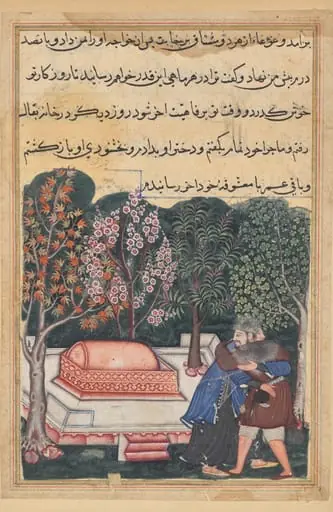 The young man of Baghdad reunited with his slave-girl, from a Tuti-nama (Tales of a Parrot): Forty-eighth Night
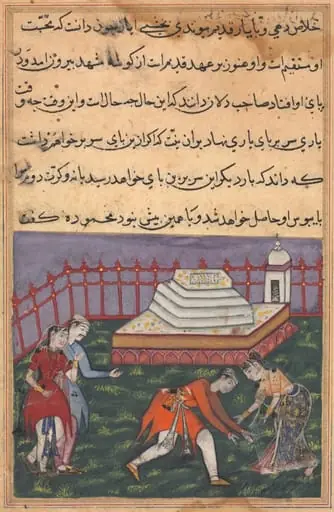 Hearing her declaration of love, Ayaz falls at the feet of Mahmuda at the holy shrine. The scene is witnessed by Salim, Ayaz’s friend, and a maid, from a Tuti-nama (Tales of a Parrot): Thirty-third Night
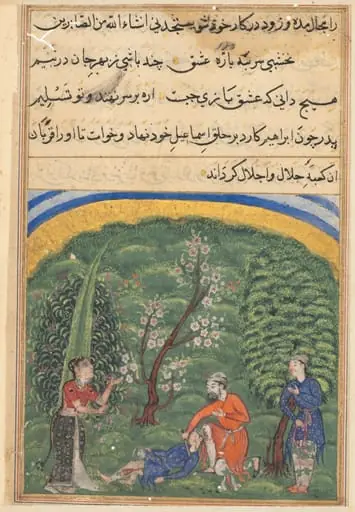 The sentinel in the employ of the Shah of Tabaristan prepares to sacrifice his son to the ghost of the Shah’s soul, from a Tuti-nama (Tales of a Parrot): Second Night
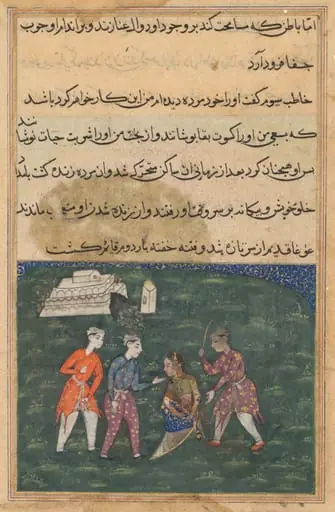 The third suitor strikes the devotee’s daughter and thus restores her to life, from a Tuti-nama (Tales of a Parrot): Twentieth Night
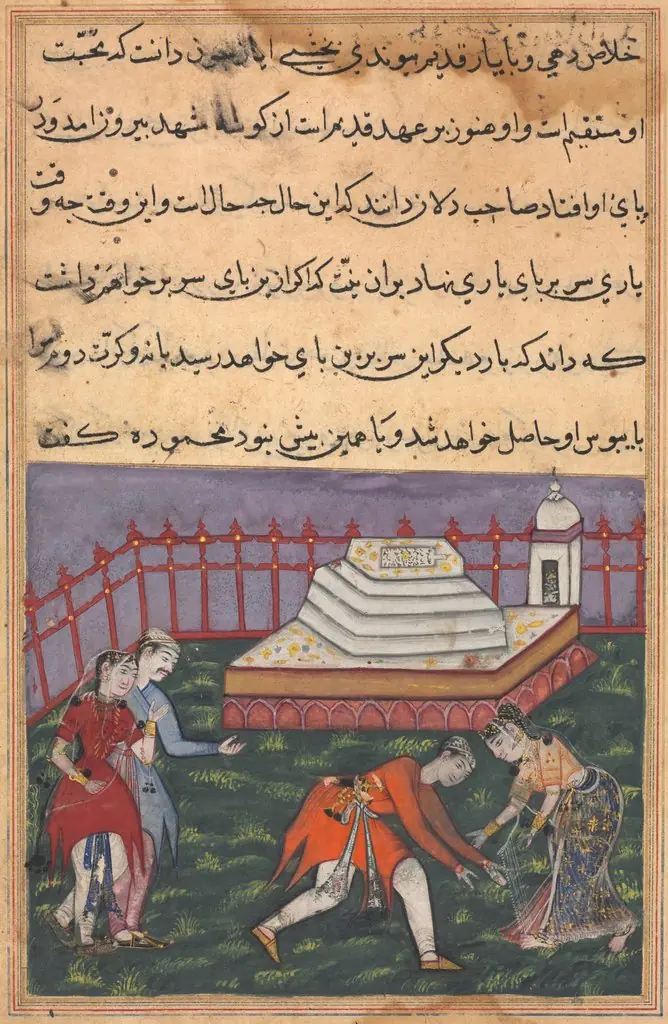 Hearing her declaration of love, Ayaz falls at the feet of Mahmuda at the holy shrine. The scene is witnessed by Salim, Ayaz’s friend, and a maid, from a Tuti-nama (Tales of a Parrot): Thirty-third Night
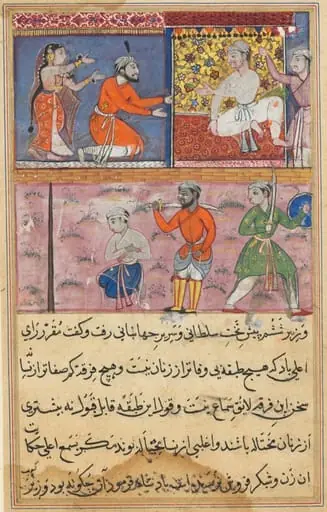 The prince sent back to the place of execution for the sixth time, from a Tuti-nama (Tales of a Parrot): Eighth Night
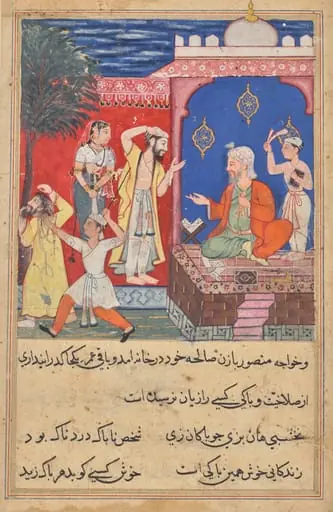 The false Mansur punished before the judge and expelled from the city, from a Tuti-nama (Tales of a Parrot): Seventeenth Night