Artwork
The young man of Baghdad reunited with his slave-girl, from a Tuti-nama (Tales of a Parrot): Forty-eighth Night
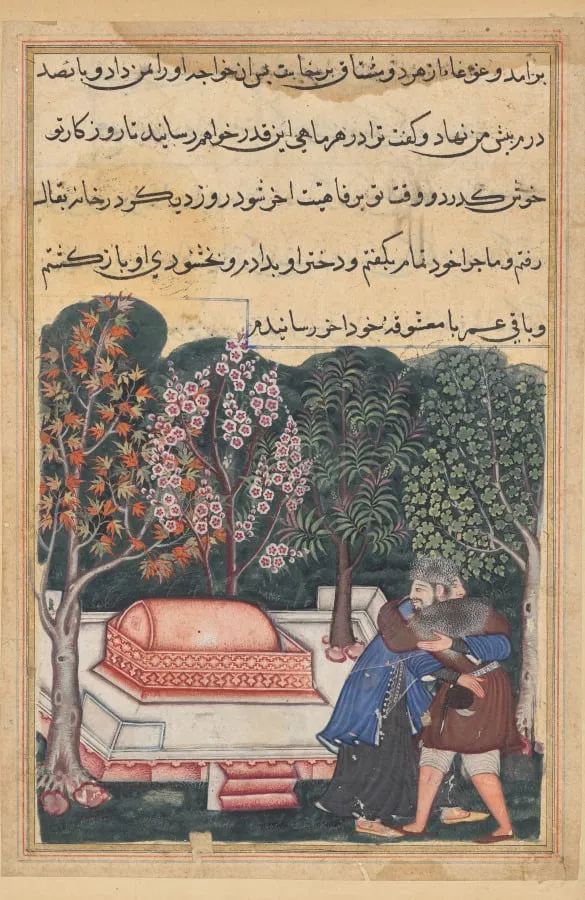
The young man of Baghdad reunited with his slave-girl, from a Tuti-nama (Tales of a Parrot): Forty-eighth Night is an unspecified painting by the Mughal Painting artist Unknown. It dates from 1560 and is held in the collection of the Cleveland Museum of Art.
About this work
You see a man and woman embracing in front of an empty grave, surrounded by trees and a small crowd.
You see a man and woman embracing in front of an empty grave, surrounded by trees and a small crowd. The woman wears black; the man looks relieved.
This painting comes from a book of parrot tales told over fifty-two nights. Each night’s story was illustrated by artists at Emperor Akbar’s court. The bright colors and flat shapes make the scene feel like a storybook page.
To see more paintings like this, look up Mughal India, court of Akbar (reigned 1556–1605).
Overview
This painting illustrates the forty-eighth night of the Tuti-nama, a collection of moral tales framed by a parrot’s stories to deter its mistress from adultery. Created in the Mughal court under Emperor Akbar, it depicts a moment of reunion between a young man and his enslaved lover after years of separation. The scene is rendered in vivid pigments on paper, characteristic of imperial manuscript illustration from the late 16th century.
Subject & Meaning
The narrative centers on mistaken death and emotional reconciliation. The woman, dressed in mourning black, has grieved for her lover, erecting a monument in his absence. Their embrace before the empty grave signals fate’s intervention—his return invalidates her sorrow. The scene underscores themes of loyalty, endurance, and divine timing, common in Persianate storytelling traditions adapted at the Mughal court.
Technique & Style
The composition employs flat planes of saturated color and minimal depth, typical of Mughal manuscript painting. Figures are rendered with fine brushwork, their gestures expressive yet restrained. The background features stylized trees and a compact crowd, framing the central reunion without perspective. The use of gold and lapis lazuli highlights the imperial patronage and the manuscript’s ceremonial function.
History & Provenance
Painted around 1560 in Akbar’s imperial atelier, this folio was part of a deluxe manuscript commissioned to illustrate the Tuti-nama. The project involved multiple artists, each contributing to different nights. The manuscript was likely kept in the royal library, used for courtly entertainment and moral instruction. Its survival offers rare insight into early Mughal artistic collaboration and literary culture.
Context
The Tuti-nama was translated from Persian into Persianate Urdu under Akbar’s patronage, reflecting his interest in syncretic culture. Illustrated manuscripts like this served both aesthetic and didactic purposes, blending Indian, Persian, and Islamic traditions. The court’s emphasis on storytelling through art reinforced imperial authority while engaging diverse audiences within the empire’s cosmopolitan milieu.
Legacy
This painting exemplifies the early Mughal style that would evolve into more naturalistic forms under later emperors. Its preservation in museum collections today allows study of how narrative illustration functioned in courtly life. The Tuti-nama’s influence extended beyond its time, shaping regional painting traditions and preserving a literary genre that bridged oral storytelling and visual art.
Artist & collection

 Domestic Scene
 Giacomo and Cardinal Marco, investing Andrea, Abbot of San Zeno, with his Benefice
 The Nymph of Fontainebleau
 Portrait of a Woman
 Madonna and Child with Saints in the Enclosed Garden
 Venus and Minerva
 Family Group of Four on Sofa
 Wall painting from Room H of the Villa of P. Fannius Synistor at Boscoreale
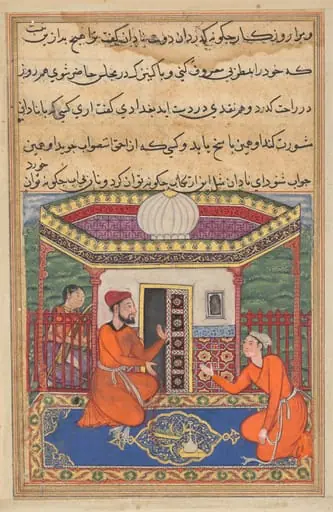 The young man of Baghdad solicits advice from a friend as his slave girl, who is adept at music, awaits, from a Tuti-nama (Tales of a Parrot): Forty-eighth Night
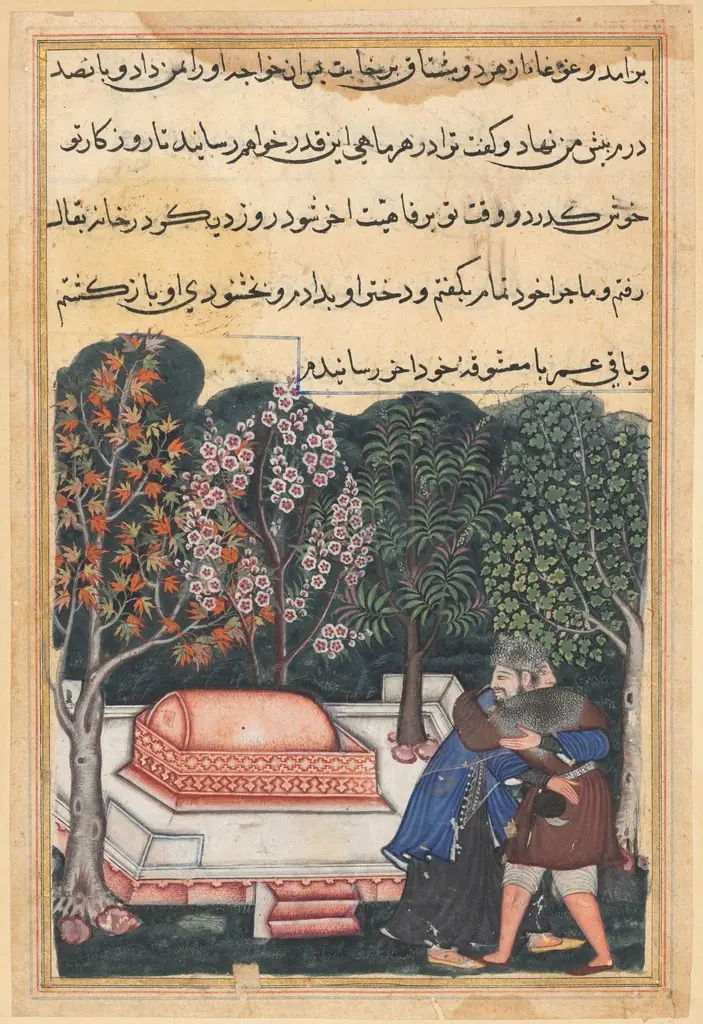 The young man of Baghdad reunited with his slave-girl, from a Tuti-nama (Tales of a Parrot): Forty-eighth Night
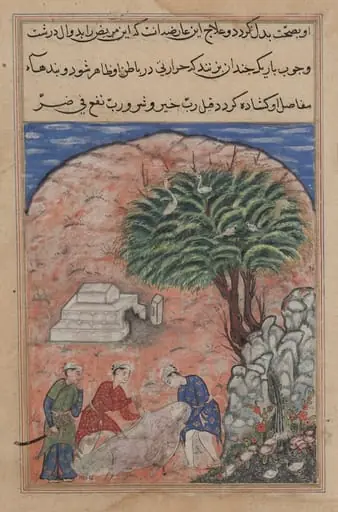 The suitors take the devotee’s daughter out of her tomb after breaking it open, when the physician discovers she is still alive, from a Tuti-nama (Tales of a Parrot): Twentieth Night
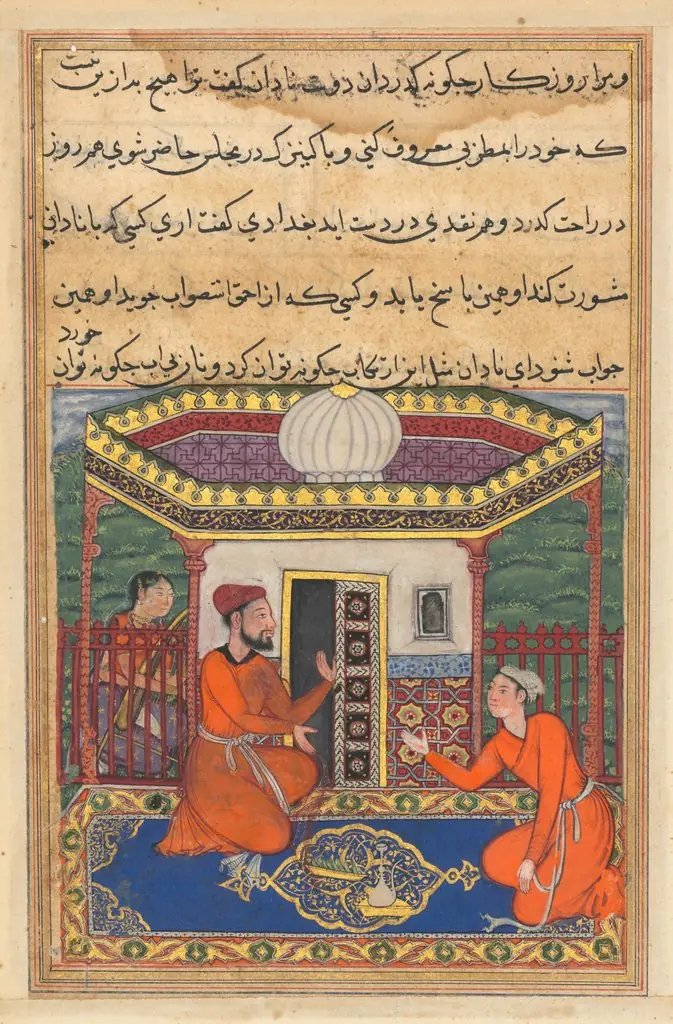 The young man of Baghdad solicits advice from a friend as his slave girl, who is adept at music, awaits, from a Tuti-nama (Tales of a Parrot): Forty-eighth Night
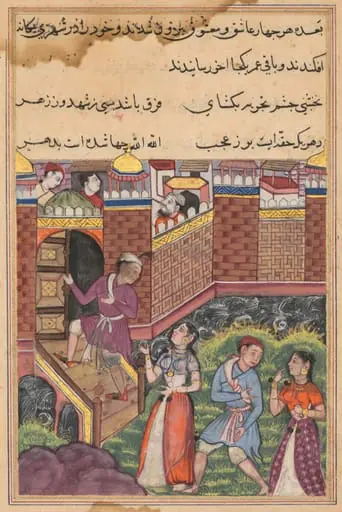 The two couples reach a foreign city where they make their home, from a Tuti-nama (Tales of a Parrot): Thirty-third Night
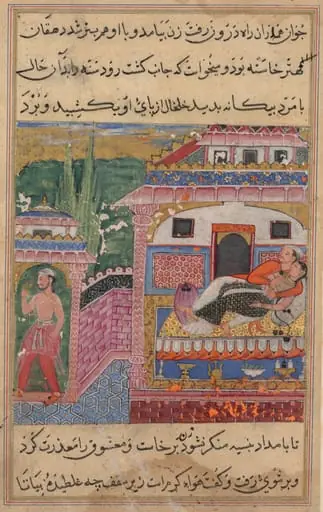 The farmer, father of the son with the deceitful wife, steals away with her anklet while she is in bed with her lover, from a Tuti-nama (Tales of a Parrot): Eighth Night
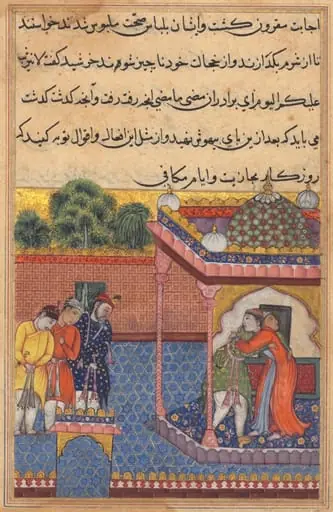 Khurshid reunited with her husband Utarid, from a Tuti-nama (Tales of a Parrot): Thirty-second Night
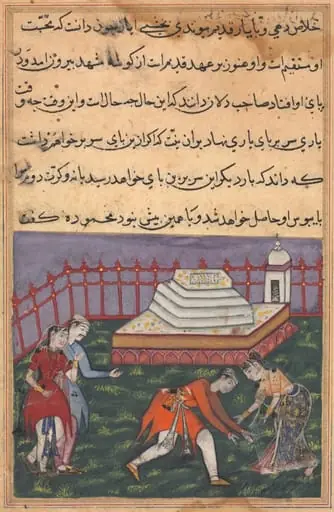 Hearing her declaration of love, Ayaz falls at the feet of Mahmuda at the holy shrine. The scene is witnessed by Salim, Ayaz’s friend, and a maid, from a Tuti-nama (Tales of a Parrot): Thirty-third Night
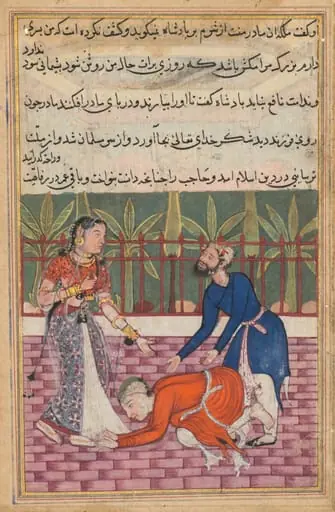 The guard restores the son who falls at his mother’s feet, from a Tuti-nama (Tales of a Parrot): Fiftieth Night
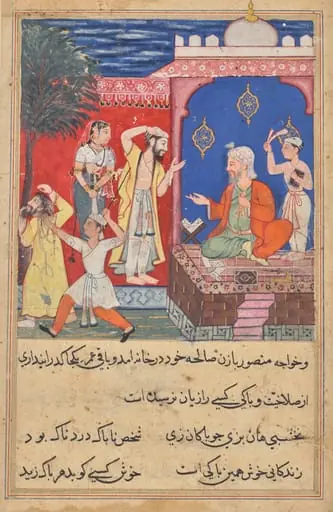 The false Mansur punished before the judge and expelled from the city, from a Tuti-nama (Tales of a Parrot): Seventeenth Night
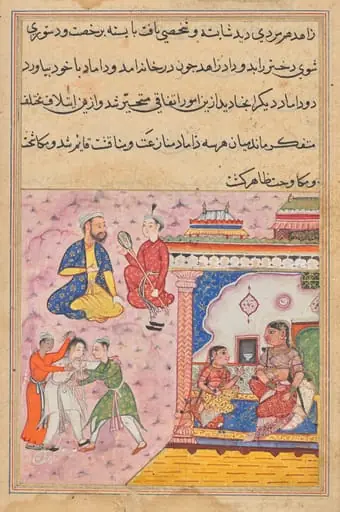 Three suitors fight amongst themselves for the hand of the devotee’s daughter, from a Tuti-nama (Tales of a Parrot): Twentieth Night