Artwork
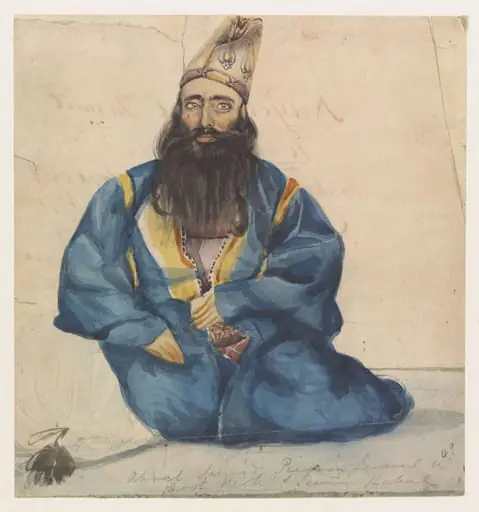
Dost Md Khan taken at Kabul
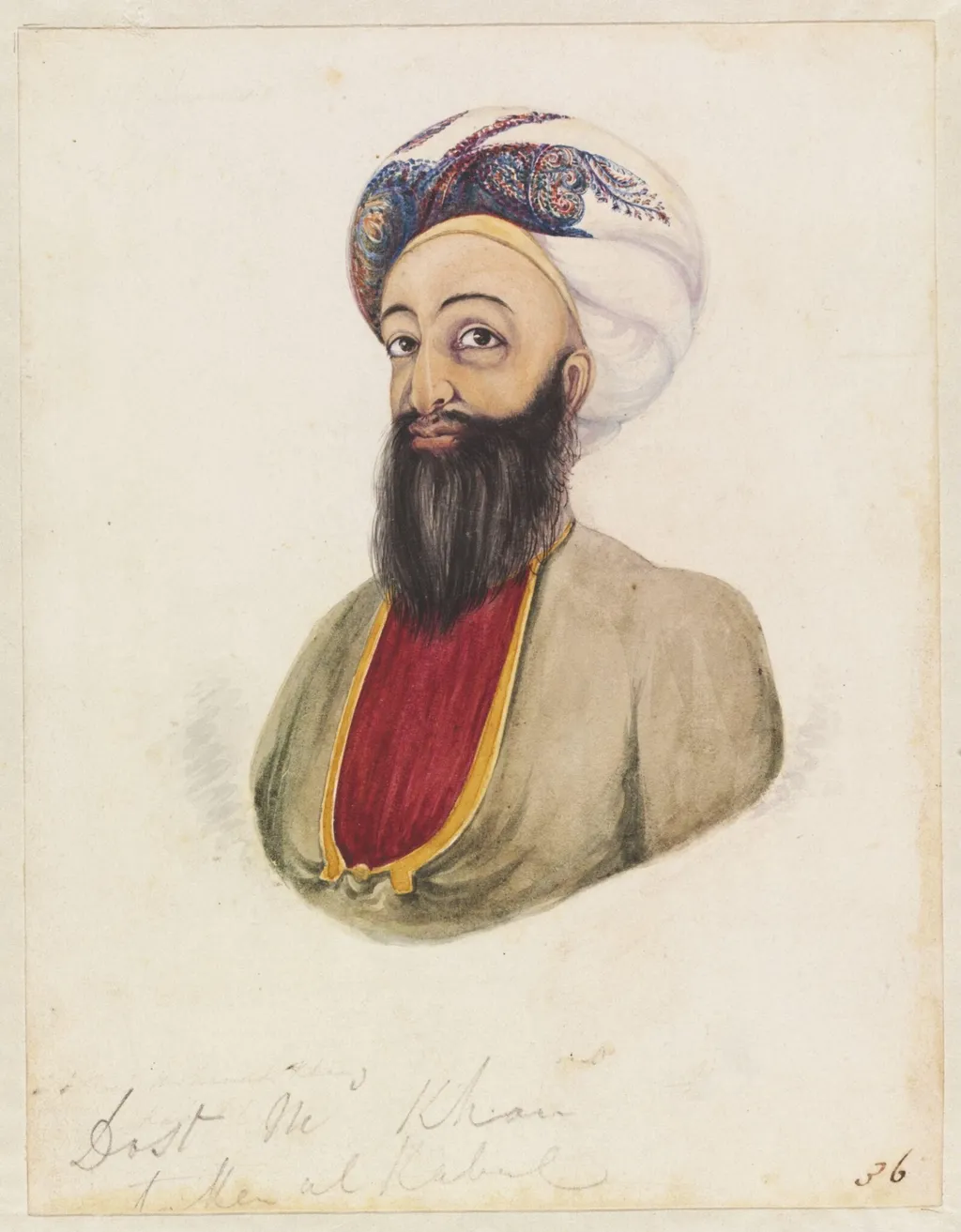
Dost Md Khan taken at Kabul is a watercolor work on paper by the Romanticist artist Godfrey Thomas Vigne. It dates from 1836 and is held in the collection of the Victoria and Albert Museum. A watercolour portrait depicts Dost Muhammad Khan, ruler of Kabul between 1834 and 1840, rendered in delicate washes with restrained detail.
About this work
Overview
A watercolour portrait depicts Dost Muhammad Khan, ruler of Kabul between 1834 and 1840, rendered in delicate washes with restrained detail.
A watercolour portrait depicts Dost Muhammad Khan, ruler of Kabul between 1834 and 1840, rendered in delicate washes with restrained detail. The work was created during his reign and later reproduced as a lithograph in Godfrey Thomas Vigne’s 1840 travel account. Its survival as a standalone piece, distinct from published prints, offers a rare direct record of the Afghan leader’s appearance during a turbulent political era.
Subject & Meaning
Dost Muhammad Khan, deposed by British forces in favor of Shah Shuja-ul-Mulk, is portrayed with solemn dignity. His direct gaze and composed posture convey authority despite his impending fall from power. The portrait functions not as propaganda but as a quiet documentation of a sovereign in transition, capturing his presence before exile and the collapse of his rule under colonial intervention.
Technique & Style
Executed in transparent watercolour, the image employs soft gradients and fine linework to define facial features and textile patterns. The turban’s blue and gold motifs stand out against a pale wash background, while the red scarf adds subtle contrast. The artist prioritizes accuracy over embellishment, focusing on the texture of fabric and the contours of the face with restrained precision.
History & Provenance
The original watercolour was likely made during Vigne’s 1839–40 journey to Afghanistan. It was later included in his published narrative, then passed through family hands until Henry D'Olier Vigne sold it in 1971 to Rodney Searight for £200. It remains connected to a larger archive of South Asian portraiture held in the India Office Library and Records, preserving its documentary lineage.
Context
Created amid the First Anglo-Afghan War, the portrait reflects the British interest in documenting Afghan leadership during military occupation. Vigne’s sketches, including this one, formed part of a broader ethnographic effort by colonial travelers to record regional figures. Unlike official portraits, this work appears uncommissioned, offering a more immediate, observational perspective.
Legacy
Though not widely exhibited, the portrait endures as a primary visual source for Dost Muhammad Khan’s appearance and the material culture of mid-19th century Afghan elites. Its survival outside published reproductions underscores its value as an unmediated artifact, contributing to historical understanding beyond the narratives of imperial records.
Artist & collection


![The Nawab Jubar Khan [br]other of Dost Md. Khan Kabul, by Godfrey Thomas Vigne](https://artifactworldgallery.com/img/godfrey-thomas-vigne--the-nawab-jubar-khan-br-other-of-dost-md-khan-kabul--fde226cb29337c2b-w320.webp)
![Ameer Khan Lohani Cheiftain [sic], by Godfrey Thomas Vigne](https://artifactworldgallery.com/img/godfrey-thomas-vigne--ameer-khan-lohani-cheiftain-sic--7c6575efa84f0a9c-w320.webp)